
Penny Dreadfuls, 1856 · page 85 of 399
Ellen Percy; or, The Memoirs of an Actress — page 85: what you’re looking at
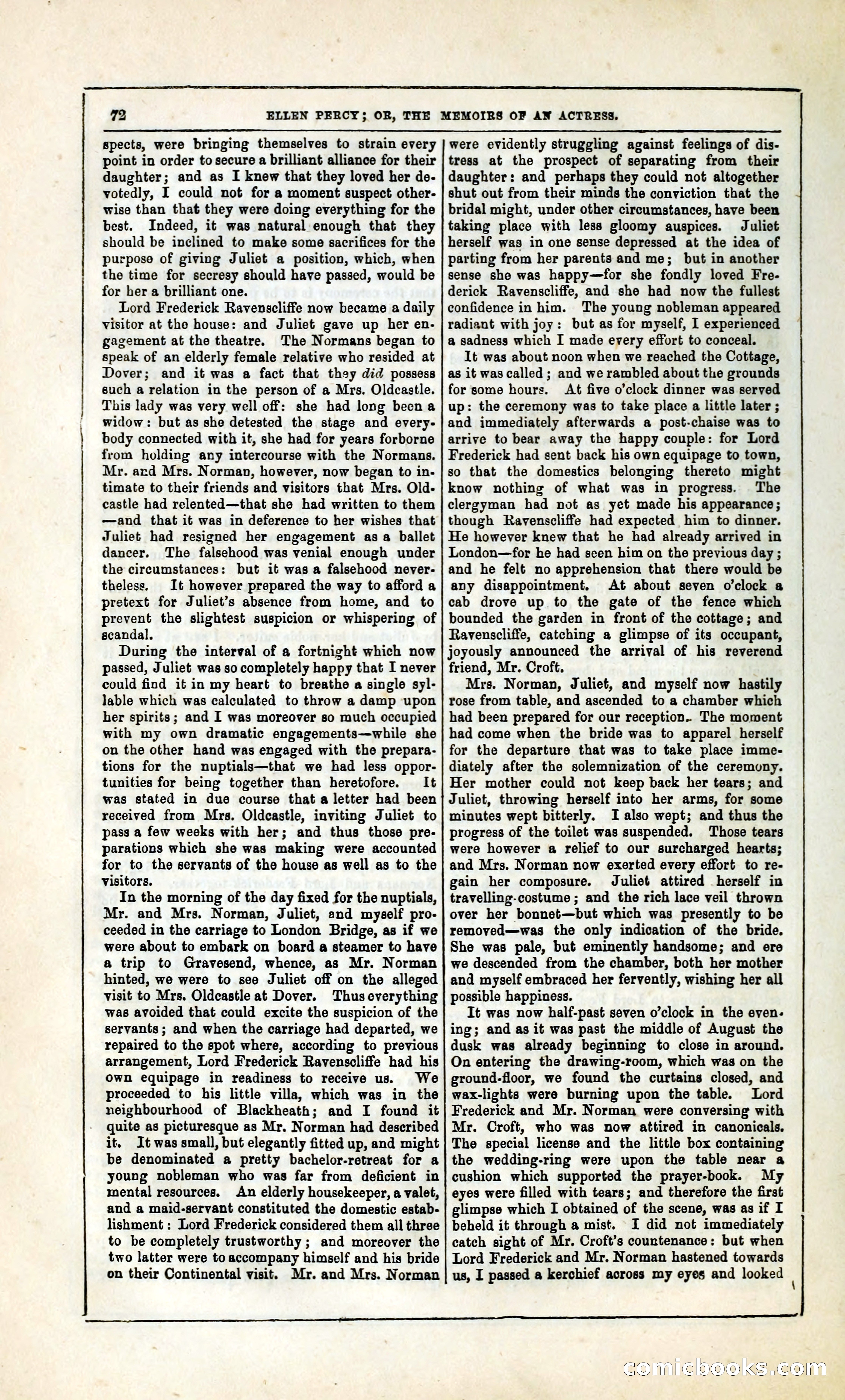
A restored page from Penny Dreadfuls, 1856. Page through the whole issue in the reader above.
📄 Transcribed text from this page (OCR, searchable)
Machine-transcribed from the original scan — historical spelling and the odd misread are preserved.
nner nnn cmncnccnccnccnmnccmcccnaccccccnccrccccccmcncccnccenccccmecceaeccccmceeceeccccceceea cece a — me 72 ELLEN PERCY; OR, THE MEMOIRS OF AW ACTRESS, spects, were bringing themselves to strain every point in order to secure a brilliant alliance for their daughter; and as I knew that they loved her de- votedly, I could not for a moment suspect other- wise than that they were doing everything for the best. Indeed, it was natural enough that they should be inclined to make some sacrifices for the purpose of giving Juliet a position, which, when the time for secresy should have passed, would be for her a brilliant one. Lord Frederick Ravenscliffe now became a daily visitor at the house: and Juliet gave up her en- gagement at the theatre. The Normans began to speak of an elderly female relative who resided at Dover; and it was a fact that they did possess euch a relation in the person of a Mrs. Oldcastle. This lady was very well off: she had long beena widow: but as she detested the stage and every- body connected with it, she had for years forborne from holding any intercourse with the Normans. Mr. ard Mrs. Norman, however, now began to in- timate to their friends and visitors that Mrs. Old- castle had relented—that she had written to them —and that it was in deference to her wishes that Juliet had resigned her engagement as a ballet dancer. The falsehood was venial enough under the circumstances: but it was a falsehood never- theless. It however prepared the way to afford a pretext for Juliet’s absence from home, and to prevent the slightest suspicion or whispering of scandal. During the interval of a fortnight which now passed, Juliet was so completely happy that I never could find it in my heart to breathe a single syl- lable which was calculated to throw a damp upon her spirits; and I was moreover so much occupied with my own dramatic engagements—while she on the other hand was engaged with the prepara- tions for the nuptials—that we had less oppor- tunities for being together than heretofore. It was stated in due course that a letter had been received from Mrs. Oldcastle, inviting Juliet to pass a few weeks with her; and thus those pre- parations which she was making were accounted for to the servants of the house as well as to the Visitors. In the morning of the day fixed for the nuptials, Mr. and Mrs. Norman, Juliet, and myself pro- ceeded in the carriage to London Bridge, as if we were about to embark on board a steamer to have a trip to Gravesend, whence, as Mr. Norman hinted, we were to see Juliet off on the alleged visit to Mrs. Oldcastle at Dover. Thus everything was avoided that could excite the suspicion of the servants; and when the carriage had departed, we repaired to the spot where, according to previous arrangement, Lord Frederick Ravenscliffe had his OwD equipage in readiness to receive us. We proceeded to his little villa, which was in the neighbourhood of Blackheath; and I found it quite as picturesque as Mr. Norman had described it. It was small, but elegantly fitted up, and might be denominated a pretty bachelor-retreat for a young nobleman who was far from deficient in mental resources. An elderly housekeeper, a valet, and a maid-servant constituted the domestic estab- lishment: Lord Frederick considered them all three to be completely trustworthy ; and moreover the two latter were to accompany himself and his bride on their Continental visit. Mr. and Mrs. Norman were evidently struggling against feelings of dis- tress at the prospect of separating from their daughter: and perhaps they could not altogether shut out from their minds the conviction that the bridal might, under other circumstances, have been taking place with less gloomy auspices. Juliet herself was in one sense depressed at the idea of parting from her parents and me; but in another sense she was happy—for she fondly loved Fre- derick Ravenscliffe, and she had now the fullest confidence in him. The young nobleman appeared radiant with joy: but as for myself, 1 experienced a sadness which I made every effort to conceal. It was about noon when we reached the Cottage, as it was called ; and we rambled about the grounds for some hours. At five o’clock dinner was served up: the ceremony was to take place a little later ; and immediately afterwards a post-chaise was to arrive to bear away the happy couple: for Lord Frederick had sent back his own equipage to town, so that the domestics belonging thereto might know nothing of what was in progress. The clergyman had not as yet made his appearance; though Ravenscliffe had expected him to dinner. He however knew that he had already arrived in London—for he had seen him on the previous day ; and he felt no apprehension that there would be any disappointment. At about seven o’clock a cab drove up to the gate of the fence which bounded the garden in front of the cottage; and Ravenscliffe, catching a glimpse of its occupant, joyously announced the arrival of his reverend friend, Mr. Croft. Mrs. Norman, Juliet, and myself now hastily rose from table, and ascended to a chamber which had been prepared for our reception.. The moment had come when the bride was to apparel herself for the departure that was to take place imme- diately after the solemnization of the ceremony. Her mother could not keep back her tears; and Juliet, throwing herself into her arms, for some minutes wept bitterly. I also wept; and thus the progress of the toilet was suspended. Those tears were however a relief to our surcharged hearts; and Mrs. Norman now exerted every effort to re- gain her composure. Juliet attired herself in travelling-costume; and the rich lace veil thrown over her bonnet—but which was presently to be removed—was the only indication of the bride. She was pale, but eminently handsome; and ere we descended from the chamber, both her mother and myself embraced her fervently, wishing her all possible happiness. It was now half-past seven o’clock in the even- ing; and as it was past the middle of August the dusk was already beginning to close in around. On entering the drawing-room, which was on the ground-floor, we found the curtains closed, and wax-lights were burning upon the table. Lord Frederick and Mr. Norman were conversing with Mr. Croft, who was now attired in canonicals. The special license and the little box containing the wedding-ring were upon the table near a cushion which supported the prayer-book. My eyes were filled with tears; and therefore the first glimpse which I obtained of the scene, was as if I beheld it through a mist. I did not immediately eatch sight of Mr. Croft’s countenance: but when Lord Frederick and Mr. Norman hastened towards us, I passed a kerchief across my eyes and looked CONMIEIOOKS Com