
Penny Dreadfuls, 1856 · page 124 of 399
Ellen Percy; or, The Memoirs of an Actress — page 124: what you’re looking at
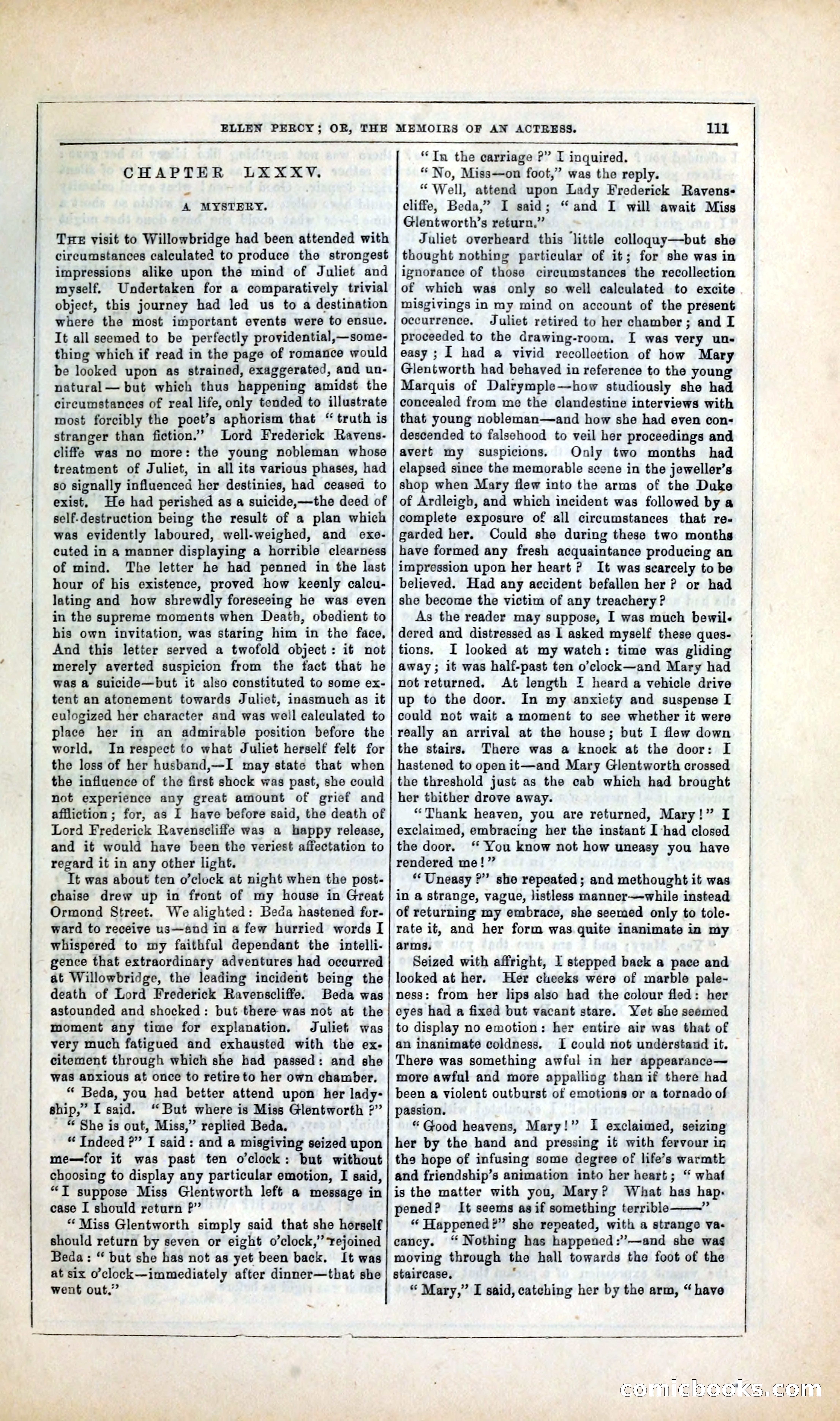
A restored page from Penny Dreadfuls, 1856. Page through the whole issue in the reader above.
📄 Transcribed text from this page (OCR, searchable)
Machine-transcribed from the original scan — historical spelling and the odd misread are preserved.
ES ELLEN PERCY; ORF, THE MEMOIRS OF AN ACTRESS. 111 CHAPTER LXXXYV. A MYSTERY. THE visit to Willowbridge had been attended with circumstances calculated to produce the strongest impressions alike upon the mind of Juliet and myself, Undertaken for a comparatively trivial object, this journey had led us to a destination where the most important events were to ensue. It all seemed to be perfectly providential,—some- thing which if read in the page of romance would be looked upon as strained, exaggerated, and un- natural — but which thus happening amidst the circumstances of real life, only tended to illustrate most forcibly the poet’s aphorism that “ truth is stranger than fiction.” Lord Frederick HKavens- cliffe was no more: the young nobleman whose treatment of Juliet, in all its various phases, had so signally influenced her destinies, had ceased to exist, He had perished as a suicide,—the deed of self-destruction being the result of a plan which was evidently laboured, well-weighed, and exe- cuted in a manner displaying a horrible clearness of mind. The letter he had penned in the last hour of his existence, proved how keenly calcu- lating and how shrewdly foreseeing he was even in the supreme moments when Death, obedient to his own invitation, was staring him in the face, And this letter served a twofold object: it not merely averted suspicion from the fact that he was a suicide—but it also constituted to some ex- tent an atonement towards Juliet, inasmuch as it eulogized her character and was well calculated to place her in an admirable position before the world, In respect to what Juliet herself felt for the loss of her husband,—I may state that when the influence of the first shock was past, she could not experience any great amount of grief and affliction ; for, as I have before said, the death of Lord Frederick Ravenscliffe was a happy release, and it would have been tho veriest affectation to regard it in any other light. It was about ten o’cluck at night when the post- chaise drew up in front of my house in Great Ormond Street. We alighted: Beda hastened for- ward to receive us—snd in a few hurried words I whispered to my faithful dependant the intelli- gence that extraordinary adventures had occurred at Willowbridge, the leading incident being the death of Lord Frederick Ravenscliffe. Beda was astounded and shocked: but there was not at the moment any time for explanation. Juliet was very much fatigued and exhausted with the ex- citement through which she had passed: and she was anxious at once to retireto her own chamber. “ Beda, you had better attend upon her lady- ship,’ I said. “ But where is Miss Glentworth ?” _ © She is out, Miss,” replied Beda. “ Indeed ?” I said: and a misgiving seized upon me—for if was past ten o'clock: but without choosing to display any particular emotion, I said, “IT suppose Miss Glentworth left a message in case I should return P” “ Miss Glentworth simply said that she horself should return by seven or eight o’clock,” tejoined Beda : “ but she has not as yet been back. It was at six o’clock—immediately after dinner—that she went out,” “In the carriage ?” I inquired. “No, Miss—on foot,” was the reply. “ Well, attend upon Lady Frederick Ravens- cliffe, Beda,” I said; “and I will await Miss Glentworth’s return.” Juliet overheard this little colloguy—but she thought nothing particular of it; for she was in ignorance of those circumstances the recollection of which was only so well calculated to excite misgivings in my mind on account of the present occurrence. Juliet retired to her chamber; and I proceeded to the drawing-room. I was very un- easy ; I had a vivid recollection of how Mary Glentworth had behaved in reference to the young Marquis of Dalrymple—how studiously she had concealed from me the clandestine interviews with that young nobleman—and how she had even con- descended to falsehood to veil her proceedings and avert my suspicions. Only two months had elapsed since the memorable scene in the jeweller’s shop when Mary flew into the arms of the Duke of Ardleigh, and which incident was followed by a complete exposure of all circumstances that re- garded her. Could she during these two months have formed any fresh acquaintance producing an impression upon her heart ? It was searcely to be believed. Had any accident befallen her ? or had she become the victim of any treachery? As the reader may suppose, I was much bewil- dered and distressed as 1 asked myself these ques- tions. I looked at my watch: time was gliding away; if was half-past ten o’clock—and Mary had not returned. At length £ heard a vehicle drive up to the door. In my anxiety and suspense I could not wait a moment to see whether it were really an arrival at the house; but I flew down the stairs. There was a knock at the door: I hastened to open it—and Mary Glentworth crossed the threshold just as the cab which had brought her thither drove away. “Thank heaven, you are returned, Mary!” I exclaimed, embracing her the instant I -had closed the door. ‘* You know not how uneasy you have rendered me!” ** Uneasy ?” she repeated; and methought it was in a strange, vague, listless manner—while instead of returning my embrace, she seemed only to tole- rate it, and her form was quite inanimate in my arms. Seized with affright, I stepped back a pace and looked at her. Her cheeks were of marble pale- ness: from her lips also had the colour fled: her eyes had a fixed but vacant stare. Yet she seemed to display no emotion: her entire air was that of an inanimate coldness. I could not understand it. There was something awful in her appearance— more awful and more appalliog than if there had been a violent outburst of emotions or a tornado of passion. “Good heavens, Mary!” I exclaimed, seizing her by the hand and pressing it with fervour ig ths hope of infusing some degree of life’s warmtk and friendship’s animation into her heart; “ what is the matter with you, Mary? What has hap. pened? It seems as if something terrible hi “ Happened?” she reneated, with a strange va« cancy. “ Nothing has happened:’—and she was moving through the hall towards the foot of the staircase. . “ Mary,” I said, catching her by the arm, “ have ee ee eee sSSS..S.S..s.Cr EORNICLOOCKK (E@)