
Penny Dreadfuls, 1856 · page 132 of 399
Ellen Percy; or, The Memoirs of an Actress — page 132: what you’re looking at
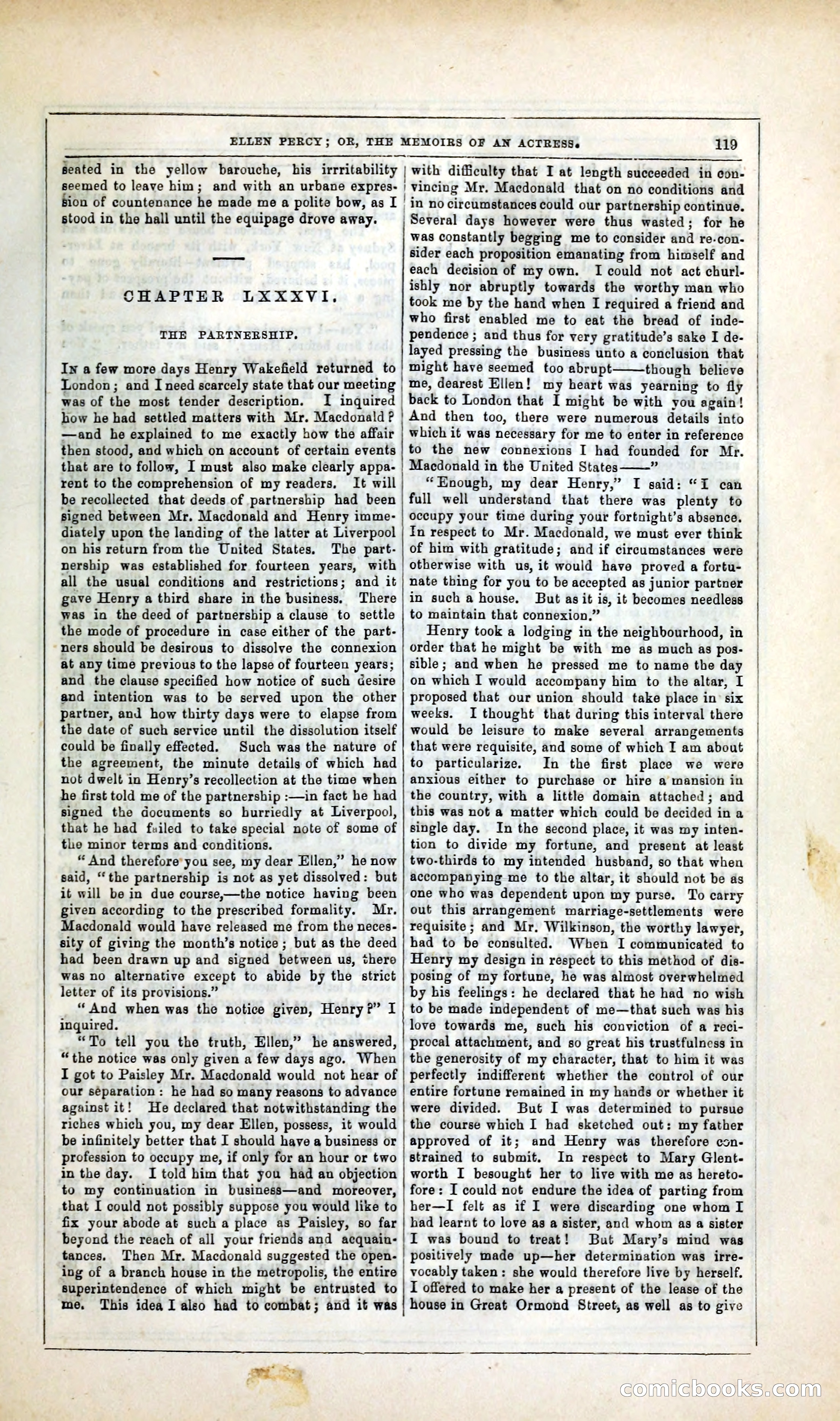
A restored page from Penny Dreadfuls, 1856. Page through the whole issue in the reader above.
📄 Transcribed text from this page (OCR, searchable)
Machine-transcribed from the original scan — historical spelling and the odd misread are preserved.
ELLEN PERCY; OR, THE MEMOIRS OF AN ACTRESS. << LT ea ecccmemrmeerrero ee 119 —_— seated in the yellow barouche, his irrritability | with difficulty that I at length adceondon in ¢con- seemed to leave him; and with an urbane expres- | vincing Mr. Macdonald that on no conditions and Bion of countenance he made me a polite bow, as I stood in the hall until the equipage drove away. CHAPTER LXxXxXVI. THE PARTNERSHIP. Iw a few more days Henry Wakefield returned to London; and I need scarcely state that our meeting was of the most tender description. I inquired how he had settled matters with Mr. Macdonald? —and he explained to me exactly how the affair then stood, and which on account of certain events that are to follow, I must also make clearly appa- rent to the comprehension of my readers. It will be recollected that deeds of partnership had been signed between Mr. Macdonald and Henry imme- diately upon the landing of the latter at Liverpool on his return from the United States. The part- nership was established for fourteen years, with all the usual conditions and restrictions; and it gave Henry a third share in the business. There was in the deed of partnership a clause to settle the mode of procedure in case either of the part- ners should be desirous to dissolve the connexion at any time previous to the lapse of fourteen years; and the clause specified how notice of such desire and intention was to be served upon the other partner, and how thirty days were to elapse from the date of such service until the dissolution itself could be finally effected. Such was the nature of the agreement, the minute details of which had not dwelt in Henry’s recollection at the time when he first told me of the partnership :—in fact he had signed the documents so hurriedly at Liverpool, that he had fuiled to take special note of some of the minor terms and conditions. “ And therefore’you see, my dear Ellen,’ he now said, “the partnership is not as yet dissolved: but it will be in due course,—the notice having been given according to the prescribed formality. Mr. Macdonald would have released me from the neces- sity of giving the month’s notice; but as the deed had been drawn up and signed between us, thero was no alternative except to abide by the strict letter of its provisions.” “And when was the notice given, Henry?” I inquired. “To tell you the truth, Ellen,” he answered, “the notice was only given a few days ago. When I got to Paisley Mr. Macdonald would not hear of our séparation: he had so many reasons to advance against it! He declared that notwithstanding the riches which you, my dear Ellen, possess, it would be infinitely better that I should have a business or profession to occupy me, if only for an hour or two in the day. I told him that you had an objection to my continuation in business—and moreover, that I could not possibly suppose you would like to fix your abode at such a place as Paisley, so far beyond the reach of all your friends and acquain- tances. Then Mr. Macdonald suggested the open- ing of a branch house in the metropolis, the entire Superintendence of which might be entrusted to me. This idea I also had to combat; and it was f% proposed that our union should take place in’ six j . . . . 11 no circumstances could our partnership continue. Several days however were thus wasted; for he was constantly begging me to consider and re-con- sider each proposition emanating from himself and each decision of my own. I could not act churl- ishly nor abruptly towards the worthy man who took me by the hand when I required a friend and who first enabled me to eat the bread of inde- pendence ; and thus for very gratitude’s sake I de- layed pressing the business unto a conclusion that might have seemed too abrupt though believe me, dearest Ellen! my heart was yearning to fly back to London that I might be with you again! And then too, there were numerous details into which it was necessary for me to enter in reference to the new connexions I had founded for Mr. Macdonald in the United States ” “Enough, my dear Henry,” I said: “I can full well understand that there was plenty to occupy your time during your fortnight’s absence. In respect to Mr. Macdonald, we must ever think of him with gratitude; and if circumstances were otherwise with us, ié would have proved a fortu- nate thing for you to be accepted as junior partner in such a house. But as it is, it becomes needless to maintain that connexion.” Henry took a lodging in the neighbourhood, in order that he might be with me as much as pos- sible; and when he pressed me to name the day on which I would accompany him to the altar, I weeks. I thought that during this interval there would be leisure to make several arrangements that were requisite, and some of which I am about to particularize. In the first place we were anxious either to purchase or hire a mansion in the country, with a little domain attached; and this was not a matter which could be decided ina single day. In the second place, it was my inten- tion to divide my fortune, and present at least two-thirds to my intended husband, so that when accompanying me to the altar, it should not be as one who was dependent upon my purse. To carry out this arrangement marriage-settlements were requisite; and Mr. Wilkinson, the worthy lawyer, had to be consulted. When I communicated to Henry my design in respect to this méthod of dis- posing of my fortune, he was almost overwhelmed ee er by his feelings: he declared that he had no wish © to be made independent of me—that such was his love towards me, such his conviction of a reci- procal attachment, and so great his trustfulness in the generosity of my character, that to him it was perfectly indifferent whether the control of our entire fortune remained in my hands or whether it were divided. But I was determined to pursue the course which I had sketched out: my father approved of it; and Henry was therefore con- strained to submit. In respect to Mary Glent- worth I besought her to live with me as hereto- fore: I could not endure the idea of parting from her—I felt as if I were discarding one whom I had learnt to love as a sister, and whom as a sister I was bound to treat! But Mary’s mind was positively made up—her determination was irre- vocably taken: she would therefore live by herself. I offered to make her a present of the lease of the house in Great Ormond Street, as well as to give COA (C OOK (CO)