
Penny Dreadfuls, 1856 · page 183 of 399
Ellen Percy; or, The Memoirs of an Actress — page 183: what you’re looking at
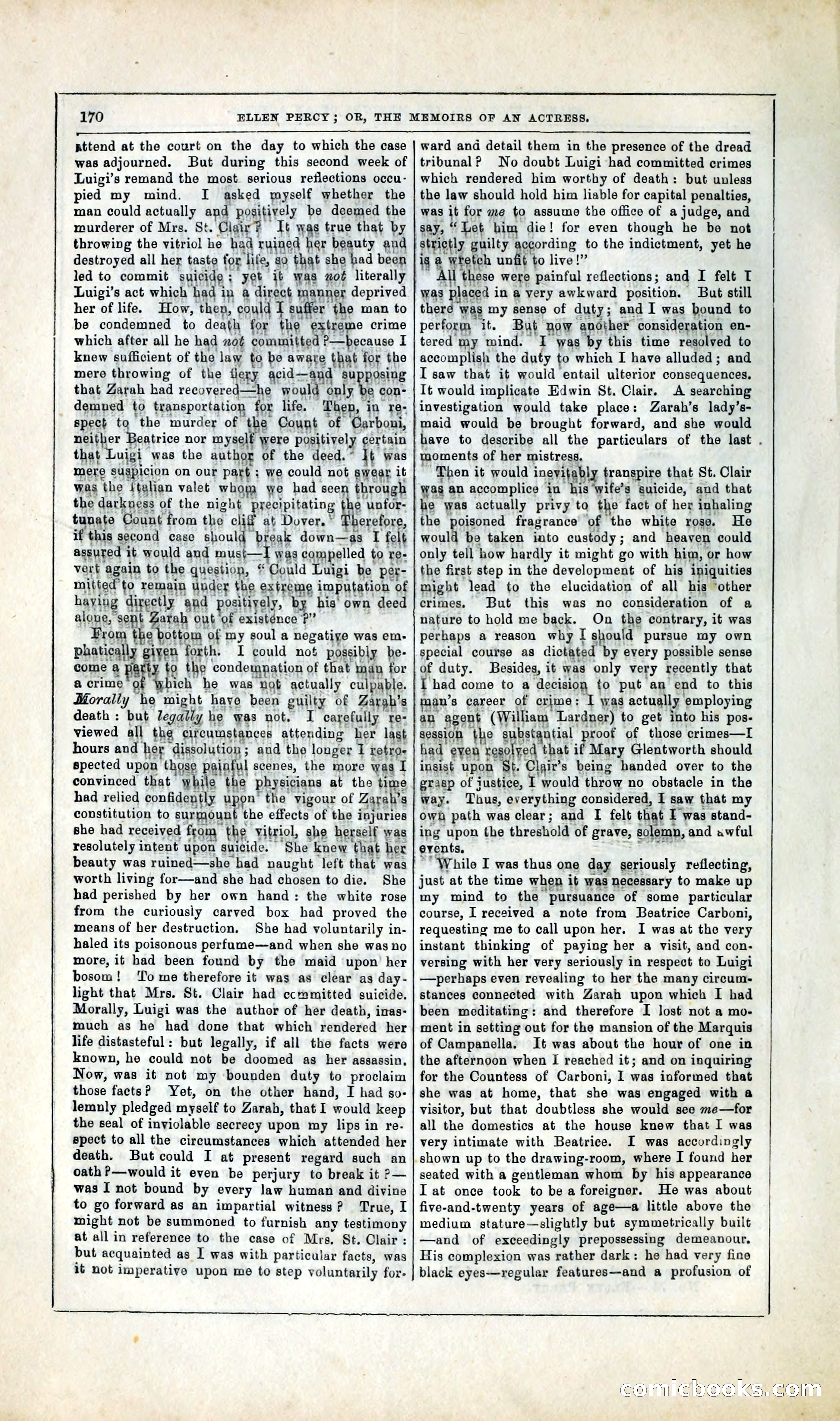
A restored page from Penny Dreadfuls, 1856. Page through the whole issue in the reader above.
📄 Transcribed text from this page (OCR, searchable)
Machine-transcribed from the original scan — historical spelling and the odd misread are preserved.
170 attend at the court on the day to which the case was adjourned. But during this second week of Luigi’s remand the most serious reflections occu- pied my mind. I asked myself whether the man could actually and positively be deemed the murderer of Mrs. St. Cigir? J¢ was true that by throwing the vitriol he had ruined her beauty and destroyed all her taste for life, so that she had been led to commit suicide; yet if was zoé literally Luigi’s act which had in a direct manner deprived her of life. How, then, could suffer the man to be condemned to death for the extreme crime which after all he had 2o¢ committed P—because I knew sufficient of the law to be aware that for the mere throwing of the fiery qacid—and supposing that Zarah had recovered—he would only be con- demned to transportation for life. Then, in re- spect to the murder of the Count of Oarboni, neither Beatrice nor myself were positively certain that Luigi was the author of the deed.” It was mere suspicion on our part: we could not swear it was the italian valet whom we had seen through the darkness of the night precipitating the unfor- tunate Count from the clif at Dover. * ‘herefore, if this second case should break down—as I felt assured it would and must—I was compelled to re- vert again to the question, “ Could Luigi be per- mitted'fo remain under the extreme imputation of haying directly apd positively, by his own deed alone, sent Zatah out of existénce P” | From the bottom of my soul a negatiye was em- phatically giyen forth. I could not possibly be- come a ar to the condemnation of that man for a crime Of ‘hich he was not actually culpable. Hiorally he might haye been guilty of Zargh’s death : but legally he was not. I carefully ‘Te- viewed all the circumstances attending her last hours and her dissolution; and the longer I retro. spected upon those alata scenes, the more was I convinced that while the physicians at the time had relied confidently upon’ the vigour of Zarah’s constitution to surmount the effects of the injuries she had received from the vitriol, she herself was resolutely intent upon suicide. She knew that her beauty was ruined—she had naught left that was worth living for—and she had chosen to die. She had perished by her own hand: the white rose from the curiously carved box had proved the means of her destruction. She had voluntarily in- haled its poisonous perfume—and when she was no more, if had been found by the maid upon her bosom! Tome therefore it was as clear as day- light that Mrs. St. Clair had ccmmitted suicide. Morally, Luigi was the author of her death, inas- much as he had done that which rendered her life distasteful: but legally, if all the facts were known, he could not be doomed as her assassin, Now, was it not my bounden duty to proclaim those facts? Yet, on the other hand, I had so- lemnly pledged myself to Zarah, that I would keep the seal of inviolable secrecy upon my lips in re- spect to all the circumstances which attended her death. But could I at present regard such an oath P—would it even be perjury to break it >— was I not bound by every law human and divine to go forward as an impartial witness? True, I might not be summoned to furnish any testimony at all in reference to the case of Mrs. St. Clair: but acquainted as J was with particular facts, was iG not imperative upon me to step voluntarily for- ELLEN PERCY; OR, THE MEMOIRS OF AN ACTRESS, ward and detail them in the presence of the dread tribunalP No doubt Luigi had committed crimes which rendered him worthy of death: but unless the law should hold him liable for capital penalties, was it for me to assume the office of a judge, and say, “Let him die! for even though he be not strictly guilty according to the indictment, yet he 1§ & Wieten unfit to live!” All these were painful reflections; and I felt T was placed in a very awkward position. But still there was my sense of duty; and I was bound to perform it. But now another consideration en- tered my mind. I was by this time resolved to accomplish the duty to which I have alluded; and I saw that it would entail ulterior consequences. It would implicate Edwin St. Clair. A searching investigation would take place: Zarah’s lady’s- maid would be brought forward, and she would have to describe all the particulars of the last . moments of her mistress, “Then it would inevitably transpire that St. Clair wag an accomplice in his ‘wife’s suicide, and that he was actually privy to the fact of her inhaling the poisoned fragrance of the white rose. He would be taken into custody; and heaven could only tell how hardly it might go with him, or how the first step in the development of his iniquities might lead to the elucidation of all his ‘other crimes. But this was no consideration of a nature to hold me back. On the contrary, it was perhaps a reason why I should pursue my own special course as dictated by every possible sense of duty. Besides, it was only very recently that I had come to a decision to put an end to this man’s career of crjme: I was actually employing an agent (William Lardner) to get into his pos- session the substantial proot of those crimes—I had even resolve that if Mary Glentworth should insist upon St. Clair’s being handed over to the grasp of justice, I would throw no obstacle in the way. Thus, everything considered, I saw that my owh path was clear; and I felt that f was stand- ing upon the threshold of grave, solemn, and awful events, TF PT '’ While I was thus one day seriously reflecting, just at the time when it was necessary to make up my mind to the pursuance of some particular course, I received a note from Beatrice Carboni, requesting me to call upon her. I was at the very instant thinking of paying her a visit, and con- versing with her very seriously in respect to Luigi —perhaps even revealing to her the many circum- stances connected with Zarah upon which I had been meditating: and therefore I lost not a mo- ment in setting out for the mansion of the Marquis of Campanella. It was about the hour of one in the afternoon when I reached it; and on inquiring for the Countess of Carboni, l was informed that she was at home, that she was engaged with a visitor, but that doubtless she would see me—for all the domestics at the house knew that I was very intimate with Beatrice. I was accordingly shown up to the drawing-room, where I found her seated with a gentleman whom by his appearance I at once took to be a foreigner. He was about five-and-twenty years of age—a little above the medium stature—slightly but symmetrically built —and of exceedingly prepossessing demeanour, His complexion was rather dark: he had very fine black eyes—regular features—and a profusion of EORNIGOOOLK< (E©)