
Penny Dreadfuls, 1856 · page 199 of 399
Ellen Percy; or, The Memoirs of an Actress — page 199: what you’re looking at
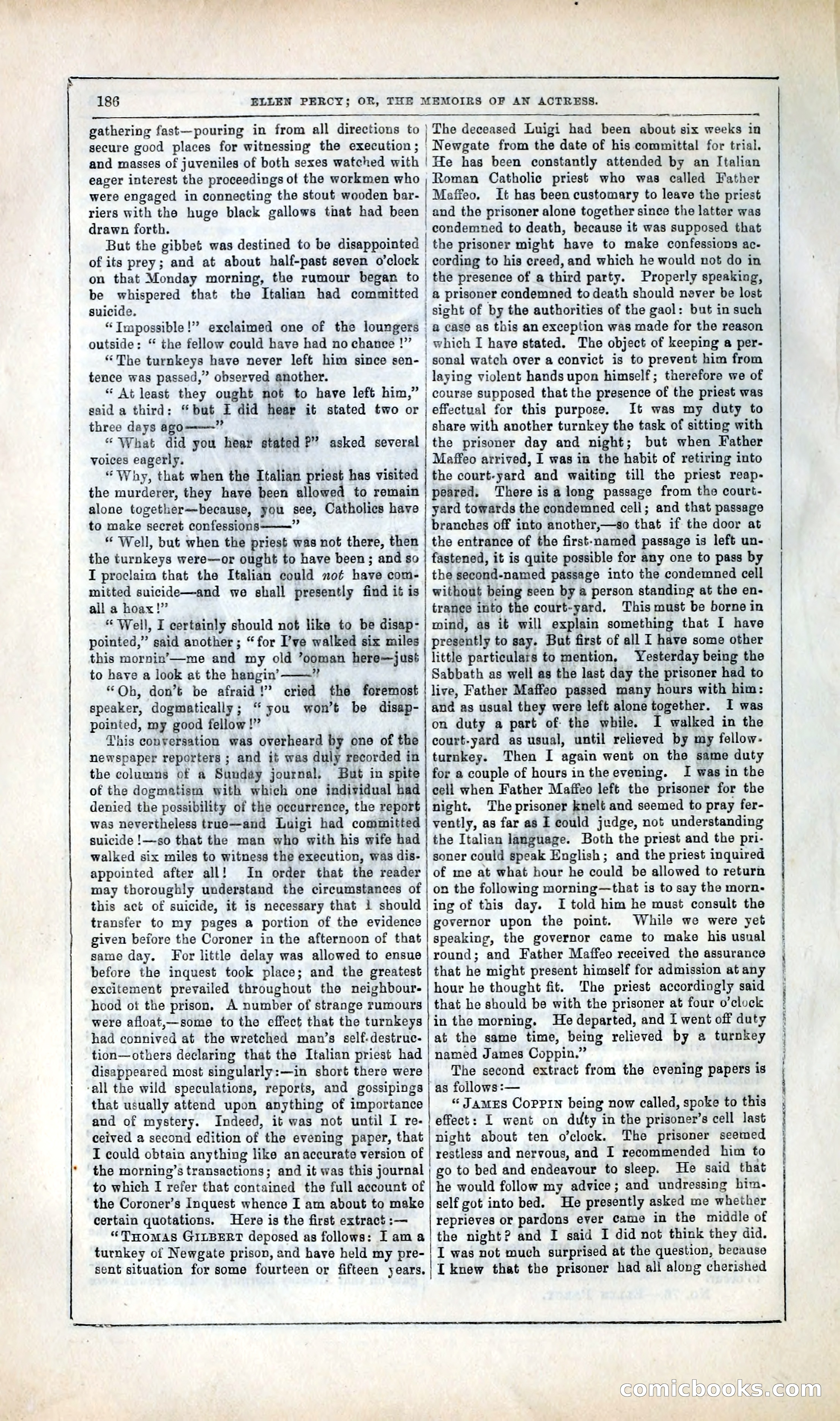
A restored page from Penny Dreadfuls, 1856. Page through the whole issue in the reader above.
📄 Transcribed text from this page (OCR, searchable)
Machine-transcribed from the original scan — historical spelling and the odd misread are preserved.
186 ELLEN PERCY; OR, THE MEMOIRS OF AN ACTRESS. gathering fast—pouring in from all directions to | The deceased Luigi had been about six weeks in secure good places for witnessing the execution; Newgate from the date of his committal for trial. and masses of juveniles of both sexes watched with | He has been constantly attended by an Italian eager interest the proceedings ot the workmen who , Roman Catholic priest who was called Father were engaged in connecting the stout wooden bar- | Mafieo, It has been customary to leave the priest riers with the huge black gallows that had been | and the prisoner alone together since the latter was drawn forth. ‘condemned to death, because it was supposed that But the gibbet was destined to be disappointed | the prisoner might have to make confessions ac- of its prey; and at about half-past seven o’clock | cording to his creed, and which he would not do in on that Monday morning, the rumour began to | the presence of a third party. Properly speaking, be whispered that the Italian had committed a prisoner condemned to death should nover be lost suicide. “Tmpossible!”” exclaimed one of the loungers outside: “ the fellow could have had no chance !” “The turnkeys have never left him since sen- tence was passed,” observed another. “ At least they ought not to have left him,” said a third: “but £ did hear it stated two or three days ago——~” “ What did you hear stated ?” asked several voices eagerly. “ Why, that when the Italian priest has visited the murderer, they have been allowed to remain alone together—because, you see, Catholics have to make secret confessions——” * Well, but when the priest was not there, then the turnkeys were—or ought to have been; and so I proclaim that the Italian could not have com- mitted suicide—and we shall presently find it is all a hoax!” “Well, I certainly should not like to be disap- pointed,” said another; “for I’ve walked six miles this mornin’—me and my old ’ooman here—just to have a look at the hangin’ ——” “Ob, don’t be afraid!” cried the foremost speaker, dogmatically; “ you won’t be disap- pointed, my good fellow!” , This conversation was overheard by one of the newspaper reporters ; and it was duly recorded in the columns of a Sund@y journal. But in spite of the dogmatism with which one individual had denied the possibility of the occurrence, the report was nevertheless true—and Luigi had committed suicide !—so that the man who with his wife had walked six miles to witness the execution, was dis- appointed after all! In order that the reader may thoroughly understand the circumstances of this act of suicide, it is necessary that 1 should transfer to my pages a portion of the evidence given before the Coroner in the afternoon of that same day. For little delay was allowed to ensue before the inquest took place; and the greatest excitement prevailed throughout the neighbour- hood ot the prison. A number of strange rumours were afloat,—some to the effect that the turnkeys had connived at the wretched man’s self-destrue- tion—others declaring that the Italian priest had disappeared most singularly:—in short there were ‘all the wild speculations, reports, and gossipings that usually attend upon anything of importance and of mystery. Indeed, it was not until I re- ceived a second edition of the evening paper, that I could obtain anything like an accurate version of the morning’s transactions; and it was this journal to which I refer that contained the full account of the Coroner’s Inquest whence I am about to make certain quotations. Here is the first extract :— “THOMAS GILBERT deposed as follows: Tama turnkey of Newgate prison, and have held my pre- sent situation for some fourteen or fifteen years. a ne ee a«~, sight of by the authorities of the gaol: but in such a case as this an exception was made for the reason which I have stated. The object of keeping a per- sonal watch over a convict is to prevent him from | laying violent hands upon himself; therefore we of course supposed that the presence of the priest was effectual for this purpoee. It was my duty to share with another turnkey the task of sitting with the prisoner day and night; but when Father Maffeo arrived, I was in the habit of retiring into the court-yard and waiting till the priest reap- peared. There is along passage from the court- yard towards the condemned cell; and that passage branches off into another,—so that if the door at the entrance of the first-named passage is left un- fastened, it is quite possible for any one to pass by the second-named passage into the condemned cell without being seen by a person standing at the en- trance into the court-yard. This must be borne in mind, as it will explain something that I have presently to say. But first of all I have some other little particulars to mention, Yesterday being the Sabbath as well as the last day the prisoner had to live, Father Maffeo passed many hours with him: and as usual they were left alone together. I was on duty a part of: the while. I walked in the court-yard as usual, until relieved by my fellow- turnkey. Then I again went on the same duty for a couple of hours intheevening. I was in the cell when Father Maffeo left the prisoner for the night. The prisoner knelt and seemed to pray fer- vently, as far as I could judge, not understanding the Italian language. Both the priest and the pri- soner could speak English; and the priest inquired of me at what hour he could be allowed to return on the following morning—that is to say the morn- ing of this day. I told him he must consult the governor upon the point. While we were yet speaking, the governor came to make his usual round; and Father Maffeo received the assurance that he might present himself for admission at any hour he thought fit. ‘The priest accordingly said that he should be with the prisoner at four o’clock in the morning. He departed, and I went off duty at the same time, being relieved by a turnkey named James Coppin.” The second extract from the evening papers is as follows:— “ James Coppin being now called, spoke to this effect: I went on duty in the prisoner’s cell last night about ten o’clock. The prisoner seemed restless and nervous, and I recommended him to go to bed and endeavour to sleep. THe said that he would follow my advice; and undressing him- self got into bed. He presently asked me whether reprieves or pardons ever came in the middle of the night? and I said I did not think they did. I was not much surprised at the question, because IT knew that the prisoner had all along cherished Gomichboo a EO eR, ge ES em