
Penny Dreadfuls, 1856 · page 201 of 399
Ellen Percy; or, The Memoirs of an Actress — page 201: what you’re looking at
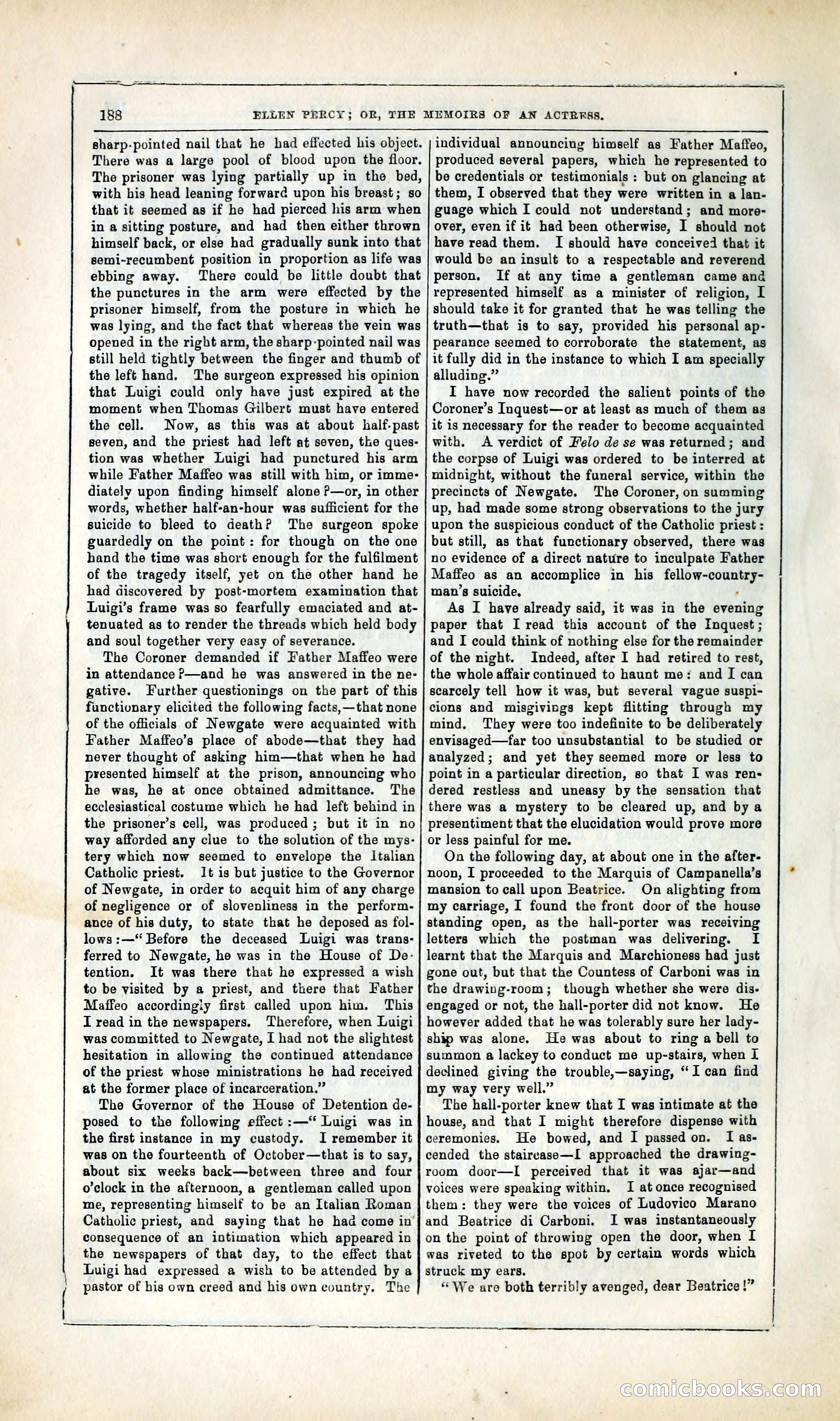
A restored page from Penny Dreadfuls, 1856. Page through the whole issue in the reader above.
📄 Transcribed text from this page (OCR, searchable)
Machine-transcribed from the original scan — historical spelling and the odd misread are preserved.
— 188 sharp- pointed nail that he had effected his object. There was a large pool of blood upon the floor. The prisoner was lying partially up in the bed, with his head leaning forward upon his breast; so that it seemed as if he had pierced his arm when in a sitting posture, and had then either thrown himself back, or else had gradually sunk into that semi-recumbent position in proportion as life was ebbing away. There could be little doubt that the punctures in the arm were effected by the prisoner himself, from the posture in which he was lying, and the fact that whereas the vein was opened in the right arm, the sharp-pointed nail was still held tightly between the finger and thumb of the left hand. The surgeon expressed his opinion that Luigi could only have just expired at the moment when Thomas Gilbert must have entered the cell. Now, as this was at about half-past seven, and the priest had left at seven, the ques- tion was whether Luigi had punctured his arm while Father Mafieo was still with him, or imme- diately upon finding himself alone P—or, in other words, whether half-an-hour was sufficient for the suicide to bleed to death? The surgeon spoke guardedly on the point: for though on the one hand the time was short enough for the fulfilment of the tragedy itself, yet on the other hand he had discovered by post-mortem examination that Luigi’s frame was so fearfully emaciated and at- tenuated as to render the threads which held body and soul together very easy of severance. The Coroner demanded if Father Maffeo were in attendance P—and he was answered in the ne- gative. Further questionings on the part of this functionary elicited the following facts,—that none of the officials of Newgate were acquainted with Father Maffeo’s place of abode—that they had never thought of asking him—that when he had presented himself at the prison, announcing who he was, he at once obtained admittance. The ecclesiastical costume which he had left behind in the prisoner’s cell, was produced; but it in no way afforded any clue to the solution of the mys: tery which now seemed to envelope the Italian Catholic priest. It is but justice to the Governor of Newgate, in order to acquit him of any charge of negligence or of slovenliness in the perform- ance of his duty, to state that he deposed as fol- lows:—“ Before the deceased Luigi was trans- ferred to Newgate, he was in the House of De- tention. It was there that he expressed a wish to be visited by a priest, and there that Father Maffeo accordingly first called upon him. This I read in the newspapers. Therefore, when Luigi was committed to Newgate, I had not the slightest hesitation in allowing the continued attendance of the priest whose ministrations he had received at the former place of incarceration.” The Governor of the House of Detention de- posed to the following effect :—*‘ Luigi was in the first instance in my custody. I remember it was on the fourteenth of October—that is to say, about six weeks back—between three and four o’clock in the afternoon, a gentleman called upon me, representing himself to be an Italian Roman Catholic priest, and saying that he haa come in consequence of an intimation which appeared in the newspapers of that day, to the effect that Luigi had expressed a wish to be attended by a pastor of his own creed and his own country. The $A ELLEN PERCY; OR, THE MEMOIRS OF -_-—_— oon AN ACTRESS, individual announcing himself as Father Maffeo, produced several papers, which he represented to be credentials or testimonials : but on glancing at them, I observed that they were written in a lan- guage which I could not understand; and more- over, even if it had been otherwise, I should not have read them. I should have conceived that it would be an insult to a respectable and reverend person. If at any time a gentleman came and represented himself as a minister of religion, I should take it for granted that he was telling the truth—that is to say, provided his personal ap- pearance seemed to corroborate the statement, as it fully did in the instance to which I am specially alluding.” I have now recorded the salient points of the Coroner’s Inquest—or at least as much of them as it is necessary for the reader to become acquainted with. A verdict of Felo de se was returned; and the corpse of Luigi was ordered to be interred at midnight, without the funeral service, within the precincts of Newgate. The Coroner, on summing up, had made some strong observations to the jury upon the suspicious conduct of the Catholic priest : but still, as that functionary observed, there was no evidence of a direct nature to inculpate Father Maffeo as an accomplice in his pr teli ar man’s suicide. As I have already said, it was in the evening paper that I read this account of the Inquest; and I could think of nothing else for the remainder of the night. Indeed, after I had retired to rest, the whole affair continued to haunt me: and I can scarcely tell how it was, but several vague suspi- cions and misgivings kept flitting through my mind. ‘They were too indefinite to be deliberately envisaged—far too unsubstantial to be studied or analyzed; and yet they seemed more or less to point in a particular direction, so that I was ren- dered restless and uneasy by the sensation that there was a mystery to be cleared up, and bya presentiment that the elucidation would prove more or less painful for me. On the following day, at about one in the after- noon, I proceeded to the Marquis of Campanella’s mansion to call upon Beatrice. On alighting from my carriage, [ found the front door of the house standing open, as the hall-porter was receiving letters which the postman was delivering. I learnt that the Marquis and Marchioness had just gone out, but that the Countess of Carboni was in the drawing-room; though whether she were dis- engaged or not, the hall-porter did not know. He however added that he was tolerably sure her lady- ship was alone. He was about to ring a bell to summon a lackey to conduct me up-stairs, when L declined giving the trouble,—saying, “I can find my way very well.” The hall-porter knew that I was intimate at the house, and that I might therefore dispense with ceremonies. He bowed, and I passed on. I as- cended the stairease—I approached the drawing- room door—lI perceived that it was ajar—and voices were speaking within. I at once recognised them: they were the voices of Ludovico Marano and Beatrice di Carboni. I was instantaneously on the point of throwing open the door, when I was riveted to the spot by certain words which struck my ears. “We are both terribly avenged, dear Beatrice !” NOOLKS (E©)