
Penny Dreadfuls, 1856 · page 301 of 399
Ellen Percy; or, The Memoirs of an Actress — page 301: what you’re looking at
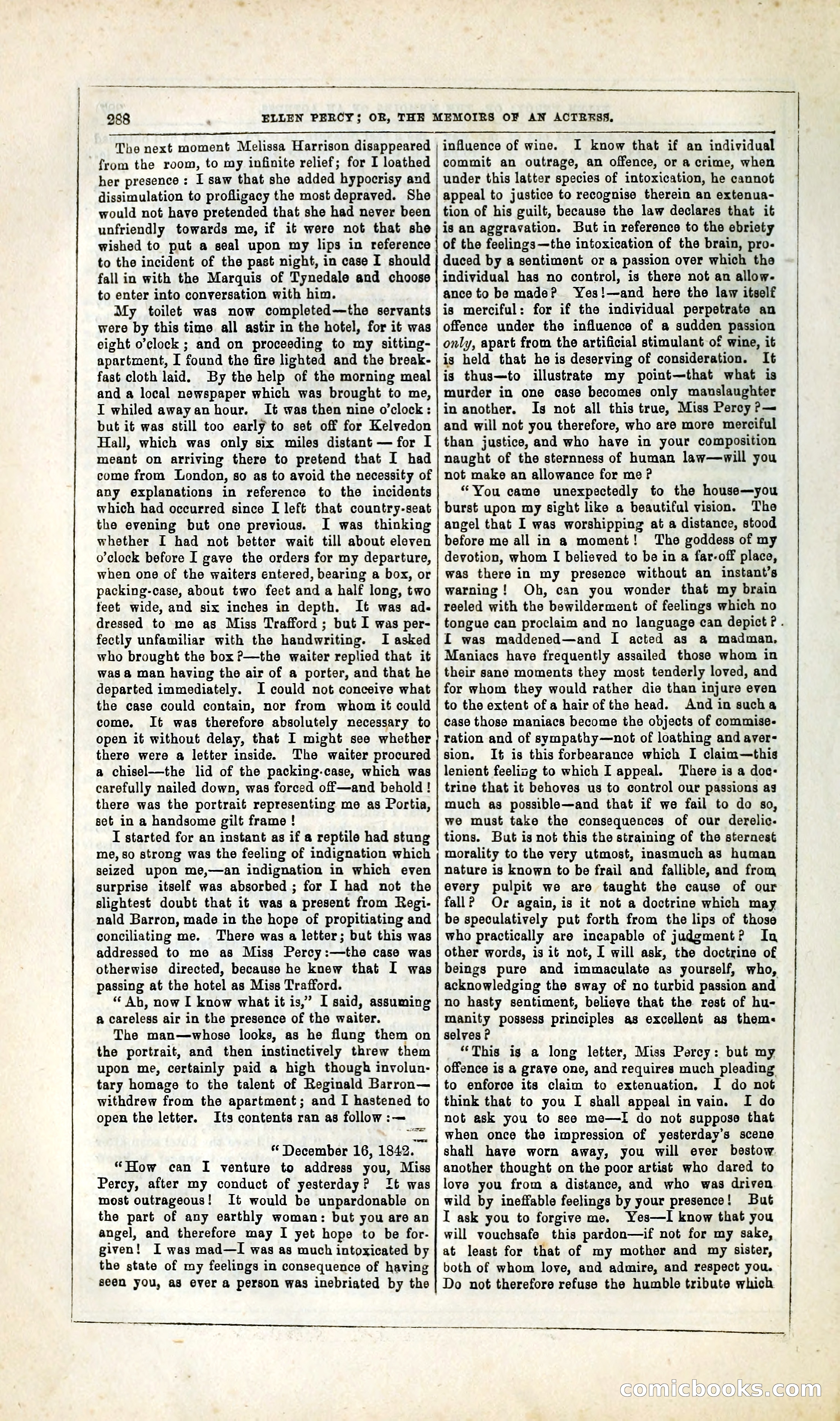
A restored page from Penny Dreadfuls, 1856. Page through the whole issue in the reader above.
📄 Transcribed text from this page (OCR, searchable)
Machine-transcribed from the original scan — historical spelling and the odd misread are preserved.
288 The next moment Melissa Harrison disappeared from the room, to my infinite relief; for I loathed her presence: I saw that she added hypocrisy and dissimulation to profligacy the most depraved. She would not have pretended that she had never been unfriendly towards me, if it were not that she wished to put a seal upon my lips in reference to the incident of the past night, in case I should fallin with the Marquis of Tynedale and choose to enter into conversation with him. My toilet was now completed—the servants were by this time all astir in the hotel, for it was eight o’clock ; and on proceeding to my sitting- apartment, I found the fire lighted and the break- fast cloth laid. By the help of the morning meal and a local newspaper which was brought to me, I whiled awayan hour. It was then nine o’clock: but it was still too early to set off for Kelvedon Hall, which was only six miles distant — for I meant on arriving there to pretend that I had come from London, so as to avoid the necessity of any explanations in reference to the incidents which had occurred since I left that country-seat the evening but one previous. I was thinking whether I had not better wait till about eleven o’clock before I gave the orders for my departure, when one of the waiters entered, bearing a box, or packing-case, about two feet and a half long, two feet wide, and six inches in depth. It was ad. dressed to me as Miss Trafford; but I was per- fectly unfamiliar with the handwriting. I asked who brought the box ?—the waiter replied that it was & man having the air of a porter, and that he departed immediately. I could not conceive what the case could contain, nor from whom it could come. It was therefore absolutely necessary to open it without delay, that I might see whether there were a letter inside. The waiter procured a chisel—the lid of the packing-case, which was carefully nailed down, was forced off—and behold ! there was the portrait representing me as Portia, set in a handsome gilt frame ! I started for an instant as if a reptile had stung me, so strong was the feeling of indignation which seized upon me,—an indignation in which even surprise itself was absorbed ; for I had not the slightest doubt that it was a present from Regi- nald Barron, made in the hope of propitiating and conciliating me. There was a letter; but this was addressed to me as Miss Percy:—the case was otherwise directed, because he knew that I was passing at the hotel as Miss Trafford. “ Ah, now I know what it is,” I said, assuming @ careless air in the presence of the waiter. The man—whose looks, as he flung them on the portrait, and then instinctively threw them upon me, certainly paid a high though involun- tary homage to the talent of Reginald Barron— withdrew from the apartment; and I hastened to open the letter. Its contents ran as follow :— oe * December 16, 1842. “How can I venture to address you, Miss Percy, after my conduct of yesterday? It was most outrageous! It would be unpardonable on the part of any earthly woman: but you are an angel, and therefore may I yet hope to be for- given! I was mad—I was as much intoxicated by the state of my feelings in consequence of having seen you, as ever a person was inebriated by the —_—— ELLEN PERCY; OR, THE MEMOIRS OF AN ACTRESS. LLL A A te, i LC INI, CC LL LC ee influence of wine. I know that if an individual commit an outrage, an offence, or a crime, when under this latter species of intoxication, he cannot appeal to justice to recognise therein an extenua- tion of his guilt, because the law declares that it is an aggravation. But in reference to the ebriety of the feelings—the intoxication of the brain, pro- duced by a sentiment or a passion over which the individual has no control, is there not an allow- ance to be madeP Yes!—and here the law itself is merciful: for if the individual perpetrate an offence under the influence of a sudden passion only, apart from the artificial stimulant of wine, it is held that he is deserving of consideration. It is thus—to illustrate my point—that what is murder in one case becomes only manslaughter in another. Is not all this true, Miss Perey ?— and will not you therefore, who are more merciful than justice, and who have in your composition naught of the sternness of human law—will you not make an allowance for me? “You came unexpectedly to the house—you burst upon my sight like a beautiful vision. The angel that I was worshipping at a distance, stood before me all in a moment! The goddess of my devotion, whom I believed to be in a far-off place, was there in my presence without an instant’s warning! Oh, can you wonder that my brain reeled with the bewilderment of feelings which no tongue can proclaim and no language can depict ? . I was maddened—and I acted as a madman, Maniacs have frequently assailed those whom in their sane moments they most tenderly loved, and for whom they would rather die than injure even to the extent of a hair of the head. And in sucha case those maniacs become the objects of commise- ration and of sympathy—not of loathing and aver- sion. If is this forbearance which I claim—this lenient feeling to which I appeal. There is a doe: trine that it behoves us to control our passions ag much as possible—and that if we fail to do so, we must take the consequences of our derelic- tions. But is not this the straining of the sternest morality to the very utmost, inasmuch as human nature is known to be frail and fallible, and from every pulpit we are taught the cause of our fall? Or again, is it not a doctrine which may be speculatively put forth from the lips of those who practically are incapable of judzment? In other words, is it not, I will ask, the doctrine of beings pure and immaculate as yourself, who, acknowledging the sway of no turbid passion and no hasty sentiment, believe that the rest of hu- manity possess principles as excellent as them: selves ? “This ig a long letter, Miss Percy: but my offence is @ grave one, and requires much pleading to enforce its claim to extenuation. I do not think that to you I shall appeal in vain. I do not ask you to see me—E do not suppose that when once the impression of yesterday's scene shall have worn away, you will ever bestow another thought on the poor artist who dared to love you from a distance, and who was driven wild by ineffable feelings by your presence! But I ask you to forgive me. Yes—lI know that you will vouchsafe this pardon—if not for my sake, at least for that of my mother and my sister, both of whom love, and admire, and respect you. Do not therefore refuse the humble tribute which (CO) 6)(6)(6) = SS (E(@)