
Penny Dreadfuls, 1856 · page 375 of 399
Ellen Percy; or, The Memoirs of an Actress — page 375: what you’re looking at
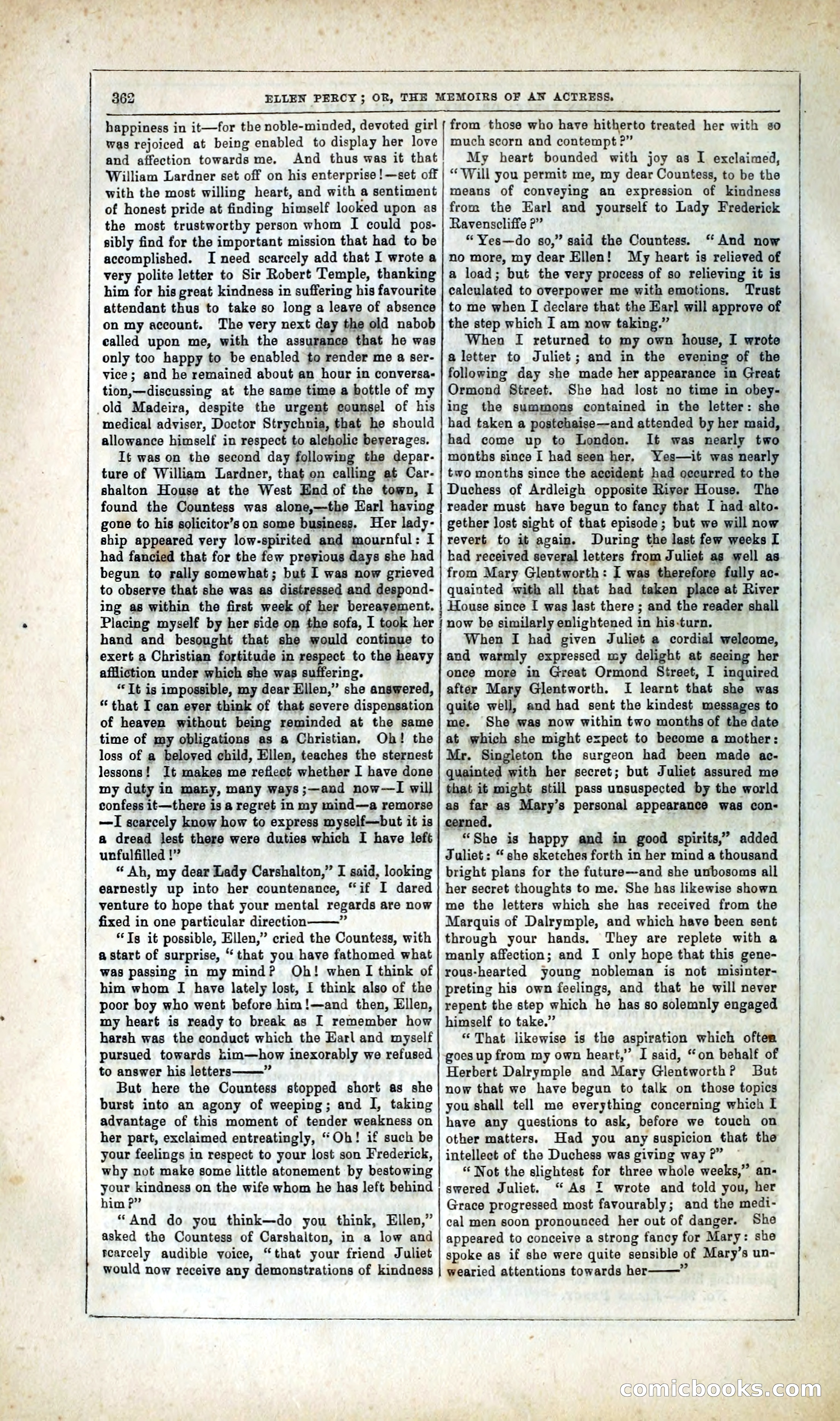
A restored page from Penny Dreadfuls, 1856. Page through the whole issue in the reader above.
📄 Transcribed text from this page (OCR, searchable)
Machine-transcribed from the original scan — historical spelling and the odd misread are preserved.
362 ELLEN PERCY; OR, THE MEMOIRS OF AWN ACTRESS, a a A a a a happiness in it—for the noble-minded, devoted girl / from those who have hitherto treated her with so was rejoiced at being enabled to display her love | much scorn and contempt?” and affection towards me. And thus was it that My heart bounded with joy as I exclaimed, William Lardner set off on his enterprise!—set off | “ Will you permit me, my dear Countess, to be the with the most willing heart, and with a sentiment of honest pride at finding himself looked upon as the most trustworthy person whom I could pos- sibly find for the important mission that had to be accomplished. I need scarcely add that I wrote a very polite letter to Sir Robert Temple, thanking him for his great kindness in suffering his favourite attendant thus to take so long a leave of absence on my account. The very next day the old nabob called upon me, with the assurance that he was only too happy to be enabled to render me a ser- vice; and he remained about an hour in conversa- tion,—discussing at the same time a bottle of my old Madeira, despite the urgent counsel of his medical adviser, Doctor Strychnia, that he should allowance himself in respect to alebolie beyerages. It was on the second day following the depar- ture of William Lardner, that on calling at Car- shalton House at the West End of the town, I found the Countess was alone,—the Earl having gone to his solicitor’s on some business. Her lady- ship appeared very low-spirited and mournful: I had fancied that for the few previous days she had begun to rally somewhat; but I was now grieved to observe that she was as distressed and despond- ing as within the first week of her bereayement. Placing myself by her side on the sofa, I took her hand and besought that she would continue to exert a Christian fortitude in respect to the heavy affliction under which she was suffering. “It is impossible, my dear Ellen,” she answered, “that I can eyer think of that severe dispensation of heaven without being reminded at the same time of my obligations as a Christian, Oh! the loss of a beloved child, Ellen, teaches the sternest lessons! It makes me reficet whether I have done my duty in many, many ways;—and now—lI will confess it—there is a regret in my mind—a remorse —I scarcely know how to express myself—but it is a dread lest there were duties which I have left unfulfilled !” “ Ah, my dear Lady Carshalton,” I said, looking earnestly up into her countenance, “if I dared venture to hope that your mental regards are now fixed in one particular direction ? ‘Ts it possible, Ellen,” cried the Countess, with a start of surprise, “‘ that you have fathomed what was passing in my mind? Oh! when I think of him whom [I have lately lost, I think also of the poor boy who went before him!—and then, Ellen, my heart is ready to break as I remember how harsh was the conduct which the Karl and myself pursued towards kim—how inexorably we refused to answer his letters-———” But here the Countess stopped short as she burst into an agony of weeping; and I, taking advantage of this moment of tender weakness on her part, exclaimed entreatingly, “Oh! if such be your feelings in respect to your lost son Frederick, why not make some little atonement by bestowing your kindness on the wife whom he has left behind him P” “And do you think—do you think, Ellen,” asked the Countess of Carshaiton, in a low and Bcarcely audible voice, “that your friend Juliet would now receive any demonstrations of kindness ee eee ae means of conveying an expression of kindness from the Earl and yourself to Lady Frederick Ravenscliffe P” | “Yes—do so,” said the Countess. “And now no more, my dear Ellen! My heart is relieved of a load; but the very process of so relieving it is calculated to overpower me with emotions. Trust to me when I declare that the Harl will approve of the step which I am now taking.” When I returned to my own house, I wrote a letter to Juliet; and in the evening of the following day she made her appearance in Great Ormond Street. She had lost no time in obey- ing the summons contained in the letter: she had taken a postehaise—and attended by her maid, had come up to London. It was nearly two months since I had seen her. Yes—it was nearly two months since the accident had occurred to the Duchess of Ardleigh opposite Riyer House. The reader must have begun to fancy that I had alto. gether Jost sight of that episode; but we will now revert to it again. During the last few weeks I kad received several letters from Juliet as well as from Mary Glentworth: I was therefore fully ac- quainted with all that bad taken place at River House since I was last there ; and the reader shall now be similarly enlightened in his-turn. When I had given Juliet a cordial welcome, and warmly expressed my delight at seeing her once more in Great Ormond Street, I inquired after Mary Glentworth. I learnt that she was quite wel], and had sent the kindest messages to me. She was now within two months of the date at which she might expect to become a mother: Mr. Singleton the surgeon had been made ac- quainted with her secret; but Juliet assured me that it might still pass unsuspected by the world as far as Mary’s personal appearance was con- cerned, “She is happy and in good spirits,’ added Juliet: “she sketches forth in her mind a thousand bright plans for the future—and she unbosoms all her secret thoughts to me. She has likewise shown me the letters which she has received from the Marquis of Dalrymple, and which have been sent through your hands, They are replete with a manly affection; and I only hope that this gene- rous-hearted young nobleman is not misinter- preting his own feelings, and that he will never repent the step which he has so solemnly engaged himself to take.” “That likewise is the aspiration which oftem goes up from my own heart,” I said, “on behalf of Herbert Dalrymple and Mary Glentworth? But now that we have begun to talk on those topics you shall tell me everything concerning which I have any questions to ask, before we touch on other matters. Had you any suspicion that the intellect of the Duchess was giving way?” = “Not the slightest for three whole weeks,” an- swered Juliet. “As I wrote and told you, her Grace progressed most favourably; and the medi- cal men soon pronoucced her out of danger. She appeared to conceive a strong fancy for Mary: she spoke as if she were quite sensible of Mary’s un- wearied attentions towards her a: a — = ee Gomichdoo mm a ee (EO f