
Penny Dreadfuls, 1856 · page 50 of 399
Ellen Percy; or, The Memoirs of an Actress — page 50: what you’re looking at
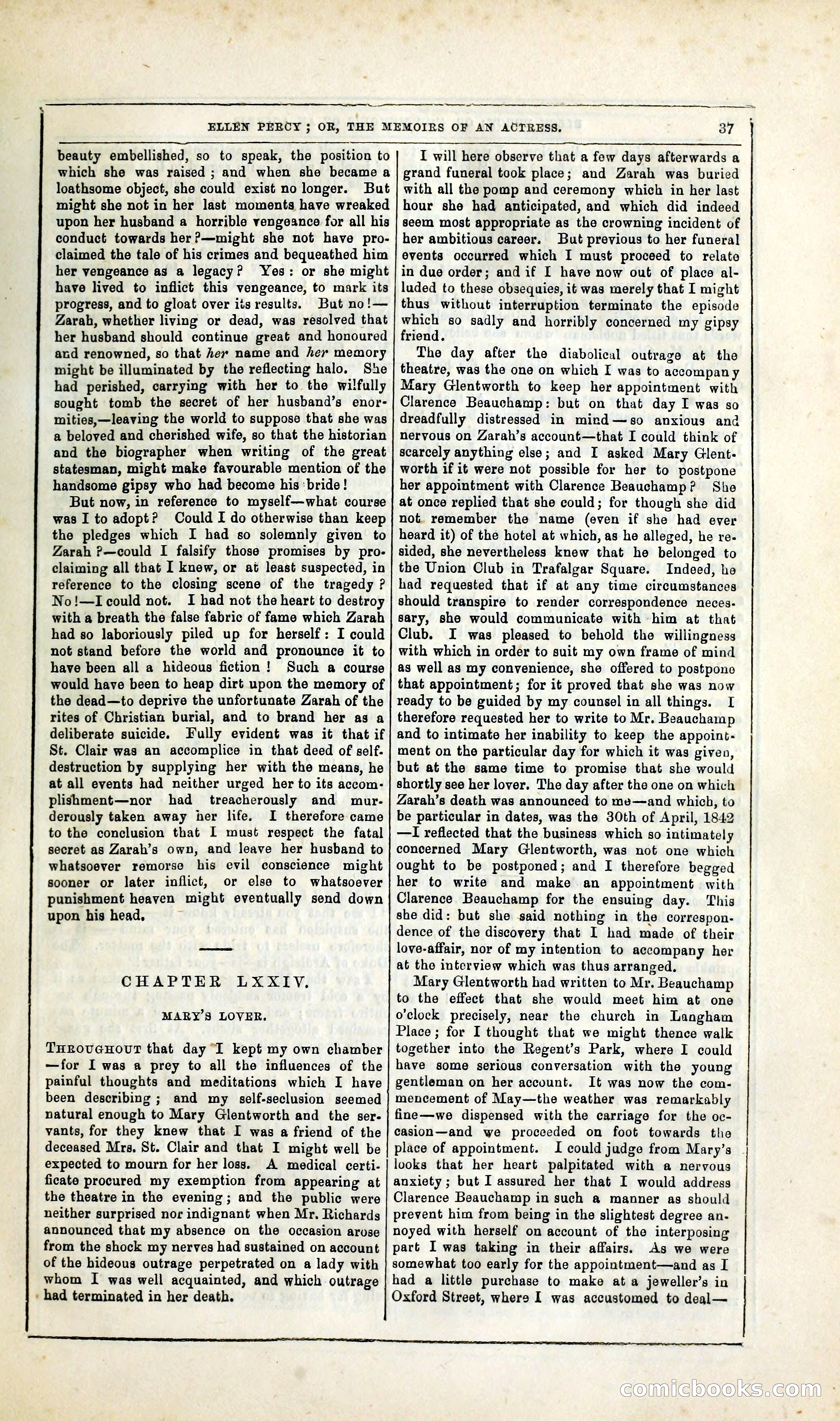
A restored page from Penny Dreadfuls, 1856. Page through the whole issue in the reader above.
📄 Transcribed text from this page (OCR, searchable)
Machine-transcribed from the original scan — historical spelling and the odd misread are preserved.
ELLEN PERCY ; OR, THE MEMOIRS OF AN ACTRESS. ——- me o7 beauty embellished, so to speak, the position to which she was raised ; and when she became a loathsome object, she could exist no longer. But might she not in her last moments have wreaked upon her husband a horrible vengeance for all his conduct towards her?—might she not have pro- claimed the tale of his crimes and bequeathed him her vengeance as a legacy? Yes: or she might have lived to inflict this vengeance, to mark its progress, and to gloat over its results. But no!— Zarah, whether living or dead, was resolved that her husband should continue great and honoured and renowned, so that fev name and her memory might be illuminated by the reflecting halo. She had perished, carrying with her to the wilfully sought tomb the secret of her husband’s enor- mities,—leaving the world to suppose that she was a beloved and cherished wife, so that the historian and the biographer when writing of the great statesman, might make favourable mention of the handsome gipsy who had become his ‘bride! But now, in reference to myself—what course was I to adopt? Could I do otherwise than keep the pledges which I had so solemnly given to Zarah ?—could I falsify those promises by pro- claiming all that I knew, or at least suspected, in reference to the closing scene of the tragedy ? No!—I could not. I had not the heart to destroy with a breath the false fabric of fame which Zarah had so laboriously piled up for herself: I could not stand before the world and pronounce it to have been all a hideous fiction! Such a course would have been to heap dirt upon the memory of the dead—to deprive the unfortunate Zarah of the rites of Christian burial, and to brand her as a deliberate suicide. Fully evident was it that if St. Clair was an accomplice in that deed of self. destruction by supplying her with the means, he at all events had neither urged her to its accom: plishment—nor had treacherously and mur- derously taken away her life. I therefore came to the conclusion that I must respect the fatal secret as Zarah’s own, and leave her husband to whatsoever remorse his evil conscience might sooner or later inflict, or else to whatsoever punishment heaven might eventually send down upon his head, CHAPTER LXXILYy. MARY’S LOVER. THRovGHOUT that day I kept my own chamber —for I was a prey to all the influences of the painful thoughts and meditations which I have been describing; and my self-seclusion seemed natural enough to Mary Glentworth and the ser- vants, for they knew that I was a friend of the deceased Mrs, St. Clair and that I might well be expected to mourn for her loss. A medical certi- ficate procured my exemption from appearing at the theatre in the evening; and the public were neither surprised nor indignant when Mr. Richards announced that my absence on the occasion arose from the shock my nerves had sustained on account of the hideous outrage perpetrated on a lady with whom I was well acquainted, and which outrage ‘had terminated in her death. I will here observe that a few days afterwards a grand funeral took place; and Zarah was buried with all the pomp and ceremony which in her last hour she had anticipated, and which did indeed seem most appropriate as the crowning incident of her ambitious career. But previous to her funeral] events occurred which I must proceed to relate in due order; and if I have now out of place al- luded to these obsequies, it was merely that I might thus without interruption terminate the episode which so sadly and horribly concerned my gipsy friend. The day after the diabolical outrage at the theatre, was the one on which I was to accompany Mary Glentworth to keep her appointment with Clarence Beauchamp: but on that day I was so dreadfully distressed in mind—so anxious and nervous on Zarah’s account—that I could think of scarcely anything else; and I asked Mary Glent- worth if it were not possible for her to postpone her appointment with Clarence Beauchamp? She at once replied that she could; for though she did not. remember the name (even if she had ever heard it) of the hotel at which, as he alleged, he re- sided, she nevertheless knew that he belonged to the Union Club in Trafalgar Square. Indeed, he had requested that if at any time circumstances should transpire to render correspondence neces- sary, she would communicate with him at that Club. I was pleased to behold the willingness with which in order to suit my own frame of mind as well as my convenience, she offered to postpono that appointment; for it proved that she was now ready to be guided by my counsel in all things. [ therefore requested her to write to Mr. Beauchamp and to intimate her inability to keep the appoint- ment on the particular day for which it was given, but at the same time to promise that she would shortly see her lover. The day after the one on which Zarah’s death was announced to me—and which, to be particular in dates, was the 30th of April, 1842 —I reflected that the business which so intimately concerned Mary Glentworth, was not one which ought to be postponed; and I therefore begged her to write and make an appointment with Clarence Beauchamp for the ensuing day. This she did: bué she said nothing in the correspon- dence of the discovery that I had made of their love-affair, nor of my intention to accompany her at the interview which was thus arranged, Mary Glentworth had written to Mr. Beauchamp to the effect that she would meet him at one o'clock precisely, near the church in Langham Place ; for I thought that we might thence walk together into the Regent’s Park, where I could have some serious conversation with the young gentleman on her account. It was now the com- mencement of May—the weather was remarkably fine—we dispensed with the carriage for the oc- casion—and we proceeded on foot towards the place of appointment. I could judge from Mary’s looks that her heart palpitated with a nervous anxiety; but I assured her that I would address Clarence Beauchamp in such a manner as should prevent him from being in the slightest degree an- noyed with herself on account of the interposing part I was taking in their affairs. As we were somewhat too early for the appointment—and as I had a little purchase to make ata jeweller’s in Oxford Street, where I was accustomed to deal— —————— JOO SS