
Penny Dreadfuls, 1856 · page 57 of 399
Ellen Percy; or, The Memoirs of an Actress — page 57: what you’re looking at
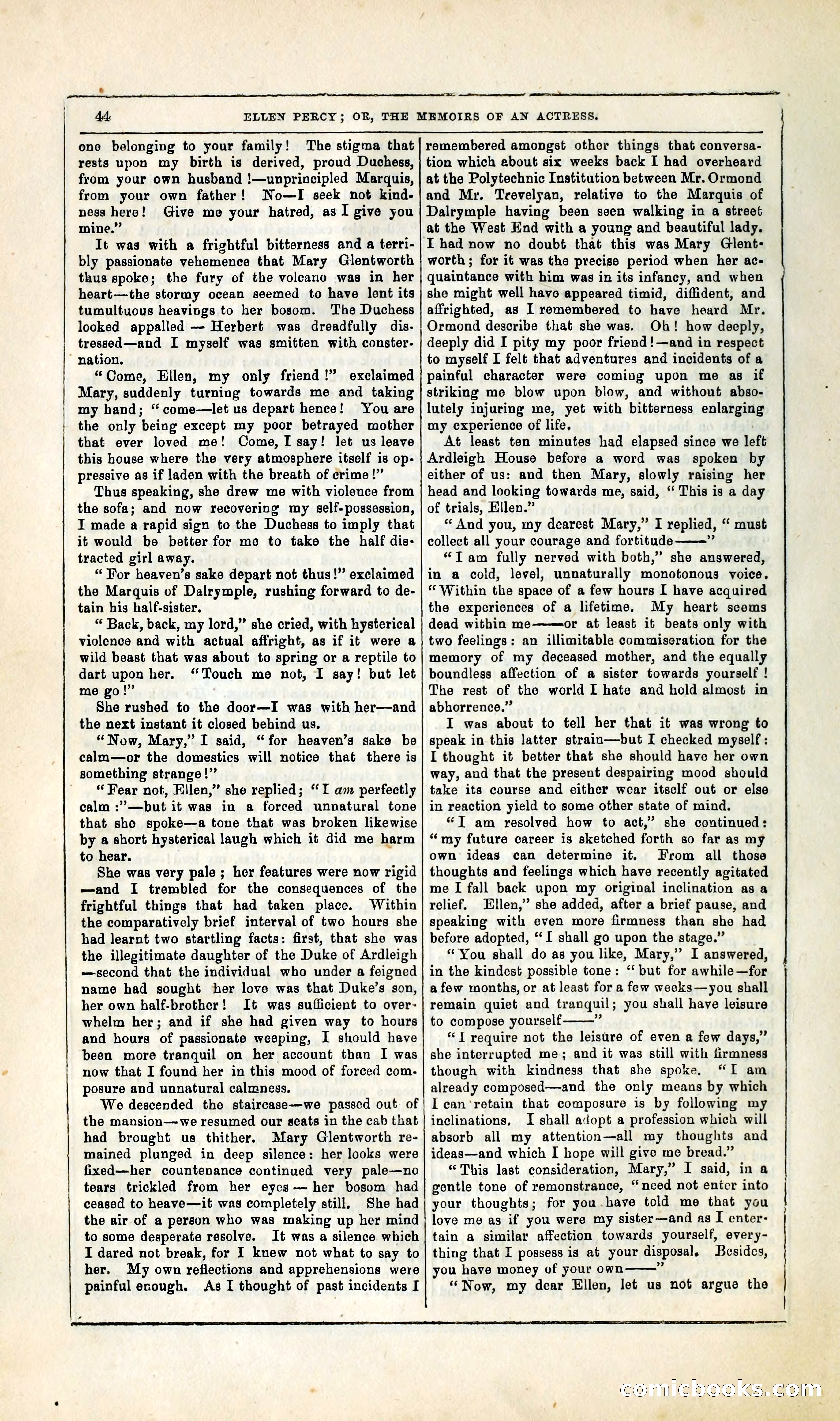
A restored page from Penny Dreadfuls, 1856. Page through the whole issue in the reader above.
📄 Transcribed text from this page (OCR, searchable)
Machine-transcribed from the original scan — historical spelling and the odd misread are preserved.
4. > ELLEN PERCY; OR, THE MEMOIRS OF AN ACTRESS. one belonging to your family! The stigma that rests upon my birth is derived, proud Duchess, from your own husband !—unprincipled Marquis, from your own father! No—TI seek not kind- ness here! Give me your hatred, as I give you mine.” It was with a frightful bitterness and a terri- bly passionate vehemence that Mary Glentworth thus spoke; the fury of the volcano was in her heart—the stormy ocean seemed to have lent its tumultuous heavings to her bosom. The Duchess looked appalled — Herbert was dreadfully dis- tressed—and I myself was smitten with conster- - nation. “Come, Ellen, my only friend!” exclaimed Mary, suddenly turning towards me and taking my hand; “ come—let us depart hence! You are the only being except my poor betrayed mother that ever loved me! Come, I say! let us leave this house where the very atmosphere itself is op- pressive as if laden with the breath of crime !” Thus speaking, she drew me with violence from the sofa; and now recovering my self-possession, I made a rapid sign to the Duchess to imply that it would be better for me to take the half dis- tracted girl away. “ For heaven’s sake depart not thus!” exclaimed the Marquis of Dalrymple, rushing forward to de- tain his half-sister. “ Back, back, my lord,” she cried, with hysterical violence and with actual affright, as if it were a wild beast that was about to spring or a reptile to dart upon her. “Touch me not, I say! but let me go!” She rushed to the door—I was with her—and the next instant it closed behind us. “Now, Mary,” I said, “for heaven’s sake be calm—or the domestics will notice that there is something strange!” “Fear not, Ellen,” she replied; “I am perfectly calm :’—but it was in a forced unnatural tone that she spoke—a tone that was broken likewise by a short hysterical laugh which it did me harm to hear. She was very pale; her features were now rigid —and I trembled for the consequences of the frightful things that had taken place. Within the comparatively brief interval of two hours she had learnt two startling facts: first, that she was the illegitimate daughter of the Duke of Ardleigh —second that the individual who under a feigned name had sought her love was that Duke’s son, her own half-brother! It was sufficient to over» whelm her; and if she had given way to hours and hours of passionate weeping, I should have been more tranquil on her account than I was now that I found her in this mood of forced com- posure and unnatural calmness. We descended the staircase—we passed out of the mansion—we resumed our seats in the cab that had brought us thither. Mary Glentworth re- mained plunged in deep silence: her looks were fixed—her countenance continued very pale—no tears trickled from her eyes — her bosom had ceased to heave—it was completely still, She had the air of a person who was making up her mind to some desperate resolve. It was a silence which I dared not break, for I knew not what to say to her. My own reflections and apprehensions were painful enough. As I thought of past incidents I remembered amongst other things that conversa- tion which ebout six weeks back I had overheard at the Polytechnic Institution between Mr. Ormond and Mr. Trevelyan, relative to the Marquis of Dalrymple having been seen walking in a street at the West End with a young and beautiful lady. I had now no doubt that this was Mary Glent- worth; for it was the precise period when her ac- quaintance with him was in its infancy, and when she might well have appeared timid, diffident, and affrighted, as I remembered to have heard Mr. Ormond describe that she was. Oh! how deeply, deeply did I pity my poor friend !—and in respect to myself I felt that adventures and incidents of a painful character were coming upon me as if striking me blow upon blow, and without abso- lutely injuring me, yet with bitterness enlarging my experience of life, : At least ten minutes had elapsed since we left Ardleigh House before a word was spoken by either of us: and then Mary, slowly raising her head and looking towards me, said, “ This is a day of trials, Ellen.” « And you, my dearest Mary,” I replied, “ must collect all your courage and fortitude oF “Tam fully nerved with both,” she answered, in a cold, level, unnaturally monotonous voice. ““ Within the space of a few hours I have acquired the experiences of a lifetime. My heart seems dead within me or at least it beats only with two feelings: an illimitable commiseration for the memory of my deceased mother, and the equally boundless affection of a sister towards yourself ! The rest of the world I hate and hold almost in abhorrence.” I was about to tell her that it was wrong to speak in this latter strain—but I checked myself: I thought it better that she should have her own way, and that the present despairing mood should take its course and either wear itself out or else in reaction yield to some other state of mind. “TI am resolved how to act,” she continued: “my future career is sketched forth so far as my own ideas can determine it. From all those thoughts and feelings which have recently agitated me I fall back upon my original inclination as a relief, Ellen,” she added, after a brief pause, and speaking with even more firmness than she had before adopted, “I shall go upon the stage.” “You shall do as you like, Mary,” I answered, in the kindest possible tone: ‘“‘ but for awhile—for a few months, or at least for a few weeks—you shall remain quiet and tranquil; you shall have leisure to compose yourself ¢ “JT require not the leisure of even a few days,” she interrupted me; and it was still with firmness though with kindness that she spoke. “I am already composed—and the only means by which I can‘retain that composure is by following my inclinations. I shall adopt a profession which will absorb all my attention—all my thoughts and ideas—and which I hope will give me bread.” “This last consideration, Mary,” I said, in a gentle tone of remonstrance, “need not enter into your thoughts; for you-have told me that you love me as if you were my sister—and as I enter- tain a similar affection towards yourself, every- thing that I possess is at your disposal. Besides, you have money of your own “ ‘Now, my dear Ellen, let us not argue the a a Gomicboo cS (E(@)