
Penny Dreadfuls, 1892 · page 8 of 24
Frank Reade Library No. 12: Frank Reade and His Steam Man of the Plains — page 8: what you’re looking at
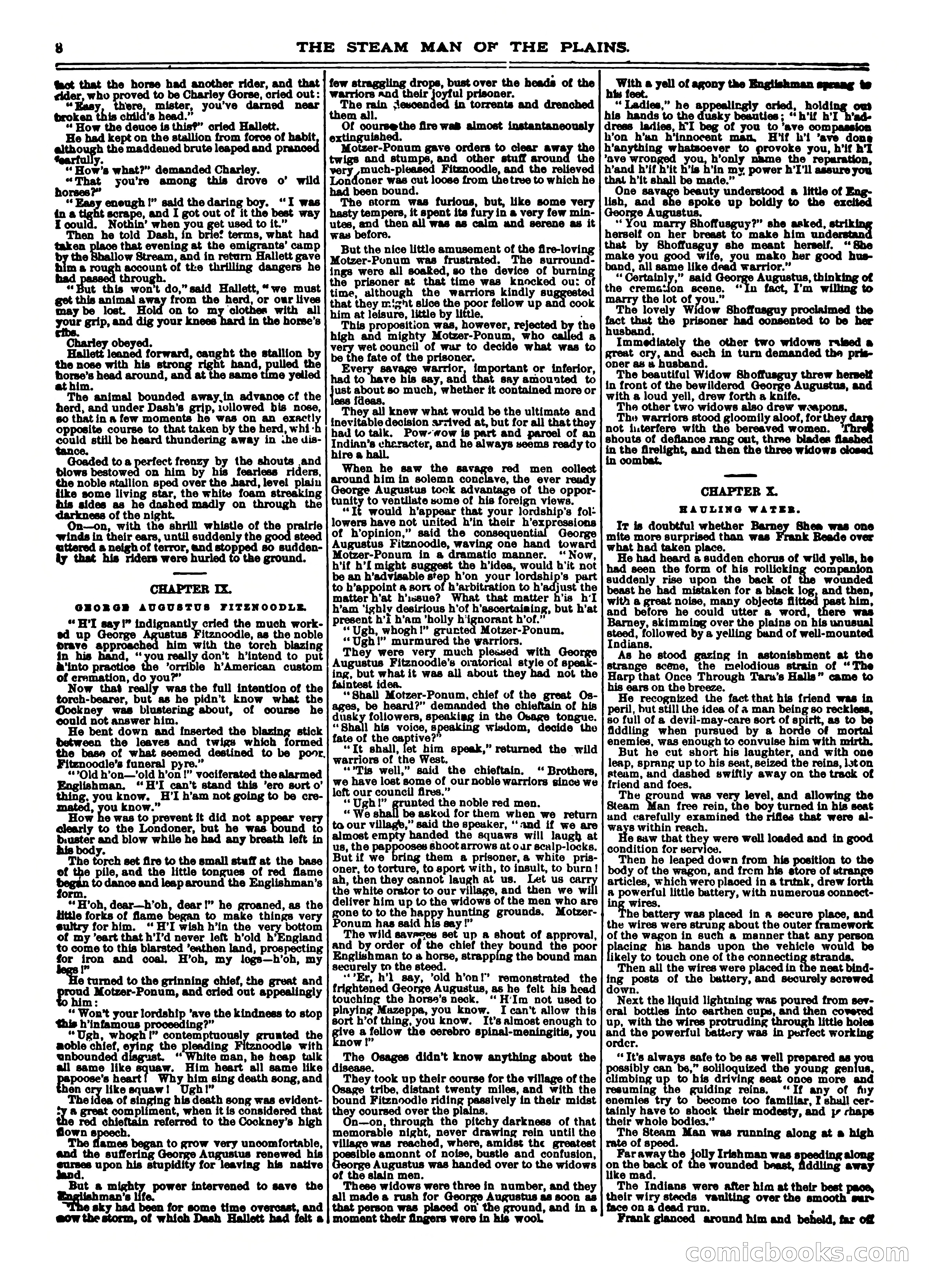
A restored page from Penny Dreadfuls, 1892. Page through the whole issue in the reader above.
📄 Transcribed text from this page (OCR, searchable)
Machine-transcribed from the original scan — historical spelling and the odd misread are preserved.
8 THE STEAM MAN OF THE PLAINS. fact that the horse had another rider, and that cider, who proved to be Charley Gorse, cried out: - Easy lere, mister, you’ve darned near broken this child's head.” “‘ How the deuce is this?” cried Hallett. He had kept on the stallion from force of habit although the maddened brute leaped and pranced “ How's what?” demanded Charley. “That you’re among this drove o’ wild no nasy ugh !” said thedaring boy. ‘I «6 ene 0 e ng i ae was ina Eb ecranc, and I got out of it the best way I oould. Nothin’ when you get used to it.” Then he told Dash, in brie? terms, what had taken place that evening at the emigrants’ camp by the ow Stream, and in return Hallett gave him a rough account of tie dangers he through. “But this won’t do,” said Hallett,“we must get this animal away from the herd, or our lives 0 may be lost. on to my clothes with all your grip, and dig your knees in the horse’s Chariey obeyed. Hallett leaned forward, caught the stallion by the nose with his strong right hand, pulled the Dorse's head around, and at the same time yelled m. The animal bounded away.in advance cf the herd, and under Dash’s grip, ivilowed bis nose, so thatin a few moments he was on an exact! opposite course to that taken by the herd, whi: could still be heard thundering away in «he dis- tance. Goaded toa ect frenzy by the shouts and blows bestowed on him by his fearless riders, the noble stallion sped over the hard, leve! plain dike some living star, the white foam streaking his sides as he dashed madly on through the darkness of the night. On—on, with the shrill whistle of the prairie winds in their ears, until suddenly the steed attered a neigh of terror, and stopped so sudden- ay that his riders were hurled to the ground. CHAPTER IX. GEORGE AUGUSTUS FITZNOODLE. “Hl say!” indignantly cried the much work- ed up George tus Fitznoodle, as the noble @rave approached him with the torch blazing in his hand, “ qn really don’t h’intend to put &'into practice the ’orrible h’American custom of cremation, do you?” Now that really was the full intention of the torch-bearer, but as he pidn’t know what the Oockney was blustering about, of course he could not answer him. He bent down and {nserted the blazing stick between the leaves and twigs which formed the base of what seemed destined to be por, Fitenoodle’s funeral pyre.” “*°Old h’on—’old h’on !” vociferated the alarmed Englishman. ‘ H’I can’t stand this ‘ero surt o’ thing, you know. H’I h’am not going to be cre- mated, you know.” How he was to prevent it did not appear very clearly to the Londoner, but he was bound to barbara and blow while he had any breath left in The torch set fire to the small stuff at the base of the pile, and the little tongues of red flame to dance and leap around the Englishman’s form. ** H’oh, dear—h’oh, dear!” he groaned, as the little forks of flame began to make things very eultry for him. ‘ H’I wish h’in the very bottom of my ’eart that h’I’d never left h'old h’England to come to this blarsted ’enthen land, prospecting for = and coal. H’oh, my logs—h’oh, my e turned to the grinn chief, the great and feoad Motzer-Ponum, andeoried out appealingly m: ‘Won't your lordship ‘ave the kindness to stop this h’infamous proceeding?” **Ugh, whogh !” contemptuously grurated the aoble chief, eying the pleading Fitznoodle with unbounded disgust. ‘‘ White man, he heap talk all same like squaw. pepocer's heart! Why him sing death song, and en cry like squaw! Ugh!” The idea of singing his death song was evident- *y & great compliment, when it is considered that e red chieftain referred to the Cockney’s high flown speech. The flames to grow very uncomfortable, and the suffering George Augustus renewed his paid upon his stupidity for leaving his native But a mighty power intervened to save the e. man’s sky had been for some time overcast, and | that @ow the storm, of which Dash Hallett had felt a Him heart all same like | d few straggling drops, bust over the heads of the warriors and their joyful prisoner. ue slesoended in torrents and drenched em all. Of coursethe fire waB almost instantaneously extinguished. Motzer-Ponum gave orders to clear away the twigs and stumps, and other stuff around the very ,much-pleased Fitznoodle, and the relieved Londoner was cut loose from the tree to which he had been bound. The storm wae ang aur like some sory hasty tempers, it spen ury in a very few - utes, and then all waa as cairn and serene as it was before. But the nice little amusement of the fire-loving Motzer-Punum was frustrated. The surround- ings were all soaked, so the device of burning the prisoner at that time was knocked ou: of time, although the warriors kindly su ted that they mizht slice the poor fellow up and cook him at leisure, little by little. ; This proposition was, however, rejected by the high and mighty Motzer-Ponum, who ed a very wet council of wur to decide what was to be the fate of the prisoner. Every savage warrior, important or inferior, had to have his say, and that say amounted to ust about so much, whether it contained more or ess fdeas. They all knew what would be the ultimate and inevitable decision arrived at, but for all that thoy had to talk. Pow-wow is part and parcel of an indisnis cheractor, and he always seems ready to re a hall. When he saw the sav red men coliect around him in solemn conclave, the ever ready George Augustus tock advantage of the oppor- tunity to ventilate some of his foreign views. “‘It would h’appear that your lordship’s fol- lowers have not united h’in their h’expressions of h’opinion,” said the consequential George Augustus Fitznoodle, waving one hand toward Motzer-Ponum in a dramatic manner. ‘Now, h’if h’{ might suggest the h’idea, would hb’it not be an h’advisable step h’on your epee oe part to h’appoint a sort of h’arbitration to h’ matter h’at h’issue? What that matter h’is h’‘I h’am ‘ighiv desirious h'of h’ascertaiaing, but h’at present h’i h'am ’bolly h‘ignorant h’of.” ‘Ugh, whogh!” grurted Motzer-Ponum. “Ugh!” murmured the warriors. They were very much pleased with George Augustus Fitznoodle’s oratorical style of speak- ing, but what it was all about they not the faintest idea. ‘*Shall Motzer-Ponum, chief of the great Os- ages, be heard?’ demanded the chieftain of his dusky followers, speakiag in the Osage tongue. “Shall his voice, speaking wisdom, decide th fate of the captive?” ‘It shall, let him speak,” returned the wild warriors of the West. “Tis well,” said the chieftain. ‘‘ Brothers, we have lost some of our noble warriors since we left our council fires.” ‘*Ugh!” nted the noble red men. “Wes be asked for them when we return ta our village,” said the speuker, ‘‘and if we are almost empty handed the squaws will laugh at us, the pap shoot arrows at our scalp-locks. But if we bring them a prisoner, a white pris- oner, to torture, to sport with, to insult, to burn! ah, then they cannot laugh at us. Let us the white orator to our village, and then we will deliver him up to the widows of the men who are gone to to the happy hunting grounds. Motver- Ponum has said say !” The wild saveces set up a shout of approval, and by order of the chief they bound the poor Englishman to a horse, strapping the bound man securely to the 8 , *°Er, h’l say, ’old h’on!’ remonstrated the frightened George Augustus, as he felt his head touching the horse’s neck. ‘‘H’Im not used to pilnying Mazeppa, you know. I can't allow this sort h’of thing, you know. It’s almost enough to pve . fellow the cerebro spinal-meningitis, you ow 1} } The Osages didn’t know anything about the isease They took up their course for the village of the Osage tribe, distant twenty miles, and with the bound Fitznood)le riding passively in their midst they coursed over the pl ‘ On—on, through the pitchy darkness of that memorable night, never drawing rein until the village was reached, where, amidst the greatest ible amonnt of noise, bustle and confusion, rge Augustus was handed over to the widows of the slain men. These widows were three in number, and they all made a rush for George Augustus as soon as person was placed on the ground, and in a moment their fingers were in his wool. just the | peast With a yell of the Englishman his feet. y agony sprang te ‘“* Ladies,” he appealirgly cried, holding oud his hands to the dusky beauties; ‘“‘h’if h’I h’ad- dress ladies, hI beg of you to ’ave compassion h’on h’an h’innocent man, H'if h’l ’ave done h'anything whatsoever to provoke you, h’'if hl ’ave wronged you, h’only name the repuration, b’and b’if h’it h’is h'in my, power h’I’ll assure you that h’it shall be made.” One savage beauty understood a little of Eng- lish, and she spoke up boldly to the excited Ceone Augustus. ‘You marry Shoffusguy?” she asked, herself on her breast to make him understan hes by So use. she mest erect 7 She make you good wife, you mako her good hus- band, 4) same like dead warrior.” “Certainly,” said George Adguetue, tiinking of the cremation scene. “ fact, I’m willing to marry the lot of you.” The lovely Widow Shoffusguy proclaimed the fact that the prisoner had consented to be her husband. acimer lately the other two widows raised a great cry, and evch in turn demanded the pris- oper as a husband. The beautiful Widow Shoffusguy threw herself in front of the bewildered George Augustus, and with a loud yell, drew forth a knife. The other two widows also drew woapons, The warriors stood gloomily aloof, forthe Kase | not fiuterfere with the bereaved women. shouts of deflance rang out, three blades flashed 7 the firelight, and then the three widows closed com CHAPTER X. HAULING WATER. It is doubtful whether Barney Shea was one mite more surprised than was Frank Reade over what had taken place. He had heard a sudden chorus of wild yells, he had seen the form of his rollicking companion suddenly rise upon the k of wounded he bad mistaken for a black log, and then, with a great noise, many objects flitted t him, and before he could utter a word, there was Barney, skimming over the plains on his unusual steed, followed by a yelling d of well-mounted Indians. As he stood gazing in astonishment at the strange scene, the melodious strain of ‘The Harp that Once Through Taru’s Halls” came to his ears on the breeze. He recognized the fact that his friend was in peril, but still ne idea of a man being so reckless, s0 full of a devil-may-care sort of epirit, as to be fiddling when pursued by a horde of mortal enemies, was enough to convulse him with mirth. But he cut short his laughter, and with one leap, sprang up to his sent, seized the reins, lston steum, and dashed swiftly away on the track of friend and foes. The ground was very level, and allowing the Steam Man free rein, the boy turned in his seat und carefully examined the rifles that were al- Ways within reach. © saw that they were well loaded and in good condition for service. Then he leaped down from his position to the body of the wagon, and frcem his estore of strange articles, which wero placed in a tritnk, drew forth 8 powerful little battery, with numerous connect- ing wires. he battery was placed in a secure place, and the wires were strung about the outer framework of the wagon in such a manner that any person piscing his hands upon the vehicle would be ikely to touch one of the connecting strands. Then all the wires were placed in the neat bind- ing posts of the battery, and securely screwed own. Next the Hquid lightning was poured from sev- eral bottles into earthen cups, and then covered up, with the wires protruding through little holes and the powerful battery was in perfect working order. ‘* It’s always safe to be as well prepared as zoe possibly can be,” soliloquized the young genlus, climbing oP to his driving seat once more and resuming the guiding reins. “If any of fuy enemies try to become too familiar, If shall cer- tainly have to shock their modesty, and jy rhaps their whole bodies.” Be eh pacis Man was running along at a high ofs Faraway the joll Irishman was s al oa the back of dee wounded beast, Saline away e mad. The Indians were after him at their best pace, their wiry stecds vaulting over the smooth sure face on a dead run. ; Frank glanced around him and beheld, far off GOMILGIOO S (SO)