
Penny Dreadfuls, 1846 · page 100 of 399
The Mysteries of London, Vol. IV — page 100: what you’re looking at
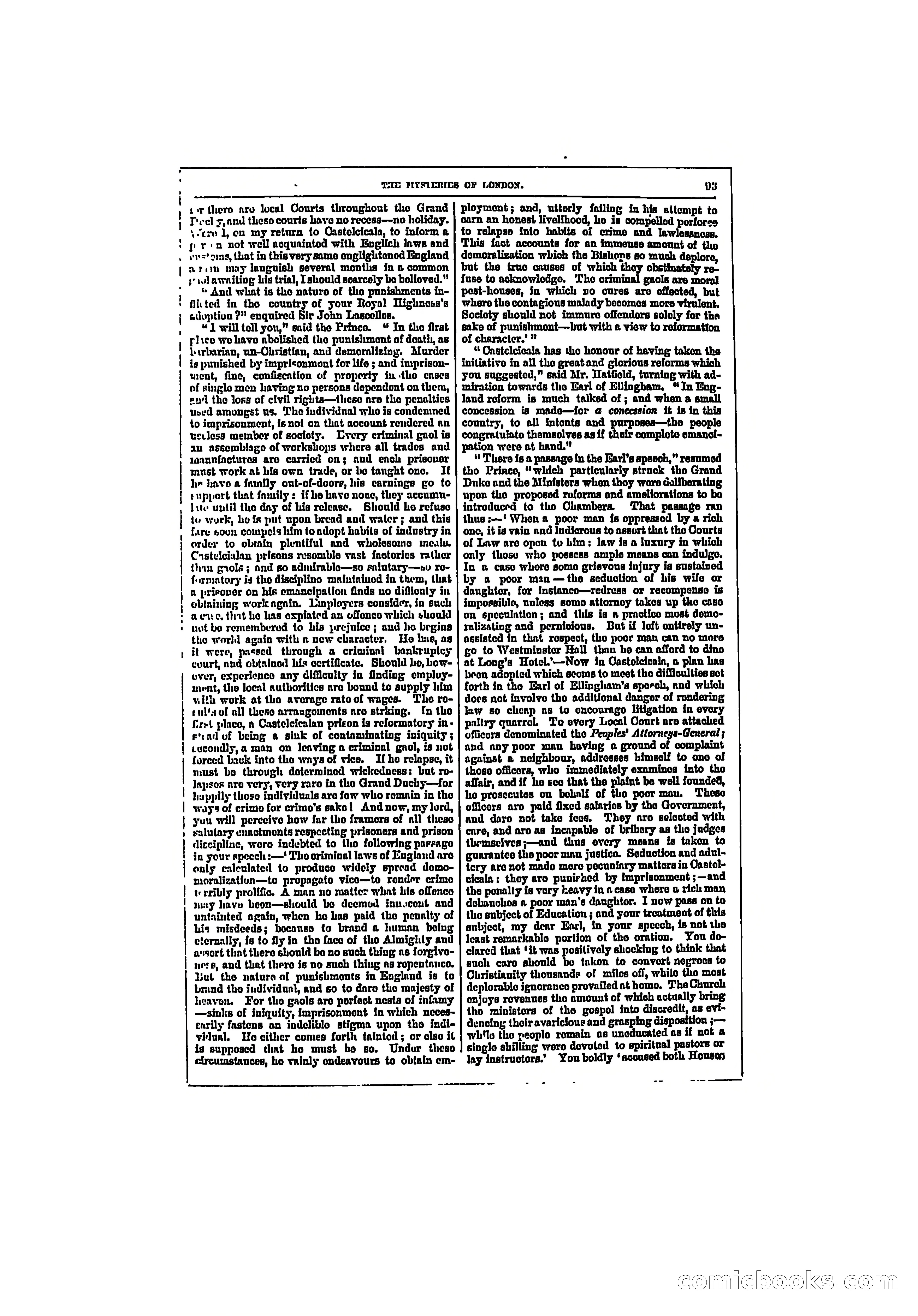
A restored page from Penny Dreadfuls, 1846. Page through the whole issue in the reader above.
📄 Transcribed text from this page (OCR, searchable)
Machine-transcribed from the original scan — historical spelling and the odd misread are preserved.
= = mw oe eee ee ee ee ew eer ewe en oan = LS SE LS SS TT mammtrase CUTE ee ee eee ee ee eee eee - TIE MYSILNIES OF LONDON. O38 ior there nre local Oourts throughout the Grand I'vel +, and theso courts have no recess—no holiday. .crn 1, on my return to Castelcicala, to inform a yp r-n not well acquainted with Englich laws and vr='ommsg, that in this verysamo englightened England a 2.1m may languish several months in a common swlavwniting his trial, [should scarcely be believed.” * And what is the nature of tho punishments in- fluted in tho country of your Royal Tighness’s aduption ?” enquired Sir John Lascelles. “J will tell you,” said the Princo. ‘ In tho first rhico wo havo abolished tho punislimont of death, as birbarian, un-Christian, and demoralizing. Murder is punished by imprisonment for life ; and imprison- tcnt, fine, confiscation of property in -the cases of singlo men having no persons dependent on them, en the loss of civil rights—theso are the penaltics used amongst us. The individual who is condemned to imprisonment, is not on that aocount rendered an rscless member of society. Livery criminal gaol is an assemblage of workshops where all trades ond wannfactures are carricd on; and ench prisoner must work at his own trade, or bo taught onc. If he have a family out-of-doors, his carnings go to tupport that family: if ho have none, they accumu- lite until the day of his release. Should ho refuso to work, he is put upon bread and water ; and this fare 600n compels him to adopt habits of industry in order to obtain plentiful and wholesome incals. Cxstelcialan prisons resomblo vast factories rather thin griols ; and so admirable—so ralutary—ovu ro- furmatory is tho disciplino maintained in them, that n prironer on his emancipation finds no diflicnty in obtaining work again. Limployers consider, in such aecie, that be has expiated an offonce which should not bo remembered to his prejuice ; and ho begins tho world again with 2 new character. He has, as it were, passed through a criminal bankruptcy cvurt, and obtained his certificate. Should ho, how- uver, experience any difficulty in finding employ- ment, the local authoritics aro bound to supply him with work at tho average ratoof wages. Tho ro- rul'sof all theso arraugements nro strking. In tho frst placo, a Castelcicalan pricon is reformatory in - ecallof being a sink of contaminating iniquity ; tucondly, A man on leaving a criminal gaol, is not forced back into the ways of vice. If ho relapse, it must bo through determined wickedness: but ro- lapses aro very, very raro in the Grand Duchy—for happily those individuals aro fow who romnin in the ways of crime for crimo's sako! And now, my lord, you will perccive how far tho framers of nll theso salutary enactments respecting prisoners and prison discipline, wero indebted to the following parrago in your speech :—*' Tho criminal laws of England aro only calculated to produce widely spread demo- moralizatiun—to propagate vice—to render crimo terribly prolific. A man no matic: what his offenco mny have beon—should be deemod innaceut and untainted again, when he has paid tho penalty of his misdeeds; becauso to brand a human being cternally, fs to fly in tho fnco of tho Almighty and assort that there should be no such thing ns forgive- ness, and that there is no such thing as ropentance. Lut tho natura of punishments in England is to brand tho individual, and so to dare tho majesty of heaven. For tho gaols are porfect nests of infamy —sinks of iniquity, imprisonment in which neces- enrily fastens on indecliblo stigma upon tho indi- vidunl. Ho cither comes forth tainted ; or clso it is supposed that ho must bo so. Under thicso circumstances, ho yainly ondeayours to obtain em- ployment; and, uttorly foiling in his attempt to earn an honest livelihood, he is compelled perfores to relapso into habits of crime and lawlessnoss. This fact accounts for an immense amount of tho demoralization which the Bishons so much deplore but the fruo causes of which thoy obstinately re- fuse to acknowledgo. Tho criminal gaols are moral pest-houses, in which no cures aro effected, but where the contagious malady becomes more virulent. Socioty should not immuro offendors solely for tha sake of punishment—but with a viow to reformation of character.’ ” “ Castcleicala has tho honour of having takon the initiative in all the grentand glorious reforms which you suggested," said Mr. Iatficld, turning with ad- miration towards tho Earl of Ellingham. “In Eng- land roform is much talked of ; and when a small concession is mado—for a@ concession it is in this country, to nll intonts and purposes—the people congratulato themselves as if thoir complete emanci- pation were at hand." “ Thero is a passnge in the Earl's speech," resumed tho Prince, “which particularly struck the Grand Duke and the Ministors when thoy wore doliberating upon tho proposed reforms and ameliorations to bo introduced to tho Ohambers. That passage ran thus :—‘ When a poor man is oppressed by a rich one, it is vain and ludicrous to assort that the Courts of Law aro opon to him: law is a luxury in which only those who posscss ample means can indulgo. In a caso where somo grievous injury is sustained by a poor man—the seduction of his wife or daughtor, for instanco—redress or recompense is imporsible, unless some attorney takes up tho caso on speculation; and this is s practico most demo- ralizating and pernicious. But if loft ontirely un- assisted in that rospect, tho poor man can no moro go to Westminstor Hall than ho can afford to dino at Long’s Hotcel.'—Now in Castelcicala, o plan has beon adopted which secms to meet tho difficulties sot forth in tho Earl of Ellingham's speech, and which does not involve tho additional dangor of rondering law so cheap as to oncourngo litigation in every paltry quarrel. To overy Local Court aro attached officers denominated tho Peoples’ Attorneys-General ; and any poor man having a ground of complaint against a neighbour, addresses himself to ono of thoso officers, who immediately oxamincs into tho affair, and if ho sco that the plaint be well founded, ho prosccutes on behalf of tho poor man. These officers aro paid fixed salarics by the Government, and daro not take feos. Thoy aro selected with care, and aro ns incapable of bribery as tho judges themselves ;—and thus every means is taken to gunrantco the poor man justice. Seduction and adul- tery aro not mado mero pecuniary mattors in Castel- cicala: thoy aro punirned by imprisonment ;—and the ponalty is vory J:eavy in a.case whoro a rich man dcbauches a poor man's daughter. I now pass on to tho subject of Education ; and your treatment of this subject, my denr Earl, in your specch, is not the least remarkablo portion of the oration. You de- clared that ‘it was positively shocking to think that such caro should bo taken to convert negroes to Christianity thousnnds of miles off, whilo the most deplorablo ignoranco provailed at homo. The Church enjoys rovonues tho amount of which actually bring tho ministors of the gospel into discredit, as evi- dencing thoir avaricious and grasping disposition ;— wh'lo the peoplo romain as uneducated as if not a singlo shilling wero devoted to spiritual pastors or lay instructors.’ You boldly ‘accused both Housoy _-— — oe = Qo eee Oe eee ee (C(O) DOO (C(O)