
Penny Dreadfuls, 1846 · page 107 of 399
The Mysteries of London, Vol. IV — page 107: what you’re looking at
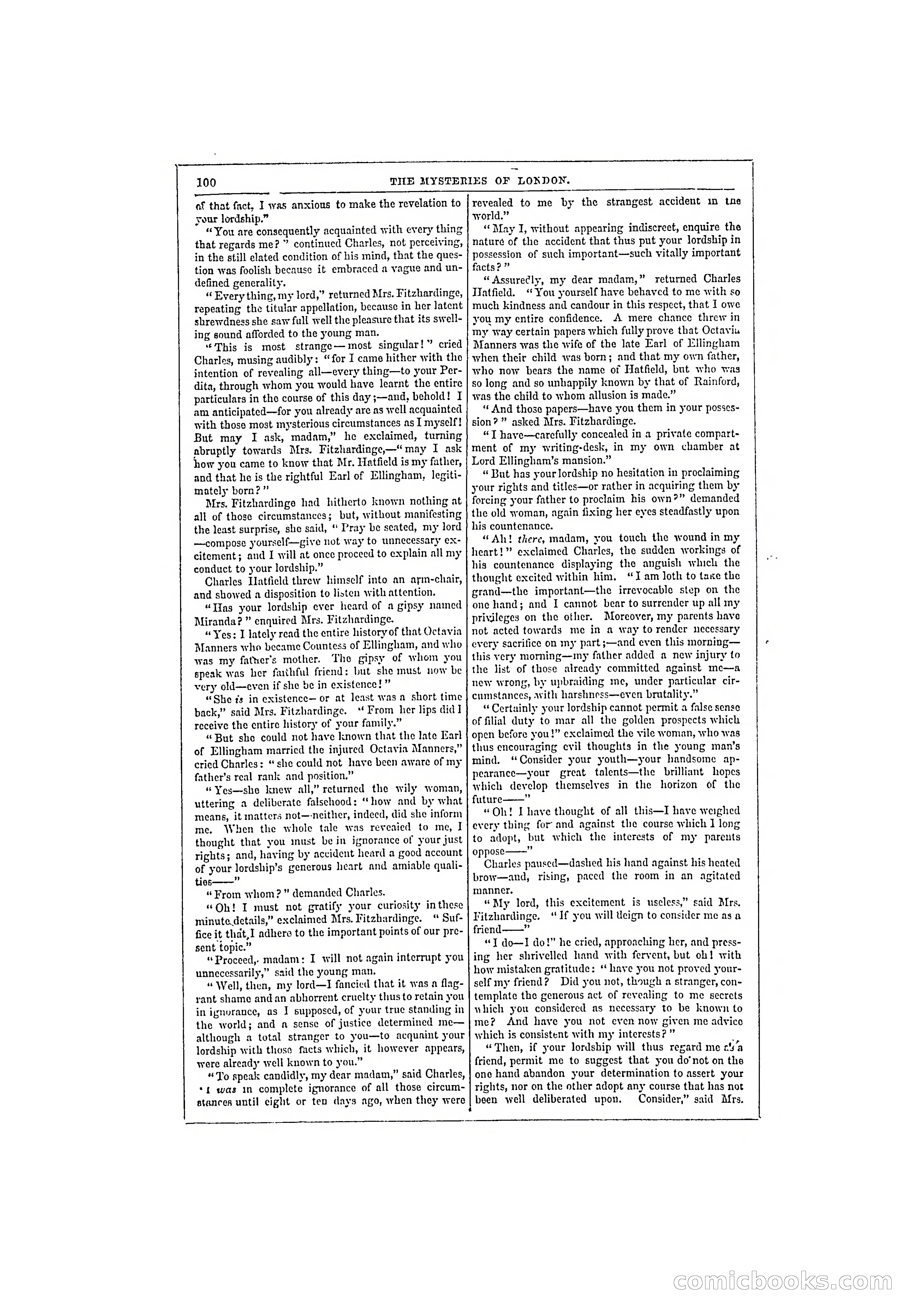
A restored page from Penny Dreadfuls, 1846. Page through the whole issue in the reader above.
📄 Transcribed text from this page (OCR, searchable)
Machine-transcribed from the original scan — historical spelling and the odd misread are preserved.
ee a a 100 TIE MYSTERIES OF LONDON. af that fact, I was anxious to make the revelation to your lordship.” “You are consequently acquainted with every thing that regards me? ” continued Charles, not perceiving, in the still elated condition of his mind, that the ques- tion was foolish because it embraced a vague and un- defined generality. “ Every thing, my lord,” returned Mrs. Fitzhardinge, repeating the titular appellation, because in her latent shrewdness she saw full well the pleasure that its swell- ing sound afforded to the young man. “This ig most strange— most singwar!” cried Charles, musing audibly: “for I came hither with the intention of revealing all—every thing—to your Per- dita, through whom you would have learnt the entire particulars in the course of this day ;—and, behold! I am anticipated—for you already are as well acquainted with those most mysterious circumstances as I myself! But may I ask, madam,” he exclaimed, turning abruptly towards Mrs. Fitzhardinge,—“ may I ask how you came to know that Mr. Hatfield is my father, and that he is the rightful Earl of Ellingham, legiti- mately born?” Mrs. Fitzhardinge had hitherto known nothing at all of those circumstances; but, without manifesting the least surprise, she said, “ Pray be seated, my lord —compose yourself—give not way to unnecessary ex- citement; and I will at once proceed to explain all my conduct to your lordship.” Charles Ilatficld threw himself into an aym-chair, and showed a disposition to listen with attention. “Was your lordship ever heard of a gipsy named Miranda? ” enquired Mrs. Fitzhardinge. “Yes: I lately read the entire history of that Octavia Manners who became Countess of Ellingham, and who was my father's mother. The gipsy of whom you speak was her fanthful friend: but she must now be very old—even if she be in existence!” “She ts in existence— or at least was a short time back,” said Mrs. Fitzhardinge. ‘* From her lips did] receive the entire history of your family.” “But she could not have known that the late Earl of Ellingham marricd the injured Octavia Manners,” cried Charles: “she could not have been aware of my father’s real rank and position.” “ Yes—she knew all,” returned the wily woman, uttering a deliberate falschood: “how and by what means, it matters not—-neither, indeed, did she inform me. When the whole tale was reveaied to me, J thought that you must be in ignorance of your just rights; and, having by accident heard a good account of your lordship’s generous heart and amiable quali- ties——” “From whom?” demanded Charles. “Oh! I must not gratify your curiosity in these minute.details,” exclaimed Mrs. Fitzhardinge. “ Suf- fice it thdt,I adhere to the important points of our pre- sent topic.” “Proceed, madam: I will not again interrupt you unnecessarily,” said the young man. “ Well, then, my lord—I fancied that it was a flag- rant shame andan abhorrent cruelty thus to retain you in ignorance, as J supposed, of your true standing in the world; and a sense of justice determined me— although a total stranger to you—to acquaint your lordship with those facts which, it however appears, were already well known to you.” “To speak candidly, my dear madam,” said Charles, *¢ was in complete ignorance of all those circum- atancern until eight or ten days ago, when they were é — revealed to me by the strangest accident in tne world.” “May I, without appearing indiscreet, enquire the nature of the accident that thus put your lordship in possession of such important—such vitally important facts?” “ Assurecly, my dear madam,” returned Charles Tfatfield. ‘* You yourself have behaved to me with so much kindness and candour in this respect, that I owe you my entire confidence. A mere chance threw in my way certain papers which fully prove that Octaviu Manners was the wife of the late Earl of l:llingham when their child was born; and that my own father, who now bears the name of Hatfield, but who was so long and so unhappily known by that of Rainford, was the child to whom allusion is made.” “ And those papers—have you them in your posses- sion? ” asked Mrs. Fitzhardinge. “T have—carefully concealed in a private compart- ment of my writing-desk, in my own chamber at Lord Ellingham’s mansion.” “ But has yourlJordship no hesitation in proclaiming your rights and titles—or rather in acquiring them by forcing your father to proclaim his own?” demanded the old woman, again fixing her eyes steadfastly upon his countenance. “Ah! there, madam, you touch the wound in my heart!’ exclaimed Charles, the sudden workings of his countenance displaying the anguish which the thought excited within him, “Jam loth to taxe the grand—the important—the irrevocable step on the one hand; and I cannot bear to surrender up all my privileges on the other. Moreover, my parents have not acted towards me in a way to render necessary every sacrifice on my part;—and even this morning— r this very morning—imy father added a new injury to the list of those already committed against me—a new wrong, by upbraiding me, under particular cir- cumstances, with harshness—even brutality.” “Certainly your lordship cannot permit a false sense of filial duty to mar all the golden prospects which open before you!” exclaimed the vile woman, who was thus encouraging evil thoughts in the young man’s mind. ‘Consider your youth—your handsome ap- pearance—your great talents—the brilliant hopes which develop themselves in the horizon of the future-——” “Oh! Ihave thought of all this—I have weighed every thing for and against the course which 1 long to adopt, but which the interests of my parents oppose ” Charles paused—dashed his hand against his heated brow—and, rising, paced the room in an agitated manner. “My lord, this excitement is uscless,” said Mrs. Yitzhardinge. “If you will Ueign to consider me as a friend——” “JT do—I do!” he cried, approaching her, and press- ing her shrivelled hand with fervent, but oh! with how mistaken gratitude: “have you not proved your- self my friend? Did you not, though a stranger, con- template the generous act of revealing to me secrets which you considered as necessary to be known to me? And have you not even now given me advice which is consistent with my interests? ” “Then, if your lordship will thus regard me ety’a friend, permit me to suggest that you do’not on the one hand abandon your determination to assert your rights, nor on the other adopt any course that has not been well deliberated upon. Consider,” said Mfrs. EConnicloooks (SO)