
Penny Dreadfuls, 1846 · page 113 of 399
The Mysteries of London, Vol. IV — page 113: what you’re looking at
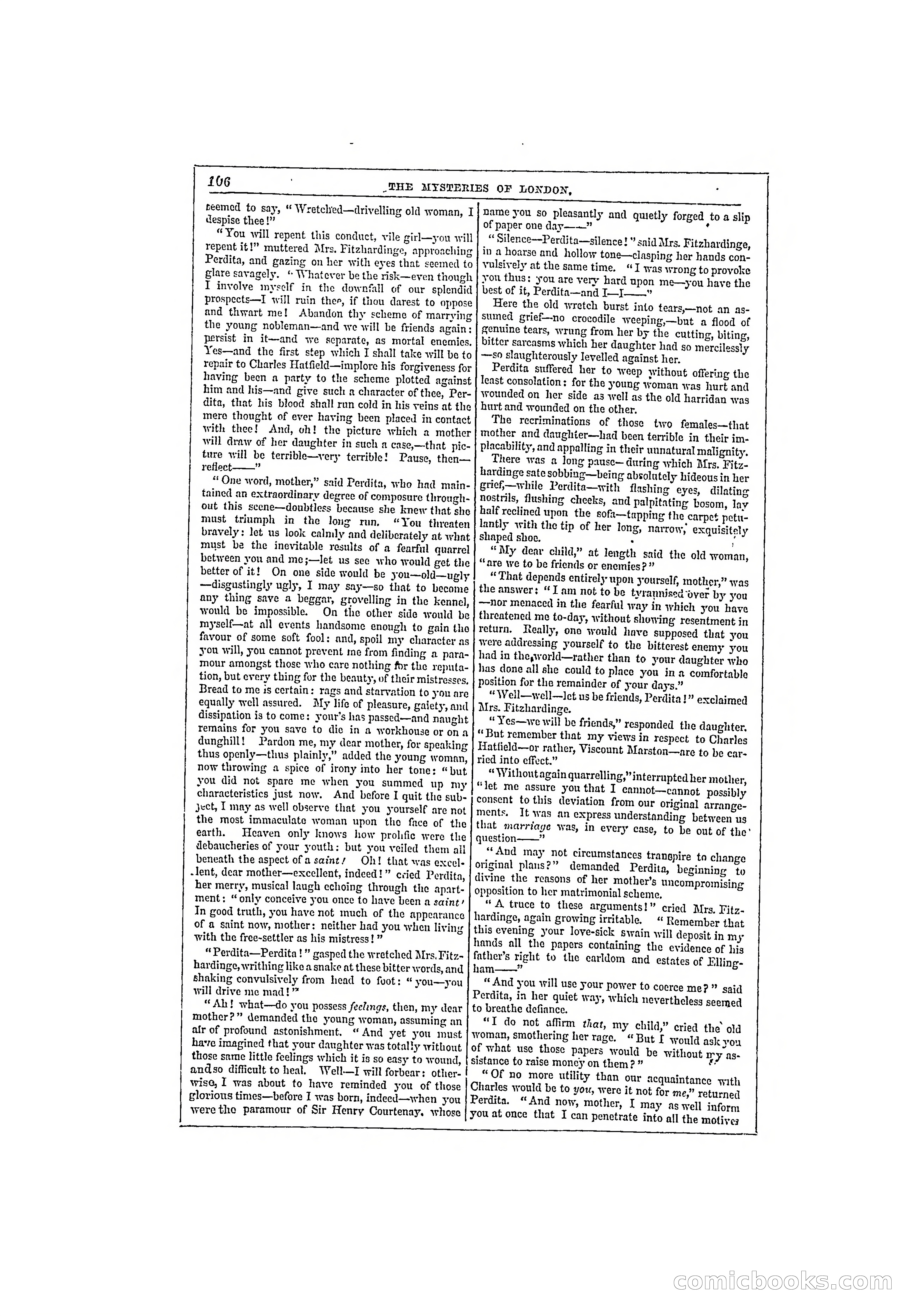
A restored page from Penny Dreadfuls, 1846. Page through the whole issue in the reader above.
📄 Transcribed text from this page (OCR, searchable)
Machine-transcribed from the original scan — historical spelling and the odd misread are preserved.
rr a ee ee ee 106 beemed to say, * Wretched—drivelling old woman, I despise thee !?” “You will repent this conduct, vile girl—you will repent it!” muttered Mrs. Fitzhardinge, approaching Perdita, and gazing on her with eyes that seemed to glare savagely. “ Whatever be the risk—even though I involve myself in the downfall of our splendid prospects—I will ruin thee, if thou darest to oppose and thwart me! Abandon thy scheme of marrying the young nobleman—and we will be friends again : persist in it~and we separate, as mortal enemies. Yes—and the first step which I shall take will be to repair to Charles Hatfield—implore his forgiveness for having been a party to the scheme plotted against, him and his—and give such a character of thee, Per- dita, that his blood shall run cold in his veins at the mere thought of ever having been placed in contact With thee! And, oh! the picture which a mother will draw of her daughter in such a case,—that pic- ture will be terrible—very terrible! Pause, then— reflect--——” “One word, mother,” said Perdita, who had main- tained an extraordinary degree of composure through- out this scene—doubtless because she knew that she must triumph in the long run. “You threaten bravely: let us look calnily and deliberately at what must be the inevitable results of a fearful quarrel between you and me;—let us see who would get the better of it! On one side would be you—old—ugly —disgustingly ugly, I may say—so that to become any thing save a beggar, grovelling in the kennel, would be impossible. On the other side would be myself—at all events handsome enough to gain tho favour of some soft fool: and, spoil my character as you will, you cannot prevent me from finding a para- mour amongst those who care nothing for the reputa- tion, but every thing for the beauty, of their mistresses, Bread to me 1s certain: rags and starvation to you are equally well assured. My life of pleasure, gaiety, and dissipation is to come: yonr’s has passed—and naught remains for you save to dic in a workhouse or ona dunghill! Pardon me, my dear mother, for speaking thus openly—thus plainly,” added the young woman, now throwing a spice of irony into her tone: “but you did not spare me when you summed up my characteristics Just now. And before I quit the sub- ject, I may as well observe that you yourself are not the most immaculate woman upon the face of the earth. Heaven only knows how prolific were the debaucheries of your youth: but you veiled them ali beneath the aspect ofa saints Oh! that was excel- lent, dear mother—excellent, indeed!” cried Perdita, her merry, musical laugh echoing through the apart- ment: “only conceive you once to have been a saint? In good truth, you have not much of the appearance of a saint now, mother: neither had you when living with the free-settler as his mistress! ” “ Perdita—Perdita! ” gasped the wretched Mrs. Fitz- hardinge, writhing like a snake at these bitter words, and shaking convulsively from head to fuot: « you—you will drive me mad!” “Ah! what—do you possess feelings, then, my dear mother?” demanded the young woman, assuming an alr of profound astonishment. “And yet you must have imagined that your daughter was total ty without those same little feelings which it is so easy to wound, andso difficult to heal. wise, I was about to have reminded you of those glorious times—before I was born, indeed—when you Well-—I will forbear: other. | THE MYSTERIES OF LONDON, name you so pleasantly and quietly forged toa slip of paper one day——” , “ Silence--Perdita—silence! ” said Mrs. F itzhardinge, in a hoarse and hollow tone—clasping her hands con- vulsively at the same time. “I was Wrong to provoke you thus: ‘you are very hard upon me—you have the best of it, Perdita—and I—J——_.” Here the old wretch burst into tears,—not an as- sumed grief—-no crocodile weeping,—bnt a flood of genuine tears, wrung from her by the cutting, biting, bitter sarcasms which her daughter had so mercilessly —so slaughterously levelled against her. Perdita suffered her to weep without offering the least consolation: for the young woman was hurt and wounded on her side as well as the old harridan was hurt and wounded on the other. The recriminations of those two females—that mother and daughter—had been terrible in their im- placability, and appalling in their unnatural malignity. There was a long pause— during which Mrs, Fitz- hardinge sate sobbing—being absolutely hideous in her grief,—while Perdita—with flashing eyes, dilating nostrils, flushing cheeks, and palpitating bosom, lay half reclined upon the sofa—tapping the carpet petu- lantly with the tip of ker long, narrow, exquisitely shaped shoe. . ; “My dear child,” at length said the old woman, “are we to be friends er enemies?” “That depends entirely upon yourself, mother,” was the answer: “Iam not to be tyrannised-over by you ~—nor menaced in the fearful way in which you have threatened me to-day, without showing resentment in return. Really, one would have supposed that you were addressing yourself to the bitterest enemy you had in thesvorld—rather than to your daughter who has done all she could to place you ina comfortable position for the remainder of your days.” “Weill—well—let us be friends, Perdita!” exclaimed Mrs. Fitzhardinge. “Yes—we will be friends,” responded the daughter, ‘But remember that my views in respect to Charles Hattield—or rather, Viscount Marston—are to be ear- ried into effect.” “Withoutagain quarrelling,” interrupted her mother, “Jet me assure you that I cannot—cannot possibly consent to this deviation from our original arrange- ments. It was an express understanding between us that marriage was, in every case, to be out of the question” “*And may not circumstances frangpire ta change original plans?” demanded Perdita, beginning to divine the reasons of her mother’s uncompromising opposition to her matrimonial scheme, “A truce to these arguments!” cried Mrs, Titz- hardinge, again growing irritable, « Remember that this evening your love-sick sywain will deposit in my hands all the papers containing the evidence of his father’s right to the carldom and estates of Elling- ham——” “And you will use your power to coerce me?” said Perdita, in her quiet way, which nevertheless seemed to breathe defiance. “I do not affirm that, my child,” cried the old woman, smothering her rage. “But I would ask you of what use those papers would be Without my as- sistance to raise money on them?” = “Of no more utility than our aequaintance with Charles would be to you, were it not for me,” returned Perdita. “And now, mother, I may aswell inform were the paramour of Sir Henry Courtenay, whose you af once that I can penetrate into all the motives y a COA GIOOKS (SO)