
Penny Dreadfuls, 1846 · page 117 of 399
The Mysteries of London, Vol. IV — page 117: what you’re looking at
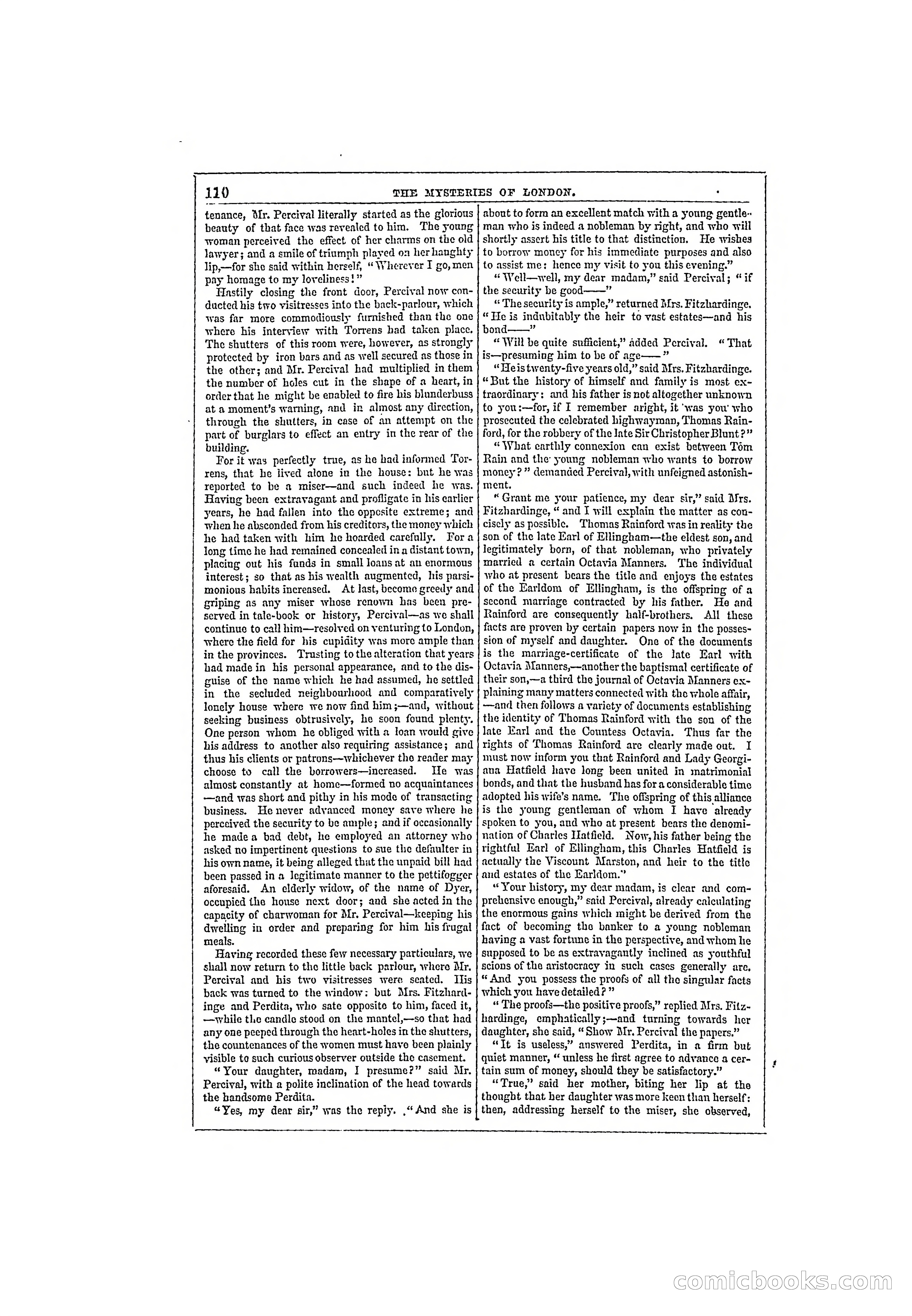
A restored page from Penny Dreadfuls, 1846. Page through the whole issue in the reader above.
📄 Transcribed text from this page (OCR, searchable)
Machine-transcribed from the original scan — historical spelling and the odd misread are preserved.
1190 THE WYSTERIBS OF LONDON, : tenance, S{r. Percival literally started as the glorious beauty of that face was revealed to him. The young woman perceived the effect of her charms on the old lawyer; and a smile of triumph played on her haughty lip,—for she said within herself, “ Wherever I go, men pay homage to my loveliness!” Hastily closing the front door, Percival now con- ducted his two visitresses into the back-parlour, which was far more commodiously furnished than the one where his interview with Torrens had taken place. The shutters of this room were, however, as strongly protected by iron bars and as well secured as those in the other; and Mr. Percival had multiplied in them the number of holes cut in the shape of a heart, in order that he might be enabled to fire his blunderbuss at a moment’s warning, and in almost any direction, through the shutters, in case of an attempt on the part of burglars to effect an entry in the rear of the building. For it was perfectly true, as he had informed Tor- rens, that he lived alone in the house: bnt he was reported to be a miser—and such indeed he was. Having been extravagant and profligate in his earlier years, he had fallen into the oppcsite extreme; and when he absconded from his creditors, the money which he had taken with him he hoarded carefully. Fora long time he had remained concealed ina distant town, placing out his funds in small loans at an enormous interest; so that as his wealth augmented, his parsi- monious habits increased. At last, become greedy and griping as any miser whose renown has been pre- served in tale-book or history, Percival~—as we shall continue to call him—resolved on venturing to London, where the field for his cupidity was more ample than in the provinces. Trusting to the alteration that years had made in his personal appearance, and to the dis- guise of the name which he had assumed, he settled in the secluded neighbourhood and comparatively lonely house where we now find him ;—and, without seeking business obtrusively, he soon found plenty. One person whom he obliged with a loan would give his address to another also requiring assistance; and thus his clients or patrons—whichever the reader may choose to call the borrowers—inereased. He was almost constantly at home—formed no acquaintances —and was short and pithy in his mode of transacting business. He never advanced money save where he perceived the security to be ample; and if occasionally he madea bad debt, he employed an attorney who asked no impertinent questions to sue the defaulter in his own name, it being alleged that the unpaid bill had been passed in a legitimate manner to the pettifogger aforesaid. An elderly widow, of the name of Dyer, occupied the house next door; and she acted in the capacity of charwoman for Mr. Percival—keeping his dwelling in order and preparing for him his frugal meals. Having recorded these few necessary particulars, we shall now return to the little back parlour, where Mr. Percival and his two visitresses were seated. Ilis back was turned to the window: but Mrs. Fitzhard- inge and Perdita, who sate opposite to him, faced it, —while the candle stood on the mantel,—so that had any one peeped through the heart-holes in the shutters, the countenances of the women must havo been plainly visible te such curious observer outside the casement. “Your daughter, madam, I presume?” said Mr. Percival, with a polite inclination of the head towards the handsome Perdita. “Yes, my dear sir,” was the reply. ,“‘And she is ee about to form an excellent match with a young gentle- man who is indeed a nobleman by right, and who will shortly assert his title to that distinction. He wishes to borrow moncy for his immediate purposes and also to assist me: hence my visit to you this evening.” * Well—well, my dear madam,” said Percival; “if the security be good——-” “ The security is ample,” returned Mfrs. Fitzhardinge, ‘We is indubitably the heir to vast estates—and his bond——” “Will be quite sufficient,” added Percival. “That is—presuming him to be of age——” “Weis twenty-five years old,” said Mrs. Fitzhardinge. * But the history of himself and family is most ex- fraordinary: and his father is not altogether unknown to you:—for, if I remember aright, it ‘was you' who prosecuted the celebrated highwayman, Thomas Rain- ford, for the robbery of the late Sir Christopher Blunt?” “What earthly connexion can exist between Tom Rain and the young nobleman who wants to borrow money?” demanded Percival, with unfeigned astonish- ment. “Grant me your patience, my dear sir,” said Mrs. Fitzhardinge, “ and I will explain the matter as con- cisely as possible. Thomas Rainford was in reality the son of the late Earl of Elingham—the eldest, son, and Jegitimately born, of that nobleman, who privately married a certain Octavia Manners. The individual who at present bears the title and enjoys the estates of the Earldom of Ellingham, is the offspring of a second marriage contracted by his father. He and Rainford are consequently half-brothers. All these facts are proven by certain papers now in the posses- sion of myself and daughter. One of the documents is the marriage-certificate of the late Earl with Octavia Manners,—another the baptismal certificate of their son,—a third the journal of Octavia Manners ex~ planing many matters connected with the whole affair, —and then follows a variety of documents establishing the identity of Thomas Rainford with the son of the late Karl and the Countess Octavia. Thus far the rights of Thomas Rainford are clearly made out. I must now inform you that Rainford and Lady Georgi- ana Hatfield have long been united in matrimonial bonds, and that the husband has for a considerable time adopted his wife’s name. The offspring of this alliance is the young gentleman of whom I have already spoken to you, and who at present bears the denomi- nation of Charles Ilatfield. Now, his father being the rightful Earl of Ellingham, this Charles Hatfield is actually the Viscount Marston, and heir to the title aud estates of the Earldom.” “Your history, my dear madam, is clear and com- prehensive enough,” said Percival, already calculating the enormous gains which might be derived from the fact of becoming the banker to a young nobleman having a vast fortune in the perspective, and whom he supposed to be as extravagantly inclined as youthful scions of the aristocracy In such cases generally are, “And you possess the proofs of all the singular facts which you have detailed? ” “ The proofs—the positive proofs,” replied Mrs. Fitz- hardinge, emphatically;~—and turning towards her daughter, she said, “Show Mr. Percival the papers.” “Tt is useless,” answered Perdita, in a firm but quiet manner, “ unless he first agree to advance a cer- tain sum of money, should they be satisfactory.” “True,” said her mother, biting her lip at the thought that her daughter was more keen than herself: then, addressing herself fo the miser, she observed, ae GIOOKS 5} (CO) (CO) >