
Penny Dreadfuls, 1846 · page 119 of 399
The Mysteries of London, Vol. IV — page 119: what you’re looking at
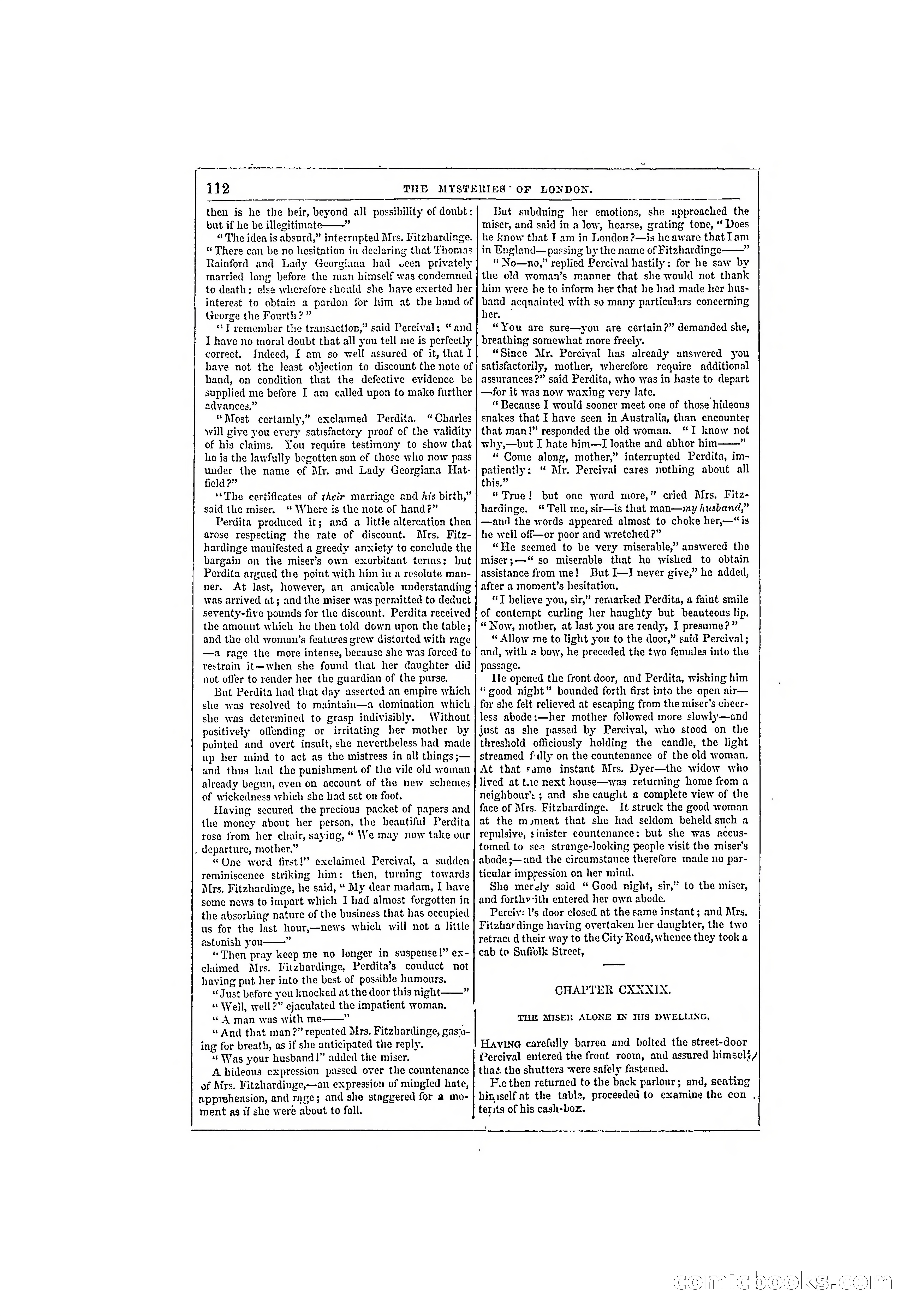
A restored page from Penny Dreadfuls, 1846. Page through the whole issue in the reader above.
📄 Transcribed text from this page (OCR, searchable)
Machine-transcribed from the original scan — historical spelling and the odd misread are preserved.
112 then is he the heir, beyond all possibility of doubt: but if he be illegitimate——” “The idea is absurd,” interrupted Mrs. Fitzhardinge. “There can be no hesitation in declaring that Thomas Rainford and Lady Georgiana had veen privately married long before the man himself was condemned to death; els¢ wherefore should she have exerted her interest to obtain a pardon for him at the hand of George the Fourth?” ‘J remember the transaction,” said Percival; “and I have no moral doubt that all you tell me is perfectly correct. Indeed, I am so well assured of it, that I have not the least objection to discount the note of hand, on condition that the defective evidence be supplied me before I am called upon to make further advances.” “Most certamly,” exclaimed Perdita. “Charles will give you every satisfactory proof of the validity of his claims. You require testimony to show that he is the lawfully begotten son of those who now pass under the name of Mr. and Lady Georgiana Hat- field ?” **The certiflcates of their marriage and his birth,” said the miser. ‘ Where is the note of hand?” Perdita produced it; and a little altercation then arose respecting the rate of discount. Mrs. Fitz- hardinge manifested a greedy anxiety to conclude the bargain on the miser’s own exorbitant terms: but Perdita argued the point with him in a resolute man- ner. At last, however, an amicable understanding was arrived at; andthe miser was permitted to deduct seventy-five pounds for the discount. Perdita received the amount which he then told down upon the table; and the old woman’s features grew distorted with rage —a rage the more intense, because she was forced to restrain it—when she found that her daughter did not offer to render her the guardian of the purse. But Perdita had that day asserted an empire which she was resolyed to maintain—a domination which she was determined to grasp indivisibly. Without positively offending or irritating her mother by pointed and overt insult, she nevertheless had made up her mind to act as the mistress in all things ;— and thus had the punishment of the vile old woman already begun, even on account of the new schemes of wickedness which she had set on foot. Ilaving secured the precious packet of papers and the moncy about her person, the beautiful Perdita rose from her chair, saying, “ We may now take our . departure, mother.” “One word first!’ exclaimed Percival, a sudden reminiscence striking him: then, turning towards Mrs. Fitzhardinge, he said, “ My dear madam, I have some news to impart which I had almost forgotten in the absorbing nature of the business that has occupied us for the last hour,—news which will not a little astonish you-—” “Then pray keep me no longer in suspense!” ex- claimed Mrs. Titzhardinge, Perdita’s conduct not having put her into the best of possible humours. “Just before you knocked at the door this night “ Well, well?” ejaculated the impatient woman. “A man was with me “ And that man?” repeated Mrs. Fitzhardinge, gas‘o- ing for breath, as if she anticipated the reply. “Was your husband!” added the miser. A hideous expression passed over the countenance of Mrs. Fitzhardinge,—an expression of mingled hate, appivhension, and rage; and she staggered for a mo- ment as if she were about to fall. +P) THE MYSTENIES’ OF LONDON. But subduing her emotions, she approached the miser, and said in a low, hoarse, grating tone, ‘‘ Does he know that I am in London ?—is he aware that Iam in England—passing by the name of Fitzhardinge——” “ No—no,” replicd Percival hastily: for he saw by the old woman’s manner that she would not thank him were he to inform her that he had made her hus- band acquainted with so many particulars concerning her. — “You are sure—you are certain?” demanded she, breathing somewhat more freely. “Since Mr. Percival has already answered you satisfactorily, mother, wherefore require additional assurances?” said Perdita, who was in haste to depart —for if was now waxing very late. ‘‘ Because I would sooner meet one of those hideous snakes that I have seen in Australia, than encounter that man!” responded the old woman. “I know not why,—but I hate him—I loathe and abhor him——” * Come along, mother,” interrupted Perdita, im- patiently: ‘“ Mr. Percival cares nothing about all this.” “True! but one word more,” cried Mrs. Fitz- hardinge. “Tell me, sir—is that man—my husband,” —and the words appeared almost to choke her,—“is he well off—or poor and wretched ?” ‘“‘FIe seemed to be very miserable,” answered the miser;—‘“ so miserable that he wished to obtain assistance from me! But I—IJ never give,” he added, after a moment’s hesitation. “T believe you, sir,” remarked Perdita, a faint smile of contempt curling her haughty but beauteous lip. “ Now, mother, at last you are ready, I presume?” * Allow me to light you to the door,” said Percival ; and, with a bow, he preceded the two females into the passage. He opened the front door, and Perdita, wishing him gt PP a iP a “ood night” bounded forth first into the open atr— for she felt relieved at escaping from the miser’s cheer- less abode:—her mother followed more slowly—and just as she passed by Percival, who stood on the threshold officiously holding the candle, the light streamed fully on the countenance of the old woman. At that same instant Mrs. Dyer—the widow who lived at tac next house—was returning home from a neighbour’: ; and she caught a complete view of the face of Mrs. Fitzhardinge. It struck the good woman at the m vment that she had seldom beheld such a repulsive, sinister countenance: but she was accus- tomed to sea strange-looking people visit the miser's abode ;— and the circumstance therefore made no par- ticular impression on her mind. She merely said ‘ Good night, sir,” to the miser, and forthr-ith entered her own abode. Perciv: l’s door closed at the same instant; and Mrs. Fitzhardinge having overtaken her daughter, the two retract d their way to the City Road, whence they took a cab to Suffolk Street, CHAPTER CXAXIX. THE MISER ALONE IN HIS DWELLING. Havine carefully barrea and bolted the street-door Percival entered the front room, and assured himsel*/ that the shutters rere safely fastened. F.c then returned to the back parlour; and, seating hiniself at the table, proceeded to examine the con . terits of his cash-box. { GIOOKS (SO) (SO)