
Penny Dreadfuls, 1846 · page 148 of 399
The Mysteries of London, Vol. IV — page 148: what you’re looking at
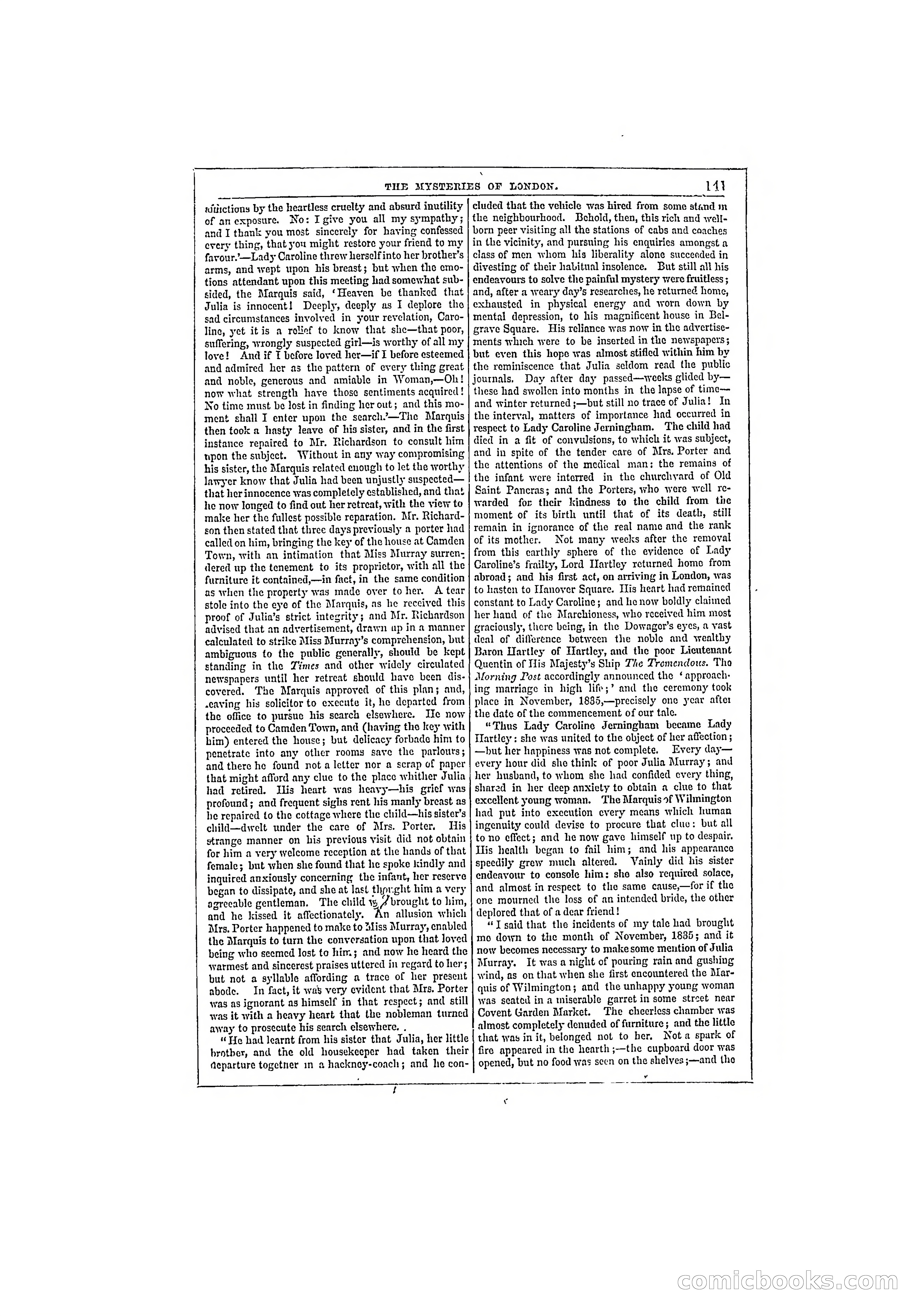
A restored page from Penny Dreadfuls, 1846. Page through the whole issue in the reader above.
📄 Transcribed text from this page (OCR, searchable)
Machine-transcribed from the original scan — historical spelling and the odd misread are preserved.
THE MYSTERIES OF LONDON. tdtiictions by the heartless cruelty and absurd inutility of an exposure. No: I give you all my sympathy ; and I thank you most sincerely for having confessed every thing, that you might restore your friend to my Julia is innocent! Deeply, deeply as I deplore the sad circumstances involved in your revelation, Caro- line, yet itis a relief to know that she—that poor, suffering, wrongly suspected girl—is worthy of all my love! And if T before loved her—if I before esteemed and admired her as the pattern of every thing great and noble, generous and amiable in Woman,—Oh! now what strength have those sentiments acquired! No time must be lost in finding her out; and this mo- ment shall I enter upon the search’—The Marquis then took a hasty leave of his sister, and in the first instance repaired to Mr. Richardson to consult him upon the subject. Without in any way compromising his sister, the Marquis related enough to let the worthy lawyer know that Julia had been unjustly suspected— that her innocence was completely established, and that he now longed to find out her retreaf, with the view to make her the fullest possible reparation. Mr. Richard- son then stated that three days previously a porter had called on him, bringing the key of the house at Camden Town, with an intimation that Miss Murray surren- dered up the tenement to its proprictor, with all the furniture it contained,—in fact, in the same condition as when the property was made over to her. A tear stole into the eye of the Marquis, as he received this proof of Julia’s strict integrity; and Mr. Richardson advised that an advertisement, drawn up in a manner calculated to strike Miss Murray’s comprehension, but ambiguous to the public generally, should be kept standing in the Zimes and other widely circulated newspapers until her retreat should have been dis- covered. The Marquis approved of this plan; and, .caving his solicitor to execute it, he departed from the office to pursue his search elsewhere. Ie now proceeded to Camden Town, and (having the key with him) entered the house; but delicacy forbade him to penetrate into any other rooms save the parlours ; and there he found not a letter nor a scrap of paper that might afford any clue to the place whither Julia had retired. Jlis heart was heavy—his grief was profound; and frequent sighs rent his manly breast as he repaired to the cottage where the child—his sister’s child—dwelt under the care of Mrs. Porter. Tis strange manner on his previous visit did not obtain for him a very welcome reception at the hands of that female; but when she found that he spoke kindly and inquired anxiously concerning the infant, her reserve began to dissipate, and she at last thpr.ght him a very agreeable gentleman. The child w /brought to him, and he kissed it affectionately. An allusion which Mrs. Porter happened to make to 2iss Murray, enabled the Marquis to turn the conversation upon that Joved being who seemed lost to him; and now he heard the warmest and sincerest praises uttered in regard to her; but not a syllable affording a trace of her present abode. In fact, it was very evident that Mrs. Porter was as ignorant as himself in that respect; and still was it with a heavy heart that the nobleman turned away to prosecute his search elsewhere. . “Te had learnt from his sister that Julia, her little brother, and the old housekeeper had taken their departure togetner in a hackney-coach; and he con- XN 143 Se eS cluded that the vehicle was hired from some stand m the neighbourhood. Bchold, then, this rich and well- born peer visiting all the stations of cabs and coaches in the vicinity, and pursuing his enquiries amongst a class of men whom his liberality alone succeeded in divesting of their habitual insolence. But still all his endeavours to solve the painful mystery were fruitless ; and, after a weary day’s researches, he returned home, exhausted in physical energy and worn down by mental depression, to his magnificent house in Bel- grave Square. His reliance was now in the advertise- ments which were to be inserted in the newspapers; but even this hope was almost stifled within him by the reminiscence that Julia seldom read the public journals. Day after day passed—weeks glided by— these had swollen into months in the lapse of time— and winter returned ;—but still no trace of Julia! In the interval, matters of importance had occurred in respect to Lady Caroline Jerningham. The child had died in a fit of convulsions, to which it was subject, and in spite of the tender care of Mrs. Porter and the attentions of the medical man; the remains of the infant were interred in the churchyard of Old Saint Pancras; and the Porters, who were well re- warded for their kindness to the child from tie moment of its birth until that of its death, still remain in ignorance of the real name and the rank of its mother. Not many weeks after the removal from this earthly sphere of the evidence of Lady Caroline’s frailty, Lord Ilartiey returned home from abroad; and his first act, on arriving in London, was to hasten to Ifanover Square. His heart had remained constant to Lady Caroline; and he now boldly claimed her hand of the Marchioness, who received him most graciously, there being, in the Dowagoer’s eyes, a vast deal of difference between the noble and wealthy Baron Lartley of Tartley, and the poor Lieutenant Quentin of Wis Majesty’s Ship The Tremendous. Tha Morning Post accordingly announced the ‘ approach- ing marriage in high life;’ and the ceremony took place in November, 1835,—precisely one ycar after the date of the commencement of our tale. “Thus Lady Caroline Jerningham became Lady Iartley : she was united to the object of her affection ; —but her happiness was not complete. Every day— every hour did she think of poor Julia Murray; and her husband, to whom she had confided every thing, shar2d in her deep anxicty to obtain a clue to that excellent young woman. The Marquis of Wilmington had put into execution every means which human ingenuity could devise to procure that clue: but all to no effect; and he now gave himself up to despair. Ilis health began to fail him; and his appearance speedily grew much altered. Vainly did his sister endenyour to console him: she also required solace, and almost in respect to the same cause,—for if the one mourned the loss of an intended bride, the other deplored that of a dear friend! “J said that the incidents of my tale had brought mo down to the month of November, 1835; and it now becomes necessary to make some mention of Julia Murray. It was a night of pouring rain and gushing wind, as on that when she first encountered the Mar- quis of Wilmington; and the unhappy young woman was seated in a miserable garret in some street near Covent Garden Market. The cheer!ess chamber was almost completely denuded of furniture; and the little that was in it, belonged not to ber. Nota spark of fire appeared in the hearth ;—the cupboard door was opened, but no food was seen on the shelves ;—and the | favour.’—Lady Caroline threw herself into her brother’s arms, and wept upon his breast; but when the emo- tions attendant upon this meeting had somewhat sub- sided, the Marquis said, ‘Heaven be thanked that Y pee A ee i ¢ (C(O) (C DOO|KS.EO