
Penny Dreadfuls, 1846 · page 15 of 399
The Mysteries of London, Vol. IV — page 15: what you’re looking at
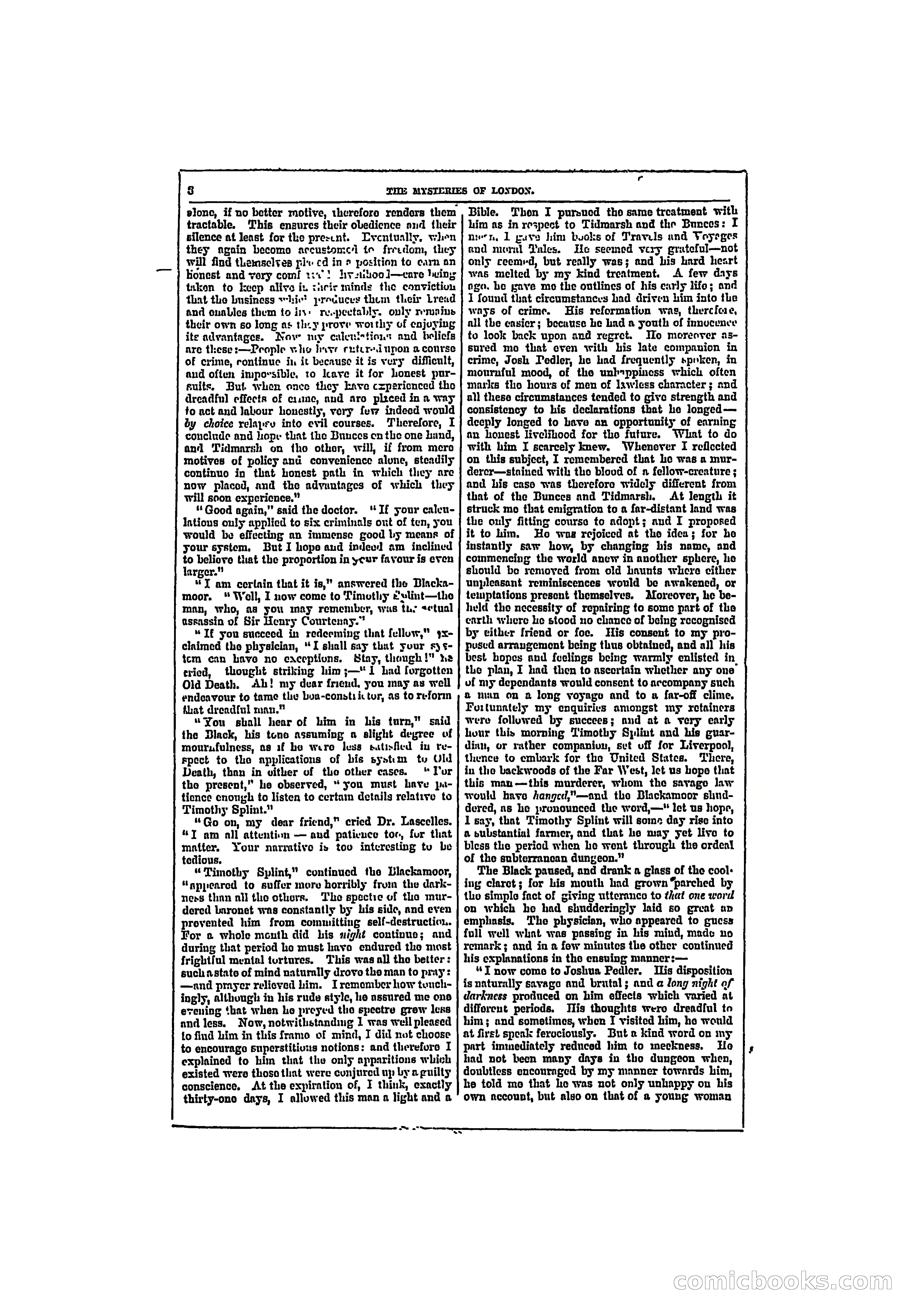
A restored page from Penny Dreadfuls, 1846. Page through the whole issue in the reader above.
📄 Transcribed text from this page (OCR, searchable)
Machine-transcribed from the original scan — historical spelling and the odd misread are preserved.
|e ce tee SR I a PR Tt mat man tel a cammasammnad ind apnea paanattcr Silat ioe tates Gatnans ca anatrenpaiaatraiale sttesibe ras: 3 TIN MYSTERIES OF LONDON. sione, if no better motive, thcreforo rendors them tractable. This ensures their obedience and their silence at least for the present. LIventually, when they gain becomo accustome te freedom, they will find themselves pi cd in > position to carn an Honest and very comf i400! vsuhooil—care eing tuken to keep alive ix incic minds the conviction that the business hie? produces them their Lread and cuables them to in: re-pectably. only remains their own so long as they prove worthy of enjoying its advantages. Now my ealeuistions and beliefs nre these :—Praple whe hive eutcred upon a conrse of crime, rontinue in it because it is very difficult, and often impovsible, to Icave it for honest pur- suits. But when onee they Eave cxpericneed the dreadfn] effects of c1ume, and aro pleeed in a way to act and labour honestly, very few indeed would by choice relapre into evil courses. Therefore, I conclude and hope that the Buuces en the one hand, and Tidmarsh on tho other, will, if from mere motives of policy and convenience alune, steadily continue in that honest path in which they are now placed, and the advantages of which they Will soon experience.” ‘Good again,” said the doctor. “If your caleu- Intious only applied to six criminals ont of ten, you would be effecting an immense good by means of your system, But I hope aud indeed am inclined to beliove that the proportion in ycur favour is even larger." “J am certain that it is," answered the Diacka- moor. “ Well, I now come to Timothy evlint—tho man, who, as you may remember, was the <ctual assassin of Sir Henry Courtenay.” “Tf you succeed in redeeming that fellow," 4x- claimed the physician, “I shall say thiut your sy ¢- tcm can havo no eaceptions. Stay, though!" he tried, thought striking him ;— 1 had forgotten Old Death. Ab! my dear friend, you may as well endeavour to tame the bon-constiic tur, as to reform fat dreadful man.” “You shall hear of him in his turn,” said the Diack, his tono assuming a slight degree of mourufulness, as if he were less satisfied tu re- rpect to the applications of bis systtm to Old Death, than in vither of tho other cases. “Tor the present,” he observed, “you must have pa- tience enongh to listen to certain details relative to Timothy Splint.” “Go on, my dear friend,” cried Dr. Lascelles. “T am all attention — and patience tor, for that matter. Your narrative is too interesting tu be tedious. “Timothy Splint,” continued the Llackamoor, “anpeared to suffer more horribly from the dark- ness thnn all the others. The spectie of the mur- dered baronet was constantly by his side, and even provented him from committing self-destruction. For a whole meuth did his aight continue; and during that period ho must havo endured the most frightful mental turtures. This was all the better: such vstato of mind naturally drove the man to pray: —and prayer relieved him. Iremember how touch- ingly, although in his rude style, he assured me one evcning ‘hat when he preyed the spectre grew less and less. Now, notwithstanding 1 was well pleased to find Lim in this framo of mind, I did not choose to encourage superstitivus notions: and therefore I explained to him that the only apparitions which existed were thoso that were cunjured up by a guilty conscience. At the expiration of, I think, exactly thirty-ono days, I allowed this man a light and a Bible. Thon I pursued tho same treatment with him as in respect to Tidmarsh and the Bunces: I nen, L gave him books of Travels and Voyeges end mural Dales. He seemed very grateful—not only ceemrd, but really was; and his hard hesrt was melted by my Kind treatment. A few days ogo. he pave me the outlines of his early life; and I found that circumstances had driven him iato the ways of crime. His reformation was, thercfcie, all the easicr; because he had a youth of innucence to look back upon and regret. Ho merenver a5- sured mo that even with his late companion in crime, Josh DPedler, he had frequently sprken, in mournful mood, of the unl ppiness which often marks tho hours of men of lawless character 3; and all these circumstances tended to give strength and consistency to his declarations that he longed— deeply longed to bave an opportunity of earning an honest livelihood for the fufure. What to do with him I scarcely knew. ‘Whenever I reficcted on this subject, I remembered that he was a mur- derer—-stained with the blood of a fellow-creature ; and his caso was therefore widely different from that of the Bunces and Tidmarsh. At length it struck mo that emigration to a far-distant land was the only fitting course to adopt; aud I propored it to him. Ho wag rejoiced at the ides; for he instantly saw how, by changing his name, and commencing the world ancw in another sphere, he should be remoyed from old haunts where cither unpleasant reminiscences would be nwakened, or temptations present themselves. Moreover, ke be- held the necessity of repniring to some part of the earth where he stood no chance of being recognised by either friend or foc. His consent to my pro- pused arrangement being thus obtained, and all his best hopes and feelings being warmly enlisted in the plan, I had then to ascertain whether any one uf my dependants would consent to accompany such & man on a long voyago and to a far-off clime. Fortunately my enquiries amongst my retainers were followed by succees; and at a very early hour this morning Timothy Splint and his guar- dian, or rather companiun, set off for Liverpool, thence to embark for the United States. There, in the backwoods of the Far West, Ict us hope that this mau—this murderer, whom the savage law would have Aanged,"—and the Blackamoor siind- dered, ns he pronounced the word,—" let us hope, I say, that Timothy Splint will some day rise into a substantial farmer, and that hoe may yet live to bless the period when he went through the ordeal of the subterrancan dungeon.” The Black paused, and drank a gings of the cool: ing claret; for his mouth had grown “parched by tho simple fact of giving utterance to that one word on which he had shudderingly laid so great an emphasis. The physician, who appeared to gucss full well what was passing in his mind, made no remarks; and in 2 few minutes the other continued his explanations in the ensuing: manner :— “T now come to Joshua Pedier. Ilis disposition is naturally savage and brutal; and @ long night of darkness profiuced on him effects which varied at different periods. Tis thoughts were dreadful to him; and sometimes, when I visited him, he would at first speak ferociously. Bute kind word on ny part immediately reduced him to mweckness. Hao had not been many days in the dungeon when, doubtless encouraged by my manner townrds him, he told mo that he was not only unhappy on his own nccount, but also on that of a young woman ger e rT ons a eg a a lg »2a (CO) GIOOKS (CO) >