
Penny Dreadfuls, 1846 · page 154 of 399
The Mysteries of London, Vol. IV — page 154: what you’re looking at
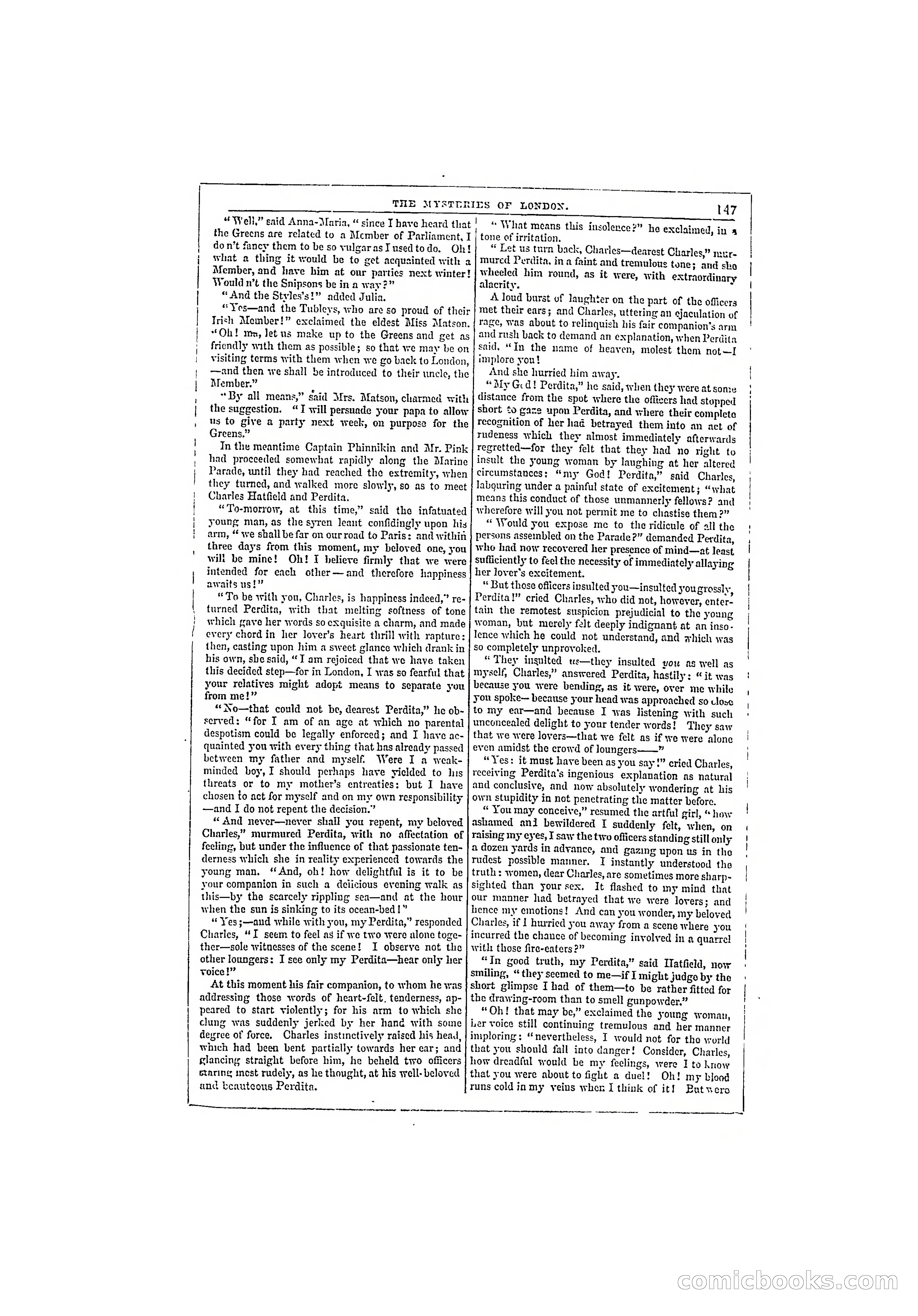
A restored page from Penny Dreadfuls, 1846. Page through the whole issue in the reader above.
📄 Transcribed text from this page (OCR, searchable)
Machine-transcribed from the original scan — historical spelling and the odd misread are preserved.
“Well,” said Anna-Maria, “since T have heard that! the Greens are related to a Member of Parliament, I don’t fancy them to be so yulgarasIusedtodo. Oh! what a thing it would be to get acquainted with 2 { Member, and have him at our parties next winter! | Would n’t the Snipsons be in a way?” | “And the Stvles’s!” added Julia. “Yes—and the Tubleys, who are so proud of their | Trish Member!” exclaimed the eldest Miss Matson. “Oh! mr, let us make up to the Greens and get as ; friendly with them as possible; so that we may be on | visiting terms with them when we go back to London, | -~and then we shall be introduced to their uncle, the | Member.” ; “By all means,” said Mrs. Matson, charmed with j the suggestion. “I will persuade your papa to allow , us to give a party next week, on purpose for the Greens.” In the meantime Captain Phinnikin and Mr. Pink had proceeded somewhat rapidly along the Blarine | Parade, until they had reached the extremity, when they turned, and walked more slowly, so as to meet | Charles Hatfield and Perdita. | “To-morrow, at this time,” said the infatuated ; young man, as the syren leant confidingly upon his ; arm, “ we shall be far on ourroad to Paris: and within three days from this moment, my beloved one, you will be mine! Oh! 1 believe firmly that we were , intended for each other—and therefore happiness | awaits us!” To be with you, Charles, is happiness indeed,” re- turned Perdita, with that melting softness of tone which gave her words socxquisite a charm, and made every chord in her lover’s heart thrill with rapture: then, casting upon him a sweet glance which drank in his own, she said, “I am rejoiced that we have taken this decided step—for in London, I was so fearful that your relatives might adopt means to separate you from me!” “«No—that could not be, dearest Perdita,” he ob- served: “for I am of an age at which no parental despotism could be legally enforced; and J have ac- quainted you with every thing that has already passed between my father and myself. Were I a weak- minded boy, I should perhaps have yielded to his threats or to my mother’s entreaties: but I have chosen to act for myself and on my own responsibility —and | do not repent the decision.” “And never—never shall you repent, mv beloved | Charles,” murmured Perdita, with no affectation of | feeling, but under the influence of that passionate ten- derness which she in reality experienced towards the young man. “And, oh! how delightful is it to be your companion in such a delicious evening walk as this—by the scarcely rippling sea—and at the hour when the sun js sinking to its ocean-bed !” Yes ;—and while with you, my Perdita,” responded Charles, “I seem to feel as if we two were alone toge- ther—sole witnesses of the scene! I observe not the SS other loungers: I see only my Perdita—hear only her voice !” At this moment his fair companion, to whom he was addressing those words of heart-felt. tenderness, ap- peared to start violently; for his arm to which she clung was suddenly jerked by her hand with some degree of force. Charles instinctively raised his head, which had been bent partially towards her ear; and glancing straight before him, he beheld two officers staring mest rudely, as he thought, at his well- beloved and beauteous Perdita. THE MYSTERIES OF LONDON. ere er 147 ees—“‘ UM “ What means this insolence?” he exclaimed, in 4 tone of irritation. “ Let us turn back, Charles—dearest Charles,” nz mured Perdita, in a faint and tremulone tone; wheeled him round, as it were, alacrity. A loud burst of laughter on the part of the officers met their ears; and Charles, uttering an ejaculation of rage, was about to relinquish his fair companion’s arm and rush back to demand an explanation, when Perdita said, “In the name of heaven, molest them not—I implore you! And she hurried him away. “My Gd! Perdita,” he said, when they were at some distance from the spot where the offizers had stopped short to gaze upo Perdita, and where their com plete recognition of her hag betrayed them into an act of rudeness which they almost immediately afterwards regretted—for they felt that they had no right to insult the young woman by laughing at her altered circumstances: “my God! Perdita,” said Charles, labouring under a painful state of excitement; “what means this conduct of those unmannerly fellows? and Wherefore will you not permit me to chastise them 2?” “ Would you expose me to the ridicule of all the persons asseinbled on the Parade?” demanded Perdita, whe had now recovered her presence of mind—at least sufficiently to feel the necessity of immediately allaying her lover's excitement. ** But those officers insulted you—insuited yougrossly, Perdita!” cried Charles, who did not, however, enter- tain the remotest suspicion prejudicial to the young woman, but merely felt deeply indignant at an inso- lence which he could not understand, and which was so completely unprovoked. “They inguited ts—they insulted you as well as i and sho with extraordinary nr ee a we ee ee eee ee eee, ee myself, Charles,” answered Perdita, hastily: “itwas | because you were bending, as it were, over me while yon spoke— because your head was approached so close to my ear—and because I was listening with such + unconcealed delight to your tender words! They saw that we were lovers—that we felt as if we were alone } | even amidst the crowd of loungers———” “Yes: it must have been as you say!” cried Charles, receiving Perdita's ingenious explanation as natural | and conclusive, and now absolutely wondering at his own stupidity in not penetrating the matter before. “ You may conceive,” resumed the artful girl, “ how ashamed ani bewildered I suddenly felt, when, on raising my eyes, I saw the two officers standing still only a dozen yards in advance, and gazing upon us in the rudest possible manner. IT instantly understood the truth : women, dear Charles, are sometimes more sharp- Sighted than yoursex, It flashed to ny mind that our manner had betrayed that we were lovers; and hence my emotions! And can you wonder, my beloved Charles, if 1 hurried you away from a scene where you incurred the chance of becoming involved in a quarrel with those fire-eaters?” “In good truth, my Perdita,” said Ifatfield, now smiling, “ they seemed to me—if I might judge by the short glimpse I had of them—to be rather fitted for the drawing-room than to smell gunpowder,” “Oh! that may be,” exclaimed the young woman, Ler voice still continuing tremulous and her manner iniploring: “nevertheless, I would not for tho world that you should fall into danger! Consider, Charles, how dreadful would be my feelings, were I to hnow that you were about to fight a duel! Oh! my blood runs coldinmy veins wher I think of it! Enatwers oe (C(O) (C DOO) <S LL (SO)