
Penny Dreadfuls, 1846 · page 158 of 399
The Mysteries of London, Vol. IV — page 158: what you’re looking at
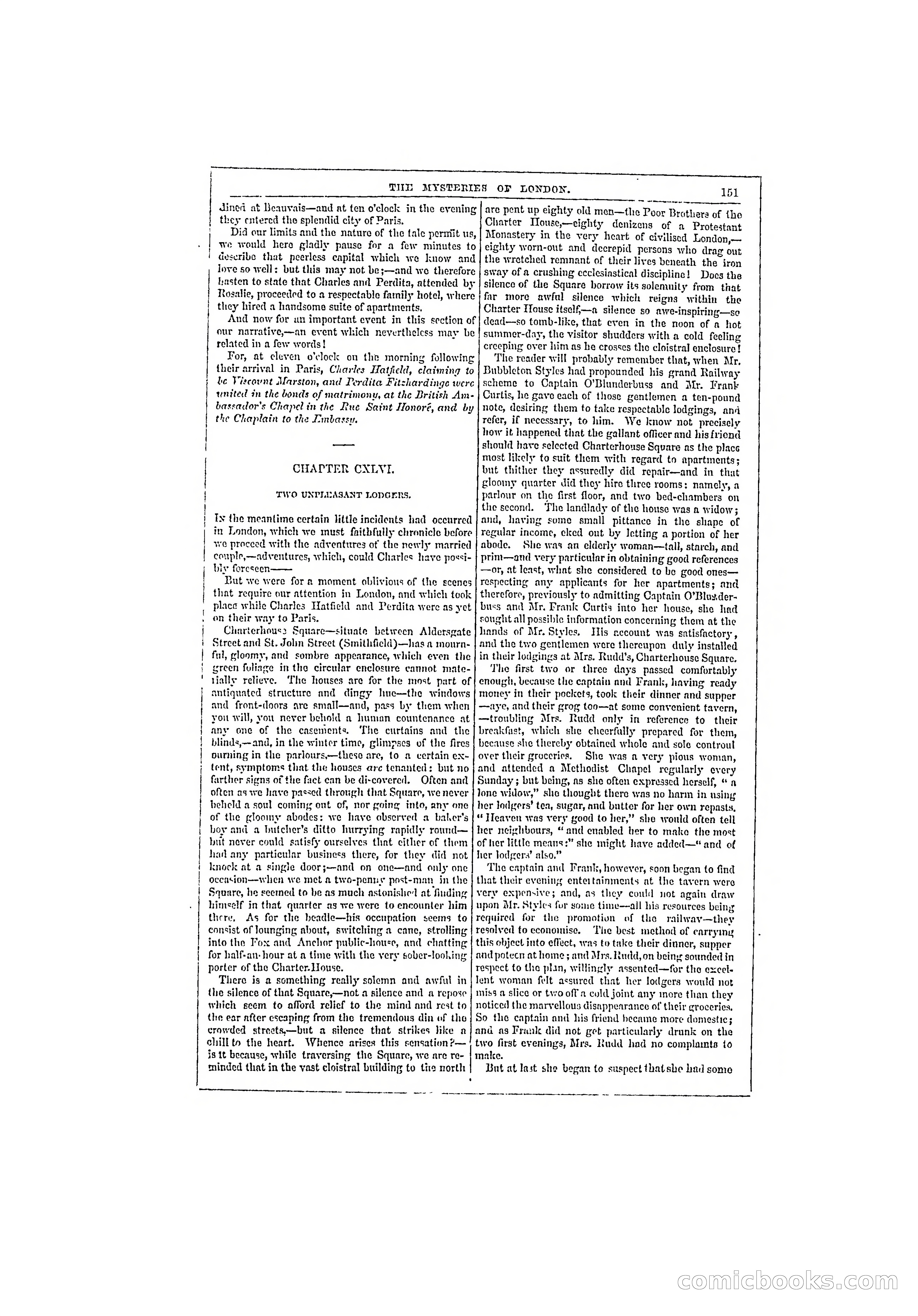
A restored page from Penny Dreadfuls, 1846. Page through the whole issue in the reader above.
📄 Transcribed text from this page (OCR, searchable)
Machine-transcribed from the original scan — historical spelling and the odd misread are preserved.
a we ee THE MYSTERIES OF LONDON. 151 ee etree dined at Deauvais—and at ten o’clock in the evening they entered the splendid city of Paris. Did our limits and the nature of the tale permit us, we would here gladly pause for a few minutes to describe that peerless capital which we know and love so well: but this may not be;—and we therefore hasten to state that Charles and Perdita, attended by Rosalie, proceeded to a respectable family hotel, where they hired a handsome suite of apartments. And now for un important event in this section of our narrative,—an event which nevertheless may be related in a few words! For, at eleven o'clock on the morning following their arrival in Paris, Charles Hatfield, claiming to be Viscount Marston, and Perdita Fitzhardinge were united in the bonds of matrinonu, at the British Am- bassador's Chapel in the Rue Saint Monoré, and by the Chaplain to the Embassy, CHAPTER CXLVE TWO UNPLEASANT LODGERS, Ix the meantime certain little incidents had occurred itt London, which we must faithfully chronicle before we proceed with the adventures of the newly married couple, —adventures, which, could Charles have possi- biv foreseen But we were fora moment oblivious of the scenes that require onr attention in London, and which took place while Charles Hatfield and Perdita were as yet on their way to Paris. Charterhous: Square—situate between Aldersgate Street and St. Jolin Street (Smithfield)—has a mourn- ful, gloomy, and sombre appearance, which even the green fuliage Inthe cirenlar enclosure cannot mate- tially relieve. ‘The houses are for the most part of antiquated structure and dingy lhne—the windows and front-doors are small—and, pass by them when you will, you never behold a human countenance at any one of the casements. The curtains and the blinds,—and, in the winter time, glimpses of the fires purning in the parlours,—theso are, to a certain ex- tent, symptoms that the houses arc tenanted: but no farther signs of the fact can be di-covered. Often and often asywe have passed through that Square, we never beheld a soul coming ont of, nor going into, any one of the gloomy abodes: we have observed a baker's boy and a butcher’s ditto hurrying rapidly rownd— but never could satisfy ourselves that cither of them had any particular business there, for they did not knock st a single doorj;—and on one—and only one occasion—-when we met a two-penuy post-man in the Squnre, he seemed to be as much astonished at finding himcelf in that. quarter a3 we were to encounter him there, As for the beadle—his ocenpation seems to consist of Jounging about, switching a cane, strolling into the Tox and Anchor public-houce, and chatting for half-an- hour at a time with the vers sober-loohing porter of the Charter. Louse. There is a something really solemn and awful in {he silence of that Square,—not a silence and a repose which seem to afford relief to the mind and rest to the ear after escaping from the tremendous din of the crowded streets—but a silence that strikes like a chillto the heart. Whence arises this sensation ?— is tt because, while traversing the Square, we are re- > EY we, ee oe oe ee are pent up eighty old men—the Poor Brothera of the Charter Iouse,—eighty denizens of a Protestant Monastery in the very heart of civilisod London,— eighty worn-out and decrepid persons who drag out the wretched remnant of their lives beneath the jron sway of a crushing ecclesiastical discipline! Does the silence of the Square borrow its solemnity from that far more awful silence which reigns within the Charter House itself—a silence so awe-inspiring—so dead—so fomb-like, that even in the noon of a hot summer-day, the visitor shudders with a cold feeling erceping over him as he crosses the cloistral enclosure! The reader will probably remember that, when Mr, Bubbleton Styles had propounded his grand Railway scheme to Captain O’Blunderbuss and Mr. rank Curtis, he gave each of those gentlemen a ten-pound note, desiring them to take respectable lodgings, and refer, if necessary, to him. We know not precisely how it happened that the gallant officer and his friend should have selected Charterhouse Square as the place most likely to suit them with regard to apartments; but thither they assuredly did repair—and in that gloomy quarter did they hire three rooms: namely, a parlour on the first floor, and two bed-chambers on the second. The landlady of the house was a widow; and, having some small pittance in the shape of regular income, eked ont by Ietting a portion of her abode. She was an elderly woman—tall, starch, and prim—and very particular in obtaining good references —or, at least, what she considered to be good ones— respecting any applicants for her apartments; and therefore, previously to admitting Captain O’Bloyder- buss and Mr. Prank Curtis into her house, she had cought all possible information concerning them at the hands of Mr. Styles. His account was satisfactory, and the two gentlemen were thereupon duly installed in their lodgings at Mrs. Rudd’s, Charterhouse Square. The first two or three days passed comfortably enough, because the captain and Frank, having ready money in their pockets, took their dinner and supper —aye, and their grog too—at some convenient tavern, —troubling Mrs. Rudd only in reference to their breakfast, which she cheerfully prepared for them, because she thereby obtained whole and sole controut over their groceries. She was a very pious woman, and attended a Methodist Chapel regularly every Sunday ; but being, ns she often expressed herself, “ a lone widow,” sho thought there was no harm in using her lodgers’ tea, sugar, and butter for her own repasts, * Heaven was very good to her,’ she would often tell her neighbours, “ and enabled her to make the most of her little means:” she night have addet—* and of hier dodgers’ also.” The captain and Frank, however, soon began to find that their evening entertainments at the tavern were very expensive; and, as they could not again draw upon Mr. Atyles fur some time—all his resources being required for the promotion of the railway—they resolved to economise. ‘The best method of carrying this object into effect, was to take their dinner, supper and potecn at home ; and Mrs. Rudd, on bein sounded in respect to the plin, willingly assented—for the excet- lent woman felt assured that her lodgers would not miss a slice or two offa culd joint any more than they noticed the marvellous disappearance of their groceries, 50 the captain and his friend became more domestic; and as Frank did not get particularly drunk on the two first evenings, Mrs. Rudd had no complaints to matce. minded that in the vast cloistral building to tie north | Lut at last she began to suspect thatshe had some vo ee ee me Oe re ee tte me + rete ee tr ee ee (C(O) DOO (SO)