
Penny Dreadfuls, 1846 · page 185 of 399
The Mysteries of London, Vol. IV — page 185: what you’re looking at
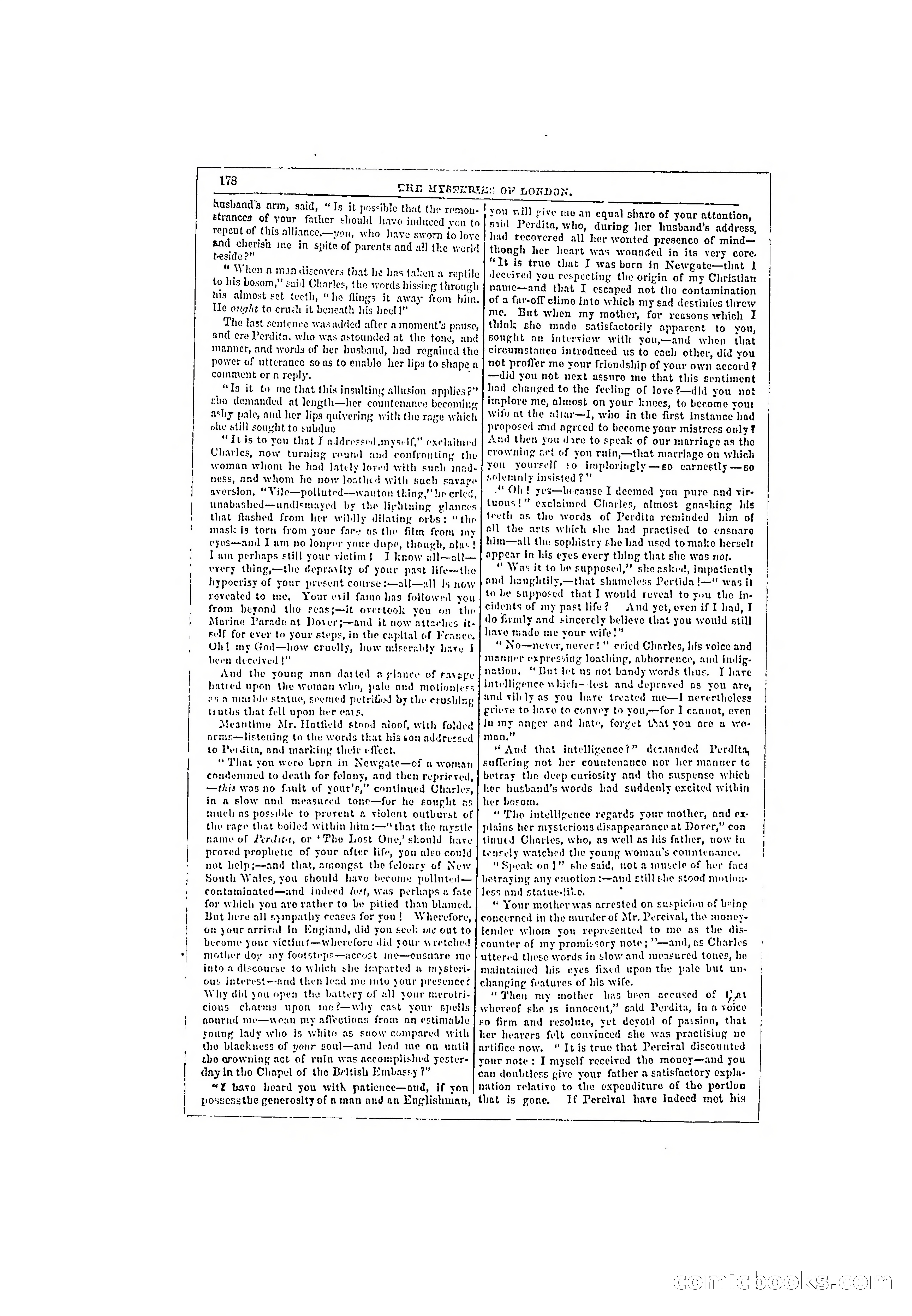
A restored page from Penny Dreadfuls, 1846. Page through the whole issue in the reader above.
📄 Transcribed text from this page (OCR, searchable)
Machine-transcribed from the original scan — historical spelling and the odd misread are preserved.
—— = + ee ev—X—_ OO rr ree ee ee a am «6 ere oe ee ee ae ere i a 178 husband's arm, said, “Is it possible that the strances of your father should havo induecd you to repent of this alliance,x—vox, who have sworn to loye and cherish me in spite of parents and all the world beside?” “ When a man discovers that he has taken a reptile to his bosom,” said Charles, the words hissing through nis almost set tecth, “he flings it away from him. Ho onght to cruch it beneath his heel!" The last sentence was added after a moment's pause, and ere Perdita, who was astounded at the tone, and inanner, and words of her husband, had regained the power of uttcrance soas to enablo her lips to shape a comment or a reply. “Is it to mo that this insulting allusion applies?” sho demanded at Iength—her countenance becoming ashy pale, and her lips quivering with the rage which blie still sought to subdue “Itis to you that I addressed myself," exelaiined Charles, now turning round and confronting the woman whom he had Jately loved with such mad- ness, and whom ho now josthed with such savage aversion, “ Vile—polluted—wanton thing,” he erled, unabashed—undismayed by the lightning glances that flashed from her wildly dilating orbs: “the mask is torn from your face as the film from my eyos—and Tam no longer your dupe, though, alus! Tam perhaps still your victin! I know all~all— every thing,—-the depravity of your past Ife—the hypocrisy of your present course :—all—all Is now revealed to me, Your esil famo has followed you from beyond tho reas;—it overtook you on the Marino Parade at Dover;—and it now attaches it- eelf for ever to your steps, In the capital of France. Ohf my God—how cruclly, how miserably have J been deceived [” And the young man darted a glance of ravere hatred upon the woman whe, pale and motionless esa marble statue, seemed petrifsl vy the crushing truths that fell upon her ears, Meantime Mr. Hatfield stood aloof, with folded arms——tistening to the words that his son addressed to Perdita, and marking thelr effect. “That you were born in Newgate—of a woman condemned to death for felony, and then repricred, —this was no fault of your's,” continued Chartes, in a slow and measuced tonec—for he sought as much as possible to prevent a violent outburst of the rage that boiled within him:—* that the mystic name of Jerdita, or ‘The Lost One,’ should have proved prophetic of your after life, you also could not help;—-and that, amongst the felonry of New South Wales, you should have become poluted— contaminated—and indeed dest, was perhaps a fate for which vou aro rather to be pitied than blamed. But here all sympathy ecases for sou! Wherefore, on your arrival In Engiand, did you seck ame out to become your victhn¢—wherefore did your wretched mother doy my footsteps—accost Ie—cnsnnro me into a discourse to Which she imparted a mysteri- ous interest—and then lead me ante your presence? Why did you open the battery of all your meretri- cious charms upon mew’—why east your spells aournd me—wean my affections from non estimable soung lady who is white as snow compared with thho blackness of your soul—and lead me on until tho crowning act of ruin was accomplished yester- day inthe Chapel of the British Embassy ?” “¥ bavo heard you with patienec—and, if you possessthe generosity of a man and an Englishman, —_—— ee SHOE MYBPERIES oF LONDON, remon- ! you will give inc an equal sharo of your attontion, Os, sid Perdita, who, during her hnsband’s address, had recovered all her wonted presence of mind— though her heart was wounded in its very core. “It is truo that I was born in Newgate—that 1 deceived you respecting the origin of my Christian name—and that I escaped not the contamination of a far-off climo into which my sad destinies threw me. But when my mother, for reasons which I think sho mado satisfactorily apparent to you, sought an interview with you,—and when that circumstance introduced us to cach other, did you not proffer mo your friendship of your own accord? —did you not next assuro me that this sentiment had changed to the feeling of love ?—did you not implore me, almost on your knees, to become yout wily at the altar—I, who in tho first instance had proposed and agreed to become your mistress only f And then you dire to speak of our marriage as tho crowning act of yon ruin,—that marriage on which you yourself :o imploringly —so carnestly —so solemnly insisted 2?” “Oh! yes—because I deemed you pure and vir- tuous!” oxclaimed Charles, almost gnaching his teeth as the words of Perdita reminded him of; ! + \ — all the arts which she had practised to ensnare him—all the sophistry she had used to make hersel! appear in lils eyes every thing that she was not. “Was it to be supposed,’ she asked, impatiently and ughtily,—that shameless Pertida !—“ was it to be supposed that I would reveal to you the in. cidents of my past life? And yet, oven if T had, I do firmly and sincerely believe that you would still have made me your wife!” “* No—never, never!" cried Charles, his voice and manner expressing loathing, abhorrence, and indig- notion, “Dut let us not bandy words thus. I have intelligence which--lost and depraved os you are, ! and viluly as you have treated me—I nevertheless | grieve to have to convey to vou,—for I cannot, even | In iny anger and hate, forget that you are a wo- man.” “And that intelligence?” decansnded Perdita, suffering not her countenance nor her manner te betray the deep curiosity and tho suspense which her husband’s words had suddenly excited within her bosom. “Tho intelllgenco regards your mother, andcx | plains her mysterious disappearance at Dorer,” con tinucd Charles, who, as well as his father, now in tensely watched the young woman's countenance, "Speak on!” she said, not a musele of her faces betraying any emotion:—and stillshe stood motions less and statuc-lil.c. . “ Your mother was arrested on suspicion of being concerned in the murder of Mr. Percival, the moncy- lender whom you represented to me as the dis- counter of my promissory note; ”’—and, as Charles . uttered these words in slow and measured tones, ho | maintained his eyes fixed upon the pale but un. : ~~ am changing features of his wife. “Then my mother has been accused of tat whereof sha 3s innocent,” said Perdita, in a voice f0 firm and resolute, yet devold of passion, that her hearers felt convinced she was practising ne artifico now. “ Itis true that Percival discounted your note: I myself received the moucy—and you can doubtless give your father a satisfactory expla- nation relative to the expendituro of tho portion | tliat is gone. If Percival havo indecd mot his GIOOKS (SO) (SO)