
Penny Dreadfuls, 1846 · page 209 of 399
The Mysteries of London, Vol. IV — page 209: what you’re looking at
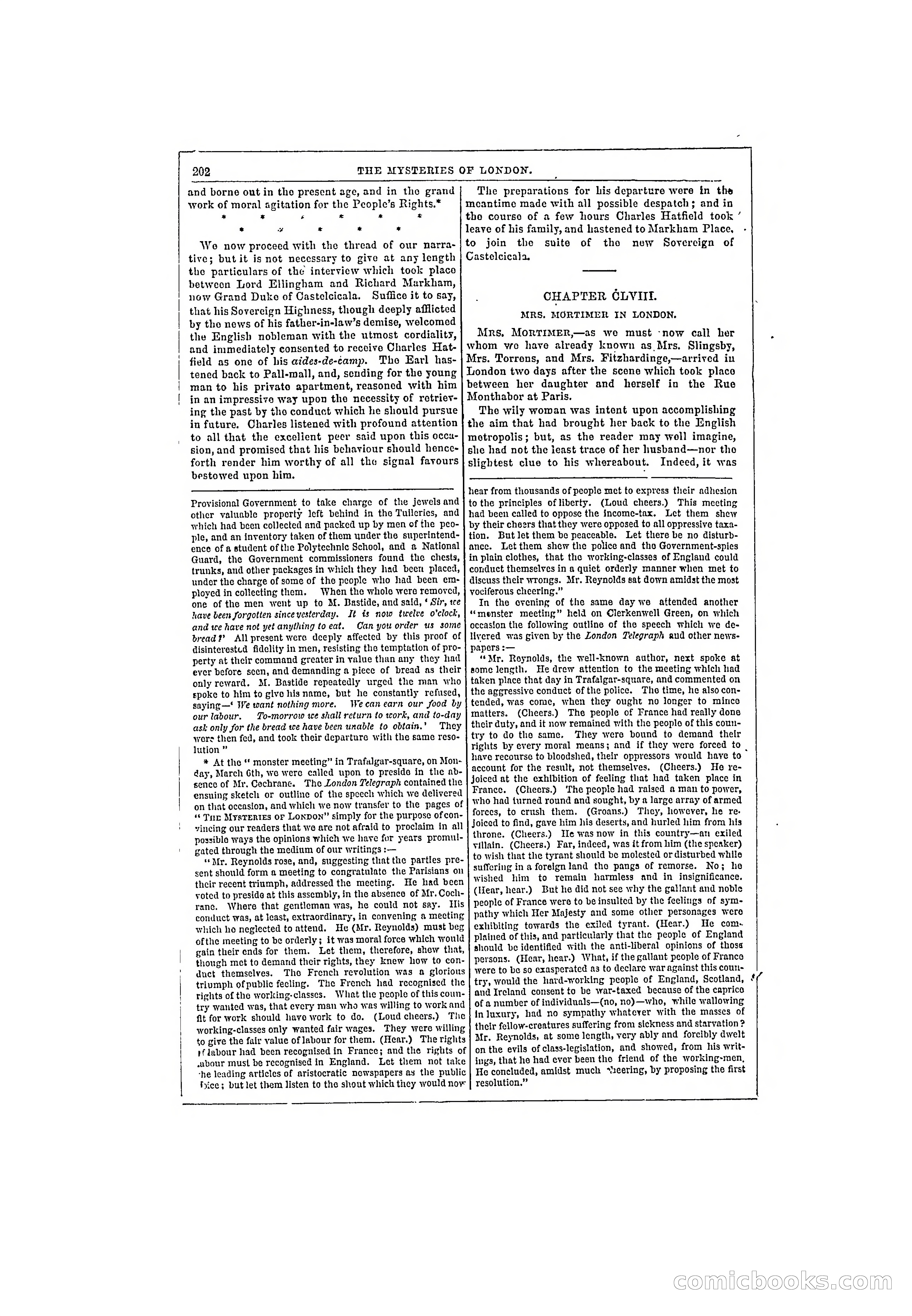
A restored page from Penny Dreadfuls, 1846. Page through the whole issue in the reader above.
📄 Transcribed text from this page (OCR, searchable)
Machine-transcribed from the original scan — historical spelling and the odd misread are preserved.
202 THE WYSTERIES OF LONDON. and borne out in the present age, and in the grand work of moral agitation for the People’s Rights.* * * ‘ « x Fs * 2 x * * We now proceed with the thread of our narra- tive; but it is not necessary to give at any length the particulars of the interview which took place between Lord Eliingham and Richard Markham, now Grand Duke of Castelcicala. Suffice it to say, that his Sovereign Highness, though deeply afflicted by the news of his father-in-law’s demise, welcomed the English nobleman with the utmost cordiality, and immediately consented to receive Charles Hat- field as one of his aides-de-camp. The Earl has- tened back to Pall-mall, and, sending for the young man to his privato apartment, reasoned with him in an impressive way upon the necessity of retriev- ing the past by the conduct which he should pursue in future. Charles listened with profound attention to all that the excelient peer said upon this occa- sion, and promised that his behaviour should hence- forth render him worthy of all the signal favours bestowed upon him. a PL A tL Na Provisional Government to take charge of the jewels and other valuable property left behind in the Tuileries, and which had been collected and packed up by men of the peo- ple, and an inventory taken of them under the superintend- ence of a student of the Polytechnic School, and a National Guard, the Government commissioners found the chests, trunks, and other packages in which they had been placed, under the charge of some of the people who had been em- ployed in collecting them. When the whole were removed, one of the men went up to M. Bastide, and said, ‘ Sir, ce have been forgotten since yesterday. It is now twelve o'clock, and twe have not yet anything toeat. Canyouorder us some bread?’ All present were deeply affected by this proof of disinterested fidelity in men, resisting the temptation of pro- perty at their command greater in value than any they had ever before scen, and demanding a piece of bread as their only reward. M. Bastide repeatedly urged the man who spoke to him to give his name, but he constantly refused, saying —‘ Ie want nothing more. Wecanearn our food by our labour. To-morrow we shall return to work, and to-day ask only for the bread we have been unable to obtain.’ They worse then fed, and took their departure with the same reso- lution ” * At the “ monster meeting” in Trafalgar-square, on Mon- day, March Gth, we were called upon to preside in the ab- sence of Mr. Cechrane. The London Telegraph contained the ensuing sketch or outline of the speech which we delivered on that occasion, and which we now transfer to the pages of ‘6 Tur MYSTERIES OF LONDON” simply for the purpose ofcon- vincing our readers that we are not afraid to proclaim in all possible ways the opinions which we have for years promul- gated through the medium of our writings :— ‘Mr. Reynolds rose, and, suggesting that the parties pre- sent should form a meeting to congratulate the Parisians on their recent triumph, addressed the mecting. He had been yoted to preside at this assembly, in the absence of Mr. Coch- ranc. Where that gentleman was, he could not say. His conduct was, at least, extraordinary, in convening a meeting which he neglected to attend. He (Mr. Reynolds) must beg ofthe meeting to be orderly; it was moral force which would gain their ends for them. Let them, therefore, shew that, though met to demand their rights, they knew how to con- duct themselves. The French revolution was a glorious triumph ofpublic feeling. The French had recognised the rights of the working-classes. What the people of this coun- try wanted was, that every man who was willing to work and fit for work should have work to do. (Loud cheers.) The working-classes only wanted fair wages. They were willing to give the fair value of Jabour for them. (Hear.) The rights if dabour had been recognised in France; and the rights of subour must be recognised in England. Let them not take ‘he leading articles of aristocratic newspapers as the public fice; but let them listen to the shout which they would nor The preparations for his departure were in the mcantime made with all possible despatch; and in the course of a few hours Charles Hatfield took leave of his family, and hastened to Markham Place, to join the suite of the new Sovercign of Castelcicala. ‘~ ed CHAPTER CLVIIT MRS. MORTIMER IN LONDON. Mrs, MorTIMER,—as we must -now call her whom we have already known as Mrs. Slingsby, Mrs. Torrens, and Mrs. Fitzhardinge,—arrived in London two days after the scene which took place between her daughter and herself in the Rue Monthabor at Paris. The wily woman was intent upon accomplishing the aim that had brought her back to the English motropolis; but, as the reader may woll imagine, she had not the least trace of her husband—nor tho slightest clue to his whereabout. Indeed, it was hear from thousands of people met to express their adhesion to the principles of liberty. (Loud cheers.) This meeting had been called to oppose the income-tax. Let them shew by their cheers that they were opposed to all oppressive taxa- tion. But let them be peaceable. Let there be no disturb- ance. Letthem shew the police and the Government-spies in plain clothes, that the working-classes of England could conduct themselves in a quiet orderly manner when met to discuss their wrongs. Mr. Reynolds sat down amidst the most vociferous cheering.” In the cvening of the same day we attended another “monster meeting” held on Clerkenwell Green, on which occasion the following outline of the speech which we de- Nvered was given by the London Telegraph aud other news- papers :— ‘Mr, Reynolds, the well-known suthor, next spoke at aome lencth. He drew attention to the meeting which had taken place that day in Trafalgar-square, and commented on the aggressive conduct of the police. The time, he also con- tended, was come, when they ought no longer to mince matters. (Cheers.) The people of France had really done their duty, and it now remained with the people of this conn- try to do the same. They were bound to demand their rights by every moral means; and if they were forced to have recourse to bloodshed, their oppressors would have to ° account for the result, not themselves. (Cheers.) He re- joiced at the exhibition of feeling that had taken place in France. (Cheers.) ‘The people had raised a man to power, who had turned round and sought, by 2 large array of armed forees, to crush them. (Groans.) They, however, he re- joiced to find, gave him his deserts, and hurled him from his throne. (Cheers.) Hewas now in this country—an exiled villain. (Cheers.) Far, indeed, was it from him (the speaker) to wish that the tyrant should be molested or disturbed while suffering in a foreign land the pangs of remorse. No; he wished him to remain harmless and in insignificance. (Hear, hear.) But he did not see why the gallant and noble people of France were to be insulted by the feelings of sym- pathy which Her Majesty and some other personages were exhibiting towards the exiled tyrant. (Hear.) He com. plained of this, and particularly that the people of England should be identified with the anti-liberal opinions of those persons. (Hear, hear.) What, if the gallant people of France were to be so exasperated as to declare war against this coun- try, would the hard-working people of England, Scotland, f and Ireland consent to be war-taxed because of the caprice of a number of individuals—(no, no)—who, while wallowing in luxury, had no sympathy whatever with the masses of their fellow-creatures suffering from sickness and starvation ? Mr. Reynolds, at some length, very ably and forcibly dwelt on the evils of class-legislation, and showed, from his writ- ings, that he had ever been the friend of the working-men, He concluded, amidst much *‘ueering, by proposing the first resolution.” econmlelooolks (SO)