
Penny Dreadfuls, 1846 · page 214 of 399
The Mysteries of London, Vol. IV — page 214: what you’re looking at
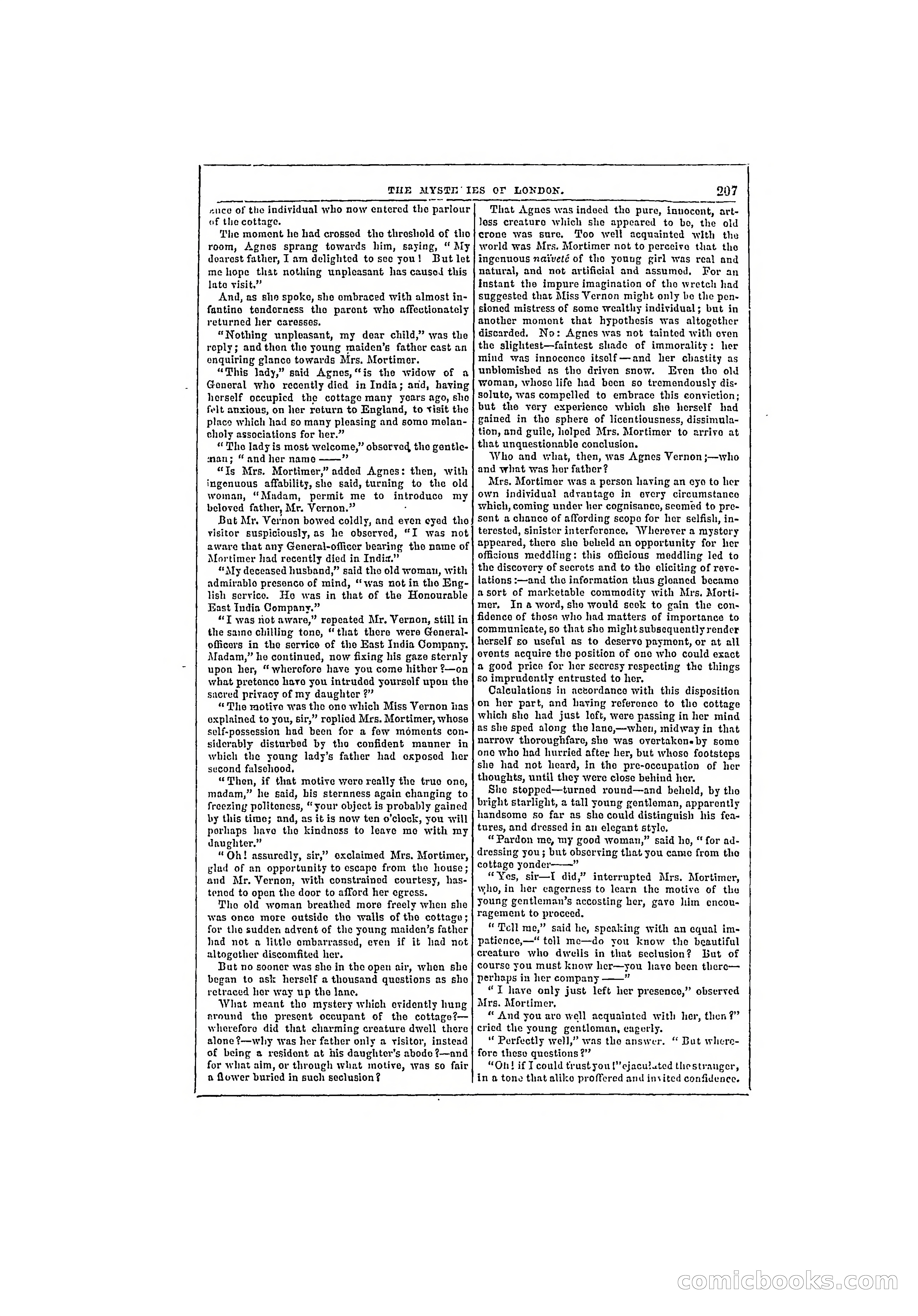
A restored page from Penny Dreadfuls, 1846. Page through the whole issue in the reader above.
📄 Transcribed text from this page (OCR, searchable)
Machine-transcribed from the original scan — historical spelling and the odd misread are preserved.
THE MYSTE' IES OF LONDON. nuce of the individual who now entered the parlour af the cottage. The moment he had crossed tho threshold of tho room, Agnes sprang towards him, saying, “ My dearest father, I am delighted to sce you! But let me hope that nothing unpleasant has causod this late visit.” And, as she spoke, she ombraced with almost in- fantino tenderness the parent who affectionately returned her caresses. “Nothing unpleasant, my dear child,” was the reply; andthon the young maiden’s father cast an enquiring glance towards Mrs. Mortimer. “This lady,” said Agnes, “is the widow of a Goneral who recently died in India; and, having herself occupicd the cottage many years ago, she felt anxious, on her return to England, to tisit the place which had so many pleasing and somo molan- choly associations for her.” “Tho lady is most welcome,” observed the gentle- ‘nan; “and her name im “Ts Mrs. Mortimer,” added Agnes: then, with ingenuous affability, she said, turning to the old woman, “Madam, permit me to introduce my beloved father, Mr. Vernon.” Bat Mr. Vernon bowed coldly, and even eyad tho visitor suspiciously, as he observed, “I was not aware that any General-officer bearing the name of Mortimer had recently died in Indiz.” % My deceased husband,” said the old woman, with admirable presence of mind, “was not in the Eng- lish service. Hoe was in that of the Honourable Iiast India Company.” “‘T was not aware,” repeated Mr. Vernon, still in the saine chilling tono, “that there were General- officers in tho service of the East India Company. Madam,” he continued, now fixing his gaze sternly upon her, “wherefore have you come hither ?—on what pretence have you intruded yoursolf upon the sacred privacy of my daughter ?” “The motive was the one which Miss Vernon inas explained to you, sir,” roplied Mrs. Mortimer, whose self-possession had been for a few moments con- siderably disturbed by tho confident manner in which the young lady’s father had exposed her second falsehood, “Then, if that motive were really the truce one, madam,” he said, his sternness again changing to freezing politoness, “your object is probably gained by this time; and, as it is now ten o’clock, you will porhaps have the kindness to leave me with my daughter.” “Oh! assuredly, sir,’ exclaimed Mrs. Mortimer, glad of an opportunity to escapo from the house; and Mr. Vernon, with constrained courtesy, has- tened to open the door to afford her cegrcss. Tho old woman breathed more freely when she was once more outside the walis of the cottage; for the sudden advent of the young maiden’s father had not a little embarrassed, even if it had not altogother discomfited her. But no sooner was she in the open air, when she began to ask herself a thousand questions as sho retraced her way up the lane. What meant the mystery which evidently hung nround the present occupant of the cottage?— wherefore did that charming creature dwell there alone ?—why was her father only a visitor, instead of being a resident at his daughter’s abode ?—~and for what aim, or through what motive, was so fair a flower buried in such seclusion ? 207 Bee eee ee ee A, That Agnes was indeed tho pure, innocont, art- less creature which she appeared to bo, the old crone was sure, Too well acquainted with the world was Mrs. Mortimer not to perceive that the ingenuous naivelé of the youug girl was real and natural, and not artificial and assumed. For an Instant the impure imagination of tho wretch had suggested that Miss Vernon might only be the pen- sioned mistress of some wealthy individual; but in another moment that hypothesis was altogether discarded. No: Agnes was not tainted with oven the slightest—faintest shade of immorality: her mind was innocence itself—-and ler chastity as unblomished as tho driven snow. Even tho old woman, whose life had been so tremendously dis- solute, was compelled to embrace this conviction; but the very experience which she herself had gained in the sphere of licentiousness, dissimula- tion, and guile, holped Mrs. Mortimer to arrivo at that unquestionable conclusion. Who and what, then, was Agnes Vernon ;—who and what was hor father? Mrs. Mortimer was a person having an eyo to her own individual advantage in every circumstance which, coming under her cognisance, seemed to pre- sent a chance of affording scopo for her selfish, in- terested, sinister interference, Wherever a mystery appeared, there she belreld an opportunity for her officious meddling: this officious meddling led to the discovery of secrets and to the eliciting of reve- lations :—and the information thus gleaned becamo asort of marketable commodity with Mrs. Morti- mer, In a word, she would seek to gain the con- fidence of those who had matters of importance to communicate, so that sho might subsequently render herself so useful as to deserve payment, or at all events acquire the position of one who could exact a good price for her secresy respecting the things so imprudently entrusted to her, Calculations in acvordance with this disposition on her part, and having reference to the cottage which she had just loft, were passing in her mind as She sped along the lane,—when, midway in that narrow thoroughfare, she was overtakoneby some one who had hurried after her, but whose footsteps she had not heard, in the pre-occupation of her thoughts, until they were close behind her. She stopped—turned round—and beheld, by tho bright starlight, a tall young gentleman, apparently handsome so far as she could distinguish his fea- tures, and dressed in an elegant stylo, “Pardon me, my good woman,” said ho, * for ad- dressing you; but observing that you came from tho cottage yonder Yes, sir—I did,” interrupted Mrs. Mortimer, who, in her cagerness to learn the motive of the young gentleman’s accosting her, gave lim encou- ragement to proceed, Tell me,” said he, speaking with an equal im- patience,—* tell mc—do you know the besutifal creature who dwells in that seclusion? But of course you must know her—you Jaye been there— perhaps in her company i “J have only just left her presence,” observed Mrs. Mortimer, “ And you aro well acquainted with her, then?” cried the young gentloman, eagerly. Perfectly well,” was tho answer. “ Bat where- fore these questions 2” “On! if Tcould trustyoul’ejacututed thestrauger, in a tone that aliko proffered and invited confidence. ty ge Ct LT CT PC A A SAT LLL LLL CI (C(O) (C DOO <S LL (SO)