
Penny Dreadfuls, 1846 · page 223 of 399
The Mysteries of London, Vol. IV — page 223: what you’re looking at
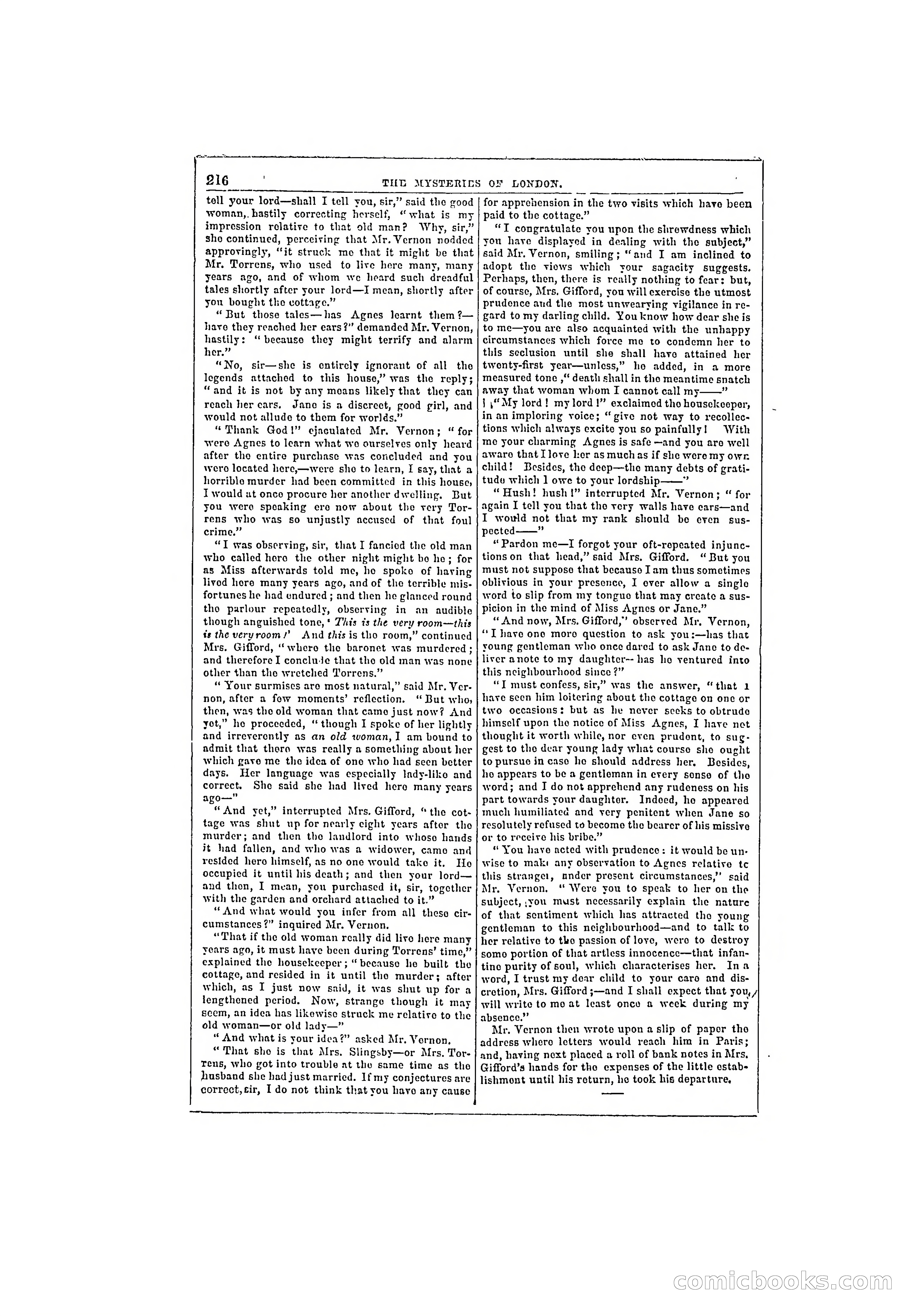
A restored page from Penny Dreadfuls, 1846. Page through the whole issue in the reader above.
📄 Transcribed text from this page (OCR, searchable)
Machine-transcribed from the original scan — historical spelling and the odd misread are preserved.
i te ta eget ate te men oe et ie Sié THE .MYSTERICS OF LONDON, tell your lord—shall I tell you, sir,” said the good woman,. hastily correcting herself, “what is my impression relative to that old man? Why, sir,” sho continued, perceiving that Mr. Vernon nodded approvingly, “it struck me that it might be that Mr. Torrens, who used to live here many, many years ago, and of whom we heard such dreadful tales shortly after your lord—J mean, shortly after you bought the vottage.” “But those tales—has Agnes learnt them ?— have they reached her ears?” demanded Mr. Vernon, hastily: “ because they might terrify and alarm her.” “No, sir—she is entirely ignorant of all the legends attached to this house,” was the reply; “and it is not by any moans likely that they can reach her cars. Jano is a discreet, good girl, and would not allude to them for worlds.” “Thank God!” ejaculated Mr. Vernon: “ for were Agnes to learn what wo ourselves only heard after tho entire purchase was concluded and you wero located here,—were she to learn, I say, that a horrible murder had been committed in this house; TI would at onco procure her another dwelling, But you wero speaking ero now about the rery Tor- rens who was so unjustly accused of that foul crime.” “T was observing, sir, that I fancied the old man who called hero the other night might bo he; for as Miss afterwards told me, he spoko of having livod hore many years ago, and of the terrible mis- fortunes he had ondured ; and then he glanced round tho parlour repeatedly, observing in an audible though anguished tone,‘ This ts the very room—this ts the veryroom?’ And this is tho room,” continued Mrs. Gifford, ‘““where the baronet was murdered ; and therefore I concluije that tho old man was none other than the wretched Torrens.” ‘‘ Your surmises are most natural,” said Mr. Ver- non, after a fow moments’ reflection. “ But who, then, was the old woman that came just now? And yot,” he proceeded, “ though I spoke of her lightly and irreverontly as an old woman, I am bound to admit that there was really a something about her which gave me the idea of one who had seen better days. Her language was especially Iady-like and correct. She said she had lived here many years ago—" “And yet,” interrupted Mrs. Gifford, “the cot- tage was shut up for nearly cight years after the murder; and then the landlord into whose hands it had fallen, and who was a widower, camo and resided hero himself, as no one would take it. He occupied it until his death; and then your lord— and thon, I mean, you purchased it, sir, together With the garden and orchard attached to it.” ‘And what would you infer from all theso cir- cumstances?” inquired Mr. Vernon. “That if the old woman really did live here many Years ago, it must have been during Torrens’ time,” explained the housekeeper; “because he built the cottage, and resided in it until tho murders; after which, as I just now said, it was shut up for a lengthened period. Now, strange though it may scem, an idea has likewise struck me relative to the old woman—or old lady—” “And what is vour idea?” asked Mr. Vornon, “That she is that Mrs. Slingsby—or Mrs. Tor- Tens, who got into trouble at the same time as the husband she had just married. If my conjectures are correct,cir, Ido not think that you havo any cause e S mt ee for apprehension in the two visits which have been paid to the cottage.” “T congratulate you upon the shrewdness which you have displayed in dealing with the subject,” said Mr, Vernon, smiling; ‘and I am inclined to adopt the views which your sagacity suggests. Perhaps, then, there is really nothing to fear: but, of course, Mrs. Gifford, you will exercise the utmost prudence aud the most unwearying vigilance in re- gard to my darling child. You know how dear she is to me—you are also acquainted with the unhappy circumstances which force me to condemn her to this seclusion until she shall have attained her twenty-first year—unless,” he added, in a more measured tone , death shall in the meantime snatch away that woman whom I cannot call my ——” j \“ My lord ! my lord !” exclaimed tho housckceper, in an imploring voice; “give not way to recollec- tions which always excite you so painfully! With me your charming Agnes is safe~and you are well awaro that Ilove ler as muchas if she weremy owr child! Besides, the decp—the many debts of grati- tude which 1 owe to your lordship——” “Hush! hush!” interrupted Mr. Vernon: “ for again I tell you that the very walls have cars—and I would not that my rank should be even sus- pocted———” “Pardon me—I forgot your oft-repeated injunc- tionson that head,” said Mrs, Gifford. “ But you must not suppose that because Iam thus sometimes oblivious in your presence, I ever allow a single word to slip from my tonguo that may create a sus- picion in the mind of Miss Aynes or Jane.” “ And now, Mrs. Gifford,’ observed Mr, Vernon, “T have one moro question to ask you:—has that voung gentleman who once dared to ask Jane to de- liver anote to my daughter-- has ho ventured into this neighbourhood since ?” “T must confess, sir,” was the answer, “that 1 have secn him loitering about the cottage on one or two occasions: but as he never seeks to obtrudea himself upon tho notice of Miss Agnes, I have not thought it worth while, nor even prudont, to sug- gest to the dear young lady what courso sho ought to pursuc in case he should address her. Besides, he appears to be a gentleman in every sonse of the word; and I do not apprehend any rudeness on his part towards your daughter. Indeed, he appeared much humiliated and very penitent when Jane so resolutely refused to become the bearer of his missive or to receive his bribe.” “ You have acted with prudence: it would be un- wise to maki any observation to Agnes relative tc this strangel, onder present circumstances,” said Mr. Vernon. ‘ Were you to speak to her on the subject, ;yyou must necessarily explain the nature of that sentiment which has attracted the young gentleman to this neighbourhood—and to talk to her relative to tho passion of love, were to destroy somo portion of that artless innocence—that infan- tino purity of soul, which characterises her. Ina word, I trust my dear child to your caro and dis- cretion, Mrs. Gifford ;—and I shall expect that you, , will write to mo at Icast once a week during my absence.” Mr. Vernon then wrote upon a slip of papor the address whero letters would reach him in Paris; and, having next placed a roll of bank notes in Mrs, Gifford’s hands for the expenses of the little estab- lishmont until his return, he took his departure, EConnicloooks (CO)