
Penny Dreadfuls, 1846 · page 237 of 399
The Mysteries of London, Vol. IV — page 237: what you’re looking at
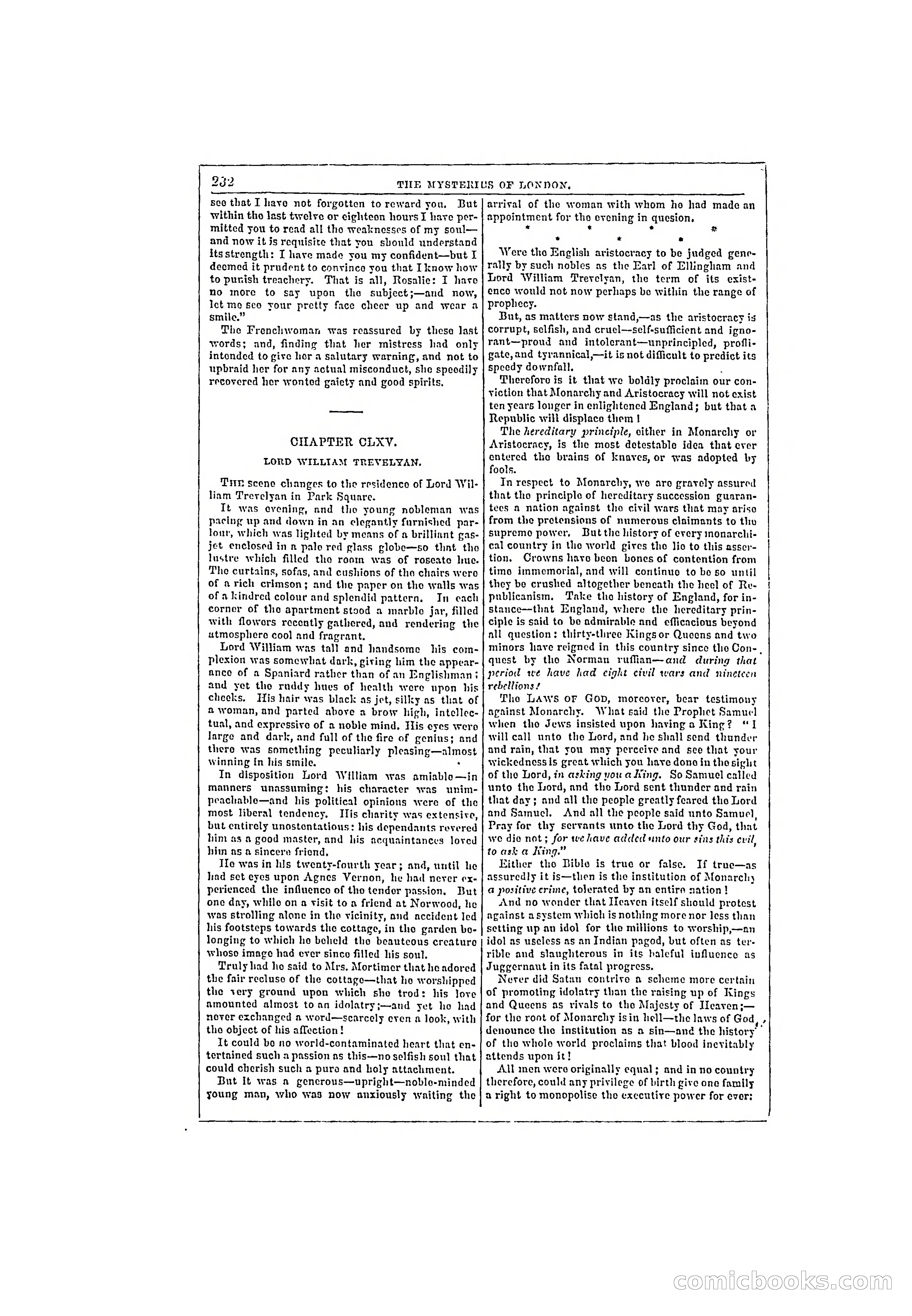
A restored page from Penny Dreadfuls, 1846. Page through the whole issue in the reader above.
📄 Transcribed text from this page (OCR, searchable)
Machine-transcribed from the original scan — historical spelling and the odd misread are preserved.
232 THE MYSTERIUS OF LONDON, seo that I have not forgotten to reward you. But within tho last twelve or cighteon hours I hare per- mitted you to read all the weaknesses of my soul— and now it js requisite that rou should understand its strength: I have made you my confident—but I deemed it prudent to convince you that Iknow how to punish treachery. That is all, Rosalie: I have no more to say upon the subject;—and now, Ict me Seo your pretty face cheer up and wear a smile.” The Frenchwoman was reassured by these Jast words; and, finding that her mistress had only intended to give hora salutary warning, and not to upbraid her for any actual misconduct, she speedily | § recovered her wonted gaiety and good spirits. CHAPTER CLAY. LORD WILLIAM TREVELYAN. TE scene changes to the residence of Lord Wil- liam Trevelyan in Park Square. Tt was evening, and tho young nobleman was pacing up and down in an clegantly furnished par- lontr, which was lighted by means of a brilliant gas- jet enclosed in rn palo red glass globe—so thnt tho lustre which filled the room was of roseato hue. The curtains, sofas, and cushions of tha chairs wero of a rich crimson; and the paper on the walls was of a kindred colour and splendid pattern, Jn cach corner of the apartment stood a marblo jar, filled with flowors recently gathered, and rendering the atmosphere cool and fragrant. Lord William was tall and handsome his com- plexion was somewhat dark, giving him the appear- ance of a Spaniard rather than of an Englishman: and yet tho ruddy hues of health were upon his cheeks. His hair was black as jet, silky as that of 2 woman, and parted above a brow high, intellec- tual, and expressive of a noble mind. His eyes wero Jarge and dark, and full of the fire of genins; and there was something peculiarly pleasing—almost Winning {n his smile. : In disposition Lord William was amiablo—in manners unassuming: his character was unim- peachable—and his political opinions were of the most liberal tendency. Ilis charity was extensive, but entircly unostentatious: his dependants revered him as a good master, and liis acquaintances loved him as a sincere friend, Ifo was in hls twenty-fourth year; and, until le had set eyes upon Agnes Vernon, he had never ex. perienced the influenco of tho tendor passion. But one day, whilo on a visit toa friend at Norwood, he was strolling alone in tho vicinity, and accident Ied his footsteps towards the cottage, in the garden bo- longing to which ho beheld tho beanutcous creature whoso image had ever sinco filled his soul. Truly liad he said to Mrs, Mortimer that he adored the fair recluso of the cottago—that ho worshipped the very ground upon which sho trod: his Jove amounted almost to an idolatry ;—and yet ho had nover exchanged a word—scarcely even a look, with tho object of his affection! It could bo no world-contaminated heart that en- tertained such a passion as this—no selfish soul that could cherish such a pura and holy attachment. But it was a gencrous—upright—noblo-minded young man, who was now anxiously waiting the arrival of the woman with whom ho had made an eppointment for tho evening in quesion, % * * 9 t x & Were the English aristocracy to be judged genc- rally by such nobles as the Earl of Ellingham and Lord William Trevelyan, the term of its exist- ence would not now perhaps be within the range of prophecy. But, as matters now stand,—as the aristocracy is corrupt, selfish, and crucl—self-sufficient and igno- rant—proud and intolerant—unprincipled, profli- gate, and tyrannical,—it is not difficult to predict its speedy downfall. Therefore is it that we boldly proclaim our con- viction that Monarchy and Aristocracy will not exist ten years longer in enlightened England; but that a Republic will displace them ! The hereditary principle, either in Monarchy or Aristocracy, Is the most detestable idea that ever entered the brains of knaves, or was adopted by fools. In respect to Monarchy, wo aro gravely assured that the principle of hereditary sucecssion guaran. tees a nation against tho civil wars that may ariso from the pretensions of numerous claimants to thu supremo power, But the history of every inonarchi- cal country in the world gives the lio to this asser- tion. Crowns have beon bones of contention from timo immemorial, and will continuo to be 50 until they be crushed altogether beneath the heel of Re- publicanism. Take tho history of England, for in- stauce—that England, where the hereditary prin- ciple is said to be admirable and efficacious beyond all question: thirty-three Kings or Quoens and two minors have reigned in this country since the Con-, quest by tho Norman ruffian—and during that period we have had cight ctuil wars and nineteen rebellions / The LAWS OF GOD, moreover, bear testimony against Monarchy. What said the Prophet Samuel when tho Jews insisted upon havinga King? “I will call unto tho Lord, and he shall send thunder and rain, that you may perceive and see that your wW ickedness is great which you have done in the sight of tho Lord, in asking vow aking, So Samuel called unto the Lord, and the Lord sent thunder and rain that day; and all the people greatly feared the Lord and Samucl. And sll the people said unto Samuel, Pray for thy servants unto the Lord thy God, that we dic not; for we have added unto our sins this evil toaska King.” Either tho Bible is true or false. If true—as assuredly it is—then is the institution of Monarchy @ positive crime, tolerated by an entire nation ! And no wonder that Ifcaven itself should protest against asystem whioh is nothing more nor less than setting up au idol for the millions to worship,—an idol ss useless as an Indian pagod, but often as ter. rible and slaughterous in its baleful influence as Juggernaut in its fatal progress. Never did Satan contrive a scheme more certain of promoting idolatry than the raising up of Kings and Queens as rivals to tho Majesty of Ileaven:— for the root of Monarchy isin hell—the laws of God, denounce the institution as a sin—ané the history of the whole world arocluinrs that blood inevitably attends upon it! All men were originally equal; and in no country therefore, could any privilege of birth give one family a right to monopolise the executive power for ever: EConnicloooks (CO)