
Penny Dreadfuls, 1846 · page 242 of 399
The Mysteries of London, Vol. IV — page 242: what you’re looking at
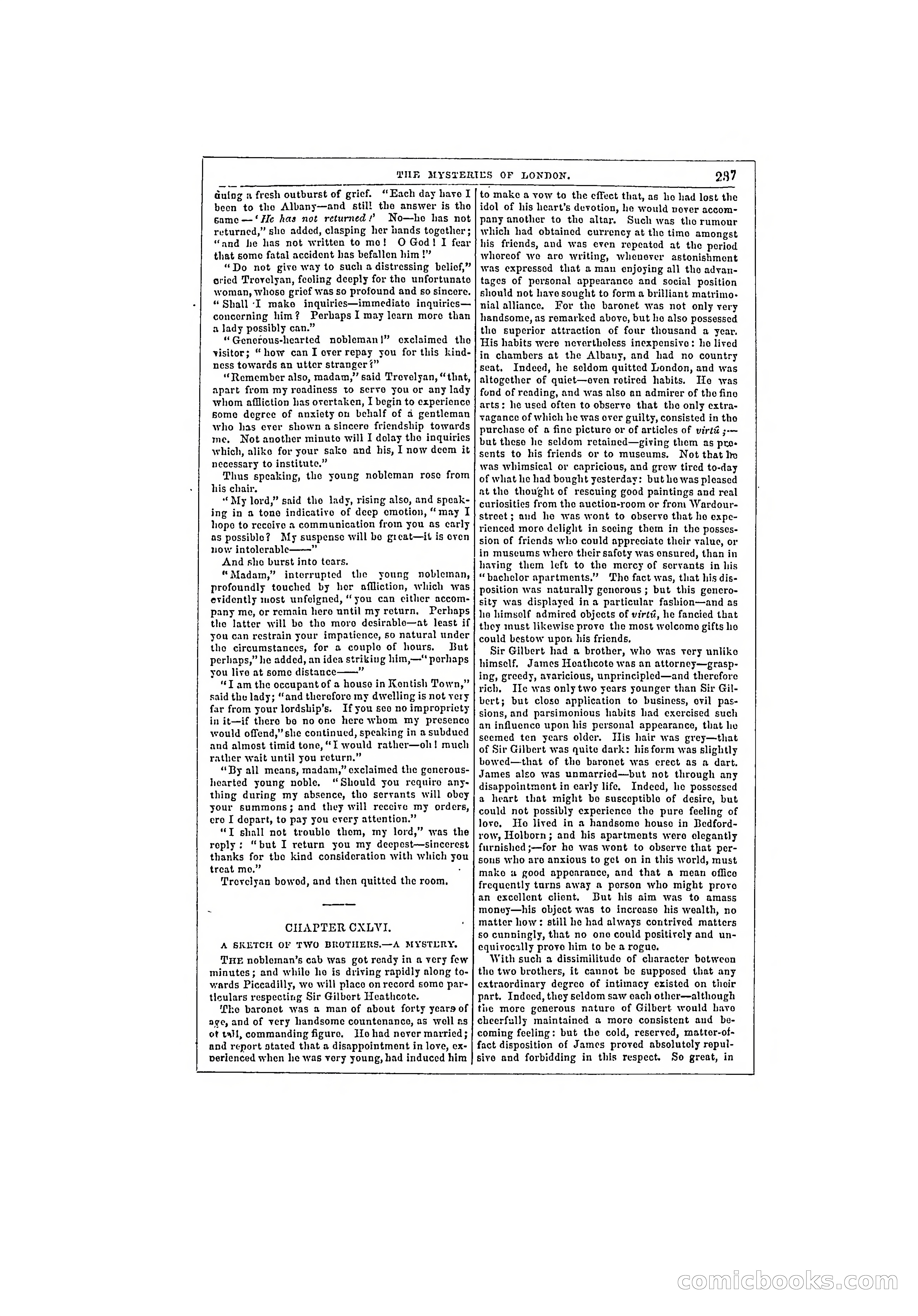
A restored page from Penny Dreadfuls, 1846. Page through the whole issue in the reader above.
📄 Transcribed text from this page (OCR, searchable)
Machine-transcribed from the original scan — historical spelling and the odd misread are preserved.
VUE Guing a fresh outburst of grief. “Each day havo I beon to the Albany—and stil! the answer is tho same — ‘Fle has not returned!’ No—he has not returned,” she added, clasping her hands together; “and he has not written to mo! O God! I fear that some fatal accident has befallen him !” “Do not give way to such a distressing belief,” cried Trovelyan, fecling deeply for the unfortunate woman, whose grief was so profound and 50 sincere. “ Shall ‘I make inquiries—immediate inquirics— concerning him? Perhaps I may learn more than a lady possibly can.” “Generous-hearted nobleman!” exclaimed tho visitor; “how can I ever repay you for this kind- ness towards an utter stranger?” ‘Remember also, madam,” said Trevelyan, “that, apart from my readiness to serve you or any lady whom affliction has overtaken, I begin to experience Bome dopree of anxiety on behalf of a gentleman who has ever shown a sincere friendship towards me, Not another minuto will I dolay the inquiries which, alike for your sake and his, I now deem it necessary to institute.” Thus speaking, the young nobleman rose from his chair. “My lord,” said the lady, rising also, and speak- ing in a tone indicativo of deep emotion, “may I hope to recoive a communication from you as carly as possible? My suspense will be grcat—it is oven now intolerable y And she burst into tears. “Madam,” interrupted the young nobleman, profoundly touched by hor affliction, which was evidently most unfeigned, “you can either accom- pany me, or remain here until my return, Perhaps the latter will bo tho moro desirable—at least if you can restrain your impatience, 50 natural under tho circumstances, for a couple of hours. But perhaps,” he added, an idea striking him,—“ porhaps you live at some distance a ‘¢T am the occupant of a house in Kontish Town,” said the lady; “and therefore my dwelling is not very far from your lordship’s. If you seo no impropriety in it—if there bo no one here whom my presence would offend,” she continued, speaking in a subducd and almost timid tone, “I would rather—ol! much rather wait until you return.” “By all means, madam,” exclaimed the gencrous- hearted young noble. “Should you requiro any- thing during my absence, tho servants will obcy your summons; and they will receive my orders, ero I depart, to pay you every attention.” “T shall not trouble thom, my lord,” was the reply: “but I return you my decpest—sincerest thanks for tbe kind considoration with which you treat mo.” Trevelyan bowod, and then quitted the room. CHAPTER CXLVI. A SKETCH OF TWO BROTHERS.—A MYSTLRY, THE nobleman’s cab was got ready in a very few minutes; and while ho is driving rapidly along to- wards Piccadilly, wo will place on record some par- ticulars respecting Sir Gilbort Heathcote. The baronet was a man of about forty years of age, and of very handsome countenance, as well as ot tall, commanding figure. HHohad never married; and report stated that a disappointment in love, cx- verienced when he was very young, bad induced him MYSTERTES OF LONDON, 287 —_— to make a vow to the effect that, as ho had lost the idol of his heart’s devotion, he would never accom- pany another to tho altar. Such was the rumour which had obtained currency at the timo amongst his friends, and was even repeated at the period whoreof we aro writing, whenever astonishment was expressed that a man enjoying all the advan- tages of personal appearance and social position should not have sought to form a brilliant matrimo- nial alliance. For the baronet was not only very handsome, as remarked above, but he also possessed the superior attraction of four thousand a year. His habits were nevertheless inexpensive: he lived in chambers at the Albany, and had no country seat. Indeed, he seldom quitted London, and was altogether of quiet—oven retired habits. Ife was fond of reading, and was also an admirer of the fino arts: he used often to observe that tho only extra- vagance of which he was over guilty, consisted in the purchase of a fine picture or of articles of virtd ;-~ but these he seldom retained—giving them as pro- sents to his friends or to museums. Not that lr was whimsical or capricious, and grew tired to-day of what he had bought yesterday: but le was pleased atthe thought of rescuing good paintings and real curiosities from the auction-room or from Wardour- street; aud he was wont to observe that he expe- rienced more delight in secing them in the posses- sion of friends who could appreciate their value, or in muscums whero their safety was onsured, than in having them left to the mercy of sorvants in lis “bachelor apartments.” Tho fact was, that his dis- position was naturally genorous ; but this gencro- sity was displayed ina particular fashion—and as he himself admired objects of virtt, he fancied that they must likewise prove the most welcomo gifts ho could bestow upon his friends, Sir Gilbert had a brother, who was very unlike himself. James Hoathcote was an attorney—grasp- ing, greedy, avaricious, unprincipled—and therefore rich, Ile was onlytwo years younger than Sir Gil- bert; but close application to business, evil pas- sions, and parsimonious habits lad exercised such an influence upon his personal appearance, that he seemed ten years older. His hair was grey—that of Sir Gilbert was quite dark: his form was slightly bowed—that of tho baronet was erect as a dart. James also was unmarried—but not through any disappointment in carly life. Indeed, he posscsesed a heart that might be susceptible of desire, but could not possibly experience the pure feeling of love, He lived in a handsome house in Bedford- row, Holborn; and his apartments were elegantly furnished ;—for he was wont to observe that per- sons who are anxious to get on in this world, must make a good appearance, and that a mean office frequently tarns away a person who might prove an excellent client, But his aim was to amass monuy—his object was to increase his wealth, no matter how: still he had always contrived matters so cunningly, that no ono could positively and un- equivocilly prove him to be a rogue. With such a dissimilitude of character botweon tho two brothers, it cannot be supposed that any extraordinary degrco of intimacy existed on thoir part. Indecd, they seldom saw each other—although tiie more generous nature of Gilbert would have cheerfully maintained a more consistent and be- coming feeling: but the cold, reserved, matter-of- fact disposition of James proved absolutoly repul- sive and forbidding in this respect. So great, in (C(O) (C DOO <S LL (SO)