
Penny Dreadfuls, 1846 · page 248 of 399
The Mysteries of London, Vol. IV — page 248: what you’re looking at
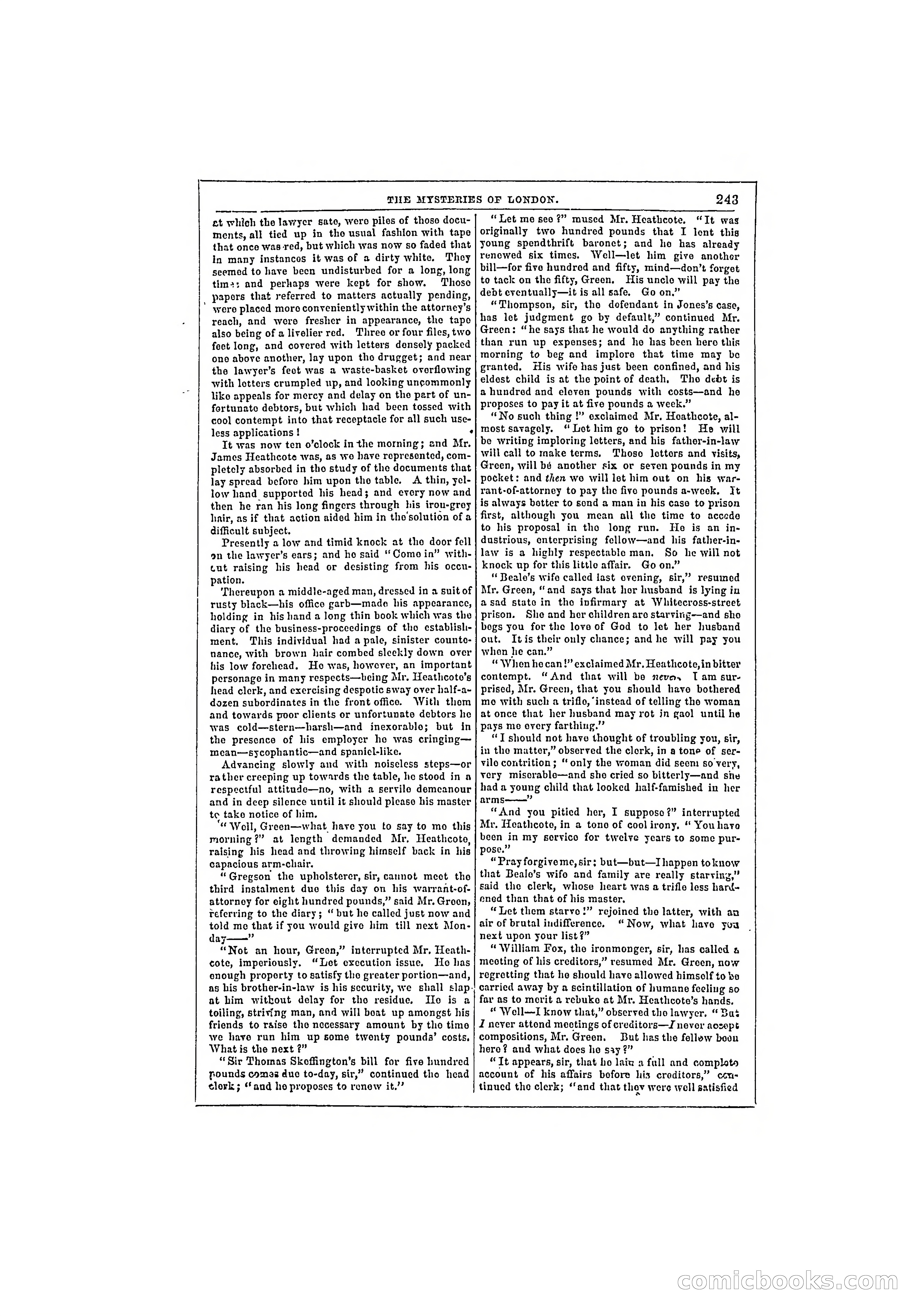
A restored page from Penny Dreadfuls, 1846. Page through the whole issue in the reader above.
📄 Transcribed text from this page (OCR, searchable)
Machine-transcribed from the original scan — historical spelling and the odd misread are preserved.
TIIE MYSTERIES OF LONDON. a a ns ee ee ee et which the lavvycr sate, were piles of those docu- ments, all tied up in the usual fashion with tape that once was red, but which was now so faded that in many instances it was of a dirty white. They seemed to have been undisturbed for a long, long tim?:: and perhaps were kept for show. Those papers that referred to matters actually pending, ' vere placed more conveniently within the attorney’s reach, and were fresher in appearance, the tapo also being of a livelier red. Three or four files, two feet long, and covered with letters densely packed one above another, lay upon the drugget; and near the lawyer’s fect was a waste-basket overflowing with letters crumpled up, and looking uncommonly like appeals for mercy and delay on the part of un- fortunate debtors, but which had been tossed with cool contempt into that receptacle for all such use- less applications ! e It was now ten o’clock in the morning; and Mr. James Heathcote was, as we have represented, com- pletely absorbed in the study of the documents that lay spread before him upon the table. <A thin, yel- low hand supported his head; and every now and then he ran his long fingers through his iron-groy hair, as if that action aided him in the'solution of a difficult subject. Presently a low and timid knock at the door fell on the lawyer’s ears; and he said ‘Come in” with- cut raising his head or desisting from his occu- pation. Thereupon a middle-aged man, dressed in a suit of rusty black—his office garb—made his appearance, holding in his hand a Jong thin book which was the diary of the business-proceedings of tho establish- ment. This individual had a pale, sinister counto- nance, with brown hair combed sleekly down over his low forchead. Ho was, however, an important personage in many respects—being Mr. Heathcoto’s head clerk, and exercising despotic sway over half-a- dozen subordinates in the front office. With them and towards poor clients or unfortunate debtors he was cold—stern—harsli—and inexorable; but in the presence of his employer he was cringing— mean—sycophantic—and spanicl-like. Advancing slowly and with noiseless steps—or rather creeping up towards the table, he stood in a respectful attitude—no, with a servile demeanour and in deep silence until it should please his master te take notice of him. “¢ Woll, Green—what have you to say to mo this morning?” at length demanded Mr, Heathcote, raising his head and throwing himself back in his capacious arm-cliair. “Gregson the upholsterer, sir, cannot mect the third instalment due this day on his warrant-of- attorney for eight hundred pounds,” said Mr. Groon, referring to the diary; ‘ but he called just now and told me that if you would give him till next Mon- day——” “Not an hour, Greon,” interrupted Mr, Heath- cote, imperiously. “Let execution issue, Jo has enough property to satisfy tho greater portion—and, ag his brother-in-law is his security, we shall slap- at him witkout delay for tho residue. Ilo is a toiling, striving man, and will boat up amongst his friends to raise the necessary amount by tho time we have run him up some tiwonty pounda’ costs, What is the next ?” “Sir Thomas Skeffington’s bill for five hundred pounds comaz duc to-day, sir,” continued the head clork; ‘*and he proposes to renew it,”’ 243 ‘Let me see ?” mused Mr. Heathcote. “It was originally two hundred pounds that I lent this young spendthrift baronet; and hoe has already renewed six times. Well—let him give another bill—for five hundred and fifty, mind—don’t forget to tack on the fifty, Green. His uncle will pay the debt eventually—it is all safe. Go on.’ “Thompson, sir, the defendant in Jones’s case, has let judgment go by default,” continued Mr. Green: “he says that he would do anything rather than run up expenses; and ho has been hero this morning to beg and implore that time may be granted. His wife has just been confined, and his eldest child is at the point of death, Tho debt is a hundred and eleven pounds with costs—and he proposes to pay it at five pounds a week.” “No such thing !” exclaimed Mr, Heathcote, al- most savagely. “ Lot him go to prison! He will be writing imploring letters, and his father-in-law will call to make terms. Thoso lettors and visits, Green, will bé another six or seven pounds in my pocket: and then wo will let him out on his war- rant-of-attorney to pay the five pounds a- week. Yt is always botter to sond a man in his case to prison first, although you mean all the time to accede to his proposal in tho long run. He is an in- dustrious, enterprising fellow—and his father-in- law is a highly respectable man. So lie will not knock up for this little affair. Go on.” ** Beale’s wife called last evening, sir,’ resumed Mr. Green, “and says that hor husband is lying in asad state in tho infirmary at Whitecross-street prison. She and her children are starving—and sho begs you for the love of God to jet her husband out. Itis their only chance; and he will pay you when he can.” “When hecan!” exclaimed Mr. Heathcote, in bitter contempt. “And that will be nevo. Tam sur- prised, Mr. Green, that you should have bothered me with such a trifle, “instead of telling the woman at once that her husband may rot in gaol until he pays me overy farthing.” *T should not have thought of troubling you, sir, in the matter,” observed the clerk, in a tone of ser- vilo contrition; “only the woman did seem s0 very, very miserable—and she cried so bitterly—and she had a young child that looked half-famished in her arms - “And you pitied her, I suppose?” interrupted Mr, Heathcote, in a tono of cool irony, * You have been in my sorvico for twelve years to some pur- pose.” “Pray forgiveme, sir; but—but—I happen to know that Beale’s wifo and family are really starving,” said the clerk, whose heart was a trifle less hard- ened than that of his master, “Let them starvo:” rejoined the latter, with an air of brutal indifference. “Now, what have you next upon your list?” “William Fox, the ironmonger, sir, has called a mecting of his creditors,” resumed Mr. Green, now regretting that he should have allowed himsolf to bo carried away by a scintillation of humane feeling so far as to morit a rebuko at Mr. Heathcote’s hands. Well—-I know that,” observed tho lawyer. “Bas Z never attond meetings of creditors—J never aozept compositions, Mr. Green. But has the fellow boon here? and what does he say 2?” “It appears, sir, that ho lain a fall and completo account of his affairs before his creditors,” con tinued the clerk; “‘and that thev wer well satisfied (C(O) (C DOO <S LL (SO)