
Penny Dreadfuls, 1846 · page 251 of 399
The Mysteries of London, Vol. IV — page 251: what you’re looking at
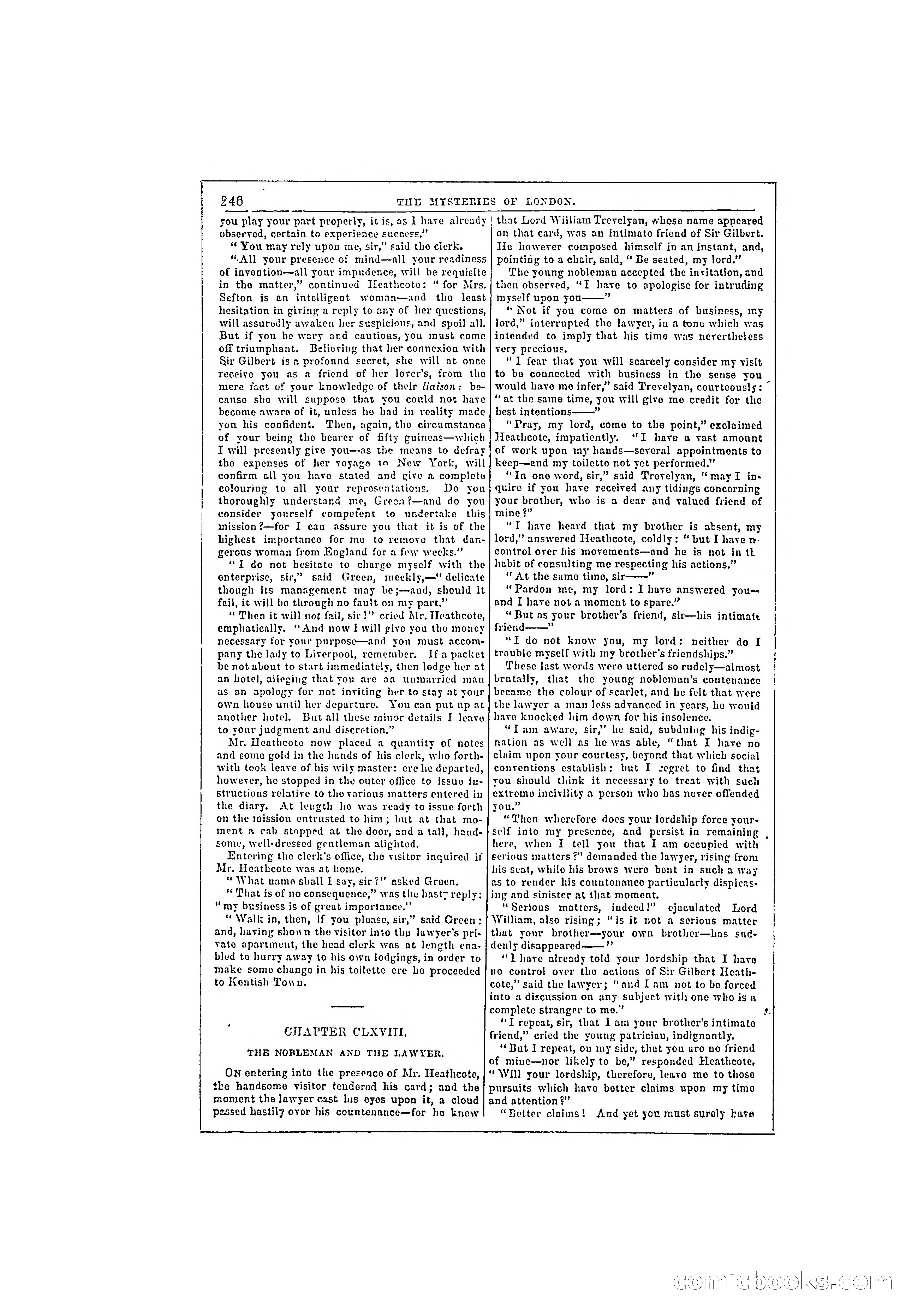
A restored page from Penny Dreadfuls, 1846. Page through the whole issue in the reader above.
📄 Transcribed text from this page (OCR, searchable)
Machine-transcribed from the original scan — historical spelling and the odd misread are preserved.
THE 246 sou play your part property, itis, as 1 have already observed, certain to experience success,” “You may rely upon me, sir,” said tho clerk. “All your presence of mind—~all your readiness of invention—all your impudence, will be requisite in the matter,” continued Heathcote: “ for Mrs. Sefton is an intelligent woman—and the least hesitation in giving a reply to any of lier questions, will assuredly awaken ber suspicions, and spoil all. But if you be wary and cautious, you must come off triumphant. Believing that her connexion with Sir Gilbert is a profound secret, she will at once receive you as a friend of her lover’s, from the | mere fact of your knowledge of their liaison: be- cause she will suppose that you could not have become aware of it, unless he had in reality made you his confident. Then, again, the circumstance ! of your being the bearer of fifty guineas—which | I will presently give you—-as the means to defray the expenses of her voyage ta New York, will confirm all you have stated and give a complete colouring to all your reprosentations. Do you thoroughly understand me, Greon?’—and do you consider yourself competent to undertake this mission’—for I can assure you that it is of the highest importance for mo to remove that dan- gerous woman from England for a few weeks.” “TI do not hesitate to chargo myself with the enterprise, sir,’ said Green, meekly,— delicate though its management may be;—and, should it fail, it will be through no fault on my part.” “Then it will not fail, sir!” pany the lady to Liverpool, remember. own house until her departure, another hotel. to your judgment and discretion.” Mr. Heathcote now placed a quantity of notes and somo gold in the hands of his clerk, who forth- with took leave of his wily master: ere he departed, however, he stopped in the outer office to issue in- structions relative to the various matters entered in the diary. At length he was ready to issue forth on the mission entrusted to him; but at that mo- ment a cab stopped at the door, and a tall, hand- Entering the clerk's office, the visitor inquired if Mr. Heathcote was at home. * What namo shall I say, sir?” asked Green. “That is of no consequence,” was the hasty reply: “my business is of great importance.” “Walk in, then, if you please, sir,’ said Green: and, having shown the visitor into thy lawyer's pri- vate apartment, the head clerk was at length ena- bled to hurry away to his own lodgings, in order to make some chango in his toilette ere ho proceeded some, Well-dressed gentleman alighted. | : to Kontish Town. CHAPTER CLAVHI. THB NOBLEMAN AND THE LAWYER. ON entering into the presence of Mr. Heathcote, the handsome visitor tendered his card; and the moment the lawyer cast lus eyes upen it, a cloud passed hastily ovor his countenance—for hoe know MYSTENRICS OF cried Mr. Heathcote, emphatically, “And now I will give you the money necessary for your purpose—and you must accom- If a packet be not about to start immediately, then lodge her at an hotel, alleging that you are an unmarried man as an apology for not inviting her to stay at your You can put up at But all these minor details I leave LONDON, 1 that Lord William Trevelyan, whese name appeared on that card, was an intimate friend of Sir Gilbert. He however composed himself in an instant, and, pointing to a chair, said, ‘‘ Be seated, my lord.” The young nobleman accepted tho invitation, and then observed, “I have to apologise for intruding myself upon you a “ Not if you come on matters of business, my lord,” interrupted the lawyer, in a tone which was intended to imply that his time was nevertheless very precious. ‘YT fear that you will scarcely consider my visit to be connected with business in the sense you would have me infer,” said Trevelyan, courteously: ‘at the same time, you will give me credit for the best intentions ‘s “Pray, my lord, come to the point,” exclaimed Iicathcote, impatiently. “I have a vast amount of work upon my hands—sereral appointments to keep—end my toiletto not yet performed.” “In ono word, sir,” said Trevelyan, “ mayI in- quire if you have received any tidings concerning your brother, who is a dear and valued friend of mine 2” “YT have heard that my brother is absent, my lord,” answered Heathcote, coldly: “but J have n- control over his movements—and he is not in tl habit of consulting me respecting his actions.” ‘At the same timo, Sir i “Pardon mc, my lord: I have answered you and I have not a moment to spare.” * But as your brother’s friend, sir—his intimate friend - “fF do not know you, my lord: neither do I trouble myself with my brother's friendships.” These last words were uttered so rudely—almost brutally, that the young nobleman’s coutenance became tho colour of scarlet, and he felt that were the lawyer a man less advanced in years, ho would have knocked him down for his insolence. “Tam aware, sir,’ he said, subduing his indig- nation as well as le was able, “that I have no cluim upon your courtesy, beyond that which social conventions establish: but I sepret to find that you should think it necessary to treat with such extremo incivility a person who has never offended you.” “Then wherefore docs your lordship force your- self into my presence, and persist in remaining here, when I tell you that I am occupied with scrious matters ¢” demanded tho lawyer, rising from his seat, whilo his brows wero bont in such a way as to render his countenance particularly displeas- ing and sinister at that moment. ‘‘Serlous matters, indeed!’ ojaculated Lord William, also rising; “is it not a serious matter that your brother—your own brother—has sud- dently disappeared sas “V have already told your lordship that I have no control over tho actions of Sir Gilbert Heath- cote,” said the lawyer; “and Iam not to be forced into a discussion on any subject with one who is a complete stranger to mo.” f, ‘‘T repeat, sir, that Iam your brother’s intimate friend,” cried the young patrician, indignantly. ‘* But I repeat, on my side, that you are no friend of minc—nor likely to be,” responded Heathcote, “Will your lordship, therefore, leave mo to those pursuits which have better claims upon my timo and attention ?” “Better claims! And yet you must suroly bare an a a a a ccc a ect ata aaa acta Anta a te ee a a GIOOKS (SO) (SO)