
Penny Dreadfuls, 1846 · page 260 of 399
The Mysteries of London, Vol. IV — page 260: what you’re looking at
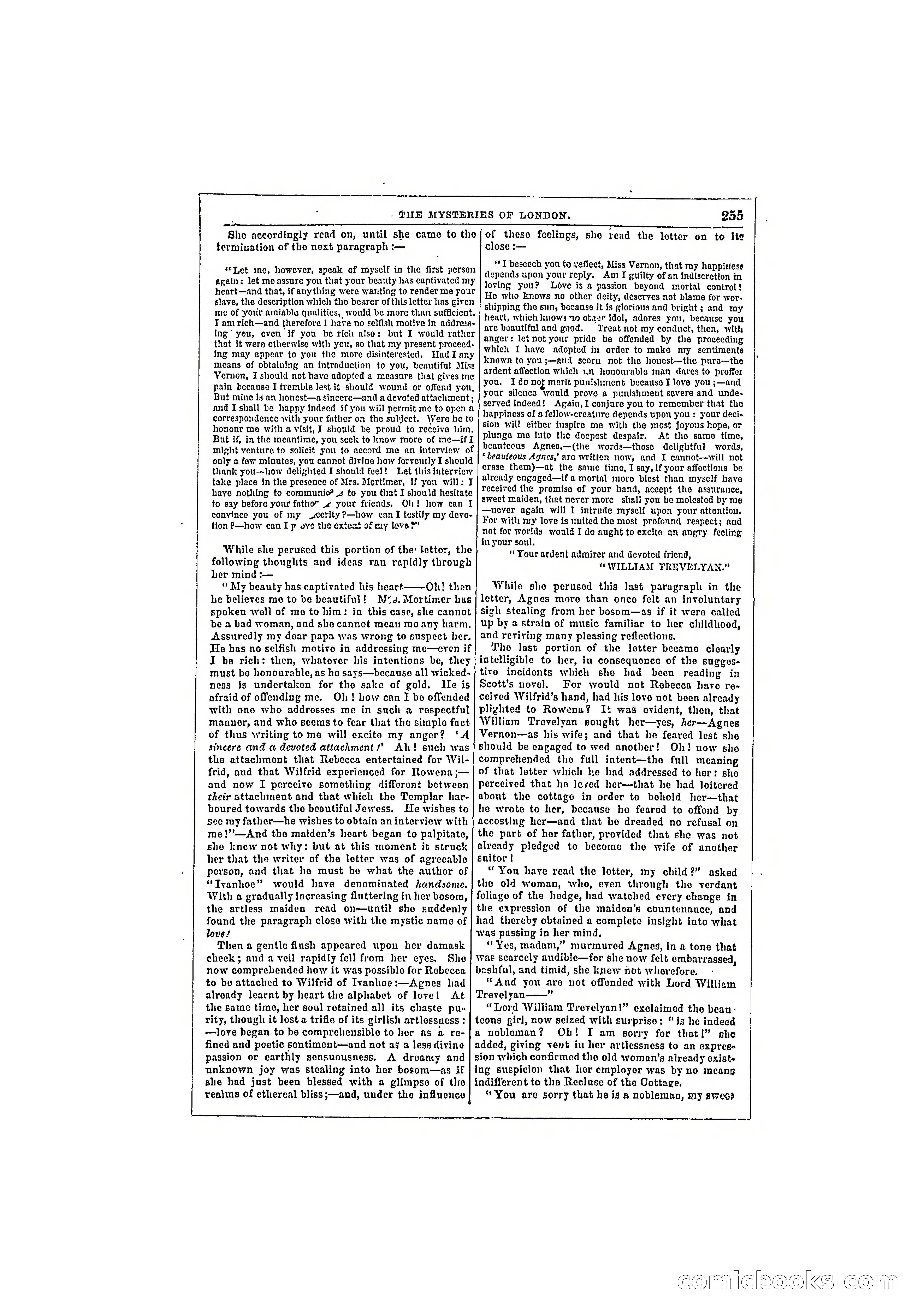
A restored page from Penny Dreadfuls, 1846. Page through the whole issue in the reader above.
📄 Transcribed text from this page (OCR, searchable)
Machine-transcribed from the original scan — historical spelling and the odd misread are preserved.
/ THE MYSTERIES OF LONDON. Sho accordingly read on, until she came to the fermination of the next paragraph :— ‘*Let me, however, speak of myself in the first person again: let me assure you that your beauty has captivated my heart—and that, if anything were wanting to render me your slave, the description which the bearer ofthis letter has given me of your amiable qualities, would be more than sufficient. Tam rich—and therefore | have no selfish motive in address- ing you, even if you be rich also: but I would rather that it were otherwise with you, so that my present procecd- ing may appear to you the more disinterested. ad I any means of obtaining an introduction to you, beautifal Miss Vernon, I should not have adopted a measure that gives me pain because I tremble lest it should wound or offend you, But mine id an honest—a sincere—and a deyoted attachment ; and I shall be happy indeed if you will permit me to open a correspondence with your father on the subject. Were bo to honour me with 4 visit, I should be proud to receive him. But if, in the meantime, you seck to know more of me—if I might venture to solicit you to accord me an interview of only a few minutes, you cannot divine how fervently I should thank you—how delighted I should feel! Let this interview take place in the presence of Mrs. Mortimer, if you will: I have nothing to communioc?_s to you that I should hesitate to say before your fatho” Uc your friends. Oh! how can I convince you of my Ucerity ?—how can I testify my devo- tion P—how canI p ovs the extent of my lave * While she perused this portion of the: lottor, the following thoughts and ideas ran rapidly through her mind :— “My beauty has captivated his heart———-Oh! then he believes me to bo beautiful! M%e. Mortimer has spoken well of me to him: in this case, she cannot be a bad woman, and she cannot mean mo any harm. Assuredly my doar papa was wrong to suspect her. He has no selfish motive in addressing me—even if I be rich: then, whatover his intentions be, they must bo honourable, as he sars—becauso all wicked- ness is undertaken for tho sake of gold. He is afraid of offending me. Oh! how can I bo offended with one who addresses me in such a respectful manner, and who seems to fear that the simple fact of thus writing to me will excito my anger? ‘A sincere and a devoted attachment /?’ Ah! such was the attachment that Rebecca entertained for Wil- frid, and that Wilfrid experienced for Rowena ;— and now I perceive something different betweon their attachinent and that which the Templar har- boured towards the beautiful Jewess. He wishes to see my father—he wishes to obtain an interview with me!”’—And the maidon’s heart began to palpitate, she knew not why: but at this moment it struck her that the writer of the letter was of agreeable person, and that he must be what the author of “Tyvanhoe” would have denominated handsome, With a gradually increasing fluttering in her bosom, the artless maiden read on—until she suddenly found the paragraph close with the mystic name of love! Then a gentle flush appeared upon her damask cheek ; and a veil rapidly fell from her eyes, Sho now comprehended how it was possible for Rebecca to be attached to Wilfrid of Ivanhoe:—Agnes had already learnt by heart the alphabet of love! At the same time, her soul retained all its chaste pu» rity, though it losta trifle of its girlish artlossness : —love began to be comprehensible to her as a re- fined and poetic sentiment—and not ag a less divine passion or earthly sensuousness. A dreamy and unknown joy was Stealing into her bosom—as if she had just been blessed with a glimpse of tho realms of ethereal blisss—and, under the influence 255 of these feelings, sho read the letter on to ite close :— ‘I beseech you to veflect, Miss Vernon, that my happirtese depends upon your reply. Am I guilty of an indiscretion in loving you? Love is a passion beyond mortal control! He who knows no other deity, deserves not blame for wor- shipping the sun, becauso it is glorious and bright; and my heart, which knows “t otuzr idol, adores yon, because you are beautifal and gaod. Treat not my conduct, then, with anger: let not your pride be offended by the procecding which I have adopted in order to make my sentiments known to you ;~—and scorn not the lonest—the pure—tho ardent affection which un honourable man dares to proffer you. I donot morit punishment because I love you ;—and your silences would prove a punishment severe and unde- served indeed! Again, I conjure you to remember that the happiness of a fellow-creature depends upon you: your deci- sion will either inspire me with the most joyous hope, or plunge me into the deepest despair. At the same time, beantecus Apnes,—(the words—those delightful words, ‘ beauleous Agnes,’ are written now, and I cannot—will not erase them)—at the same time, I say, if your affections be already engaged—if a mortal moro blest than myself have received the promise of your hand, accept the assurance, swect maiden, thet never more shall you be molested by me —never again will I intrude myself upon your attention. For with my love fs nuited the most profound respect; and not for worlds would I do aught to excite an angry fecling in your soul. “Your ardent admirer and devoted friend, ‘WILLIAM TREVELYAN.” While she perused this last paragraph in the letter, Agnes moro than onco felt an involuntary sigh stealing from her bosom—as if it were called up by a strain of music familiar to her childhood, and reviving many pleasing reflections. The last portion of the letter became clearly [intelligible to her, in consequence of the sugges- tive incidents which she had beon reading in Scott’s novel. For would not Rebecca have re- ceived Wilfrid’s hand, liad his love not been already plighted to Rowena? It was evident, then, that William Trevelyan sought her—yes, her—Agnes Vernon—as his wife; and that he feared lcst she should be engaged to wed another! Oh! now she comprehended tho full intent—tho full meaning of that letter which he had addressed to her: she perceived that he Ieved her—that he had loitcred about the cottage in order to behold her—that he wrote to her, because he feared to offend by accosting her—and that he dreaded no refusal on the part of her father, provided that she was not already pledged to become the wife of another Buitor ! “You have read the letter, my child?” asked the old woman, who, even through the verdant foliage of the hedge, had watched every change in the expression of tlie maidon’s countenance, and had thereby obtained a complete insight into what was passing in her mind, “Yes, madam,” murmured Agnes, in a tone that was searcely audible—for she now felt embarrassed, bashful, and timid, she knew not wherefore. ‘And you are not offended with Lord Williem Trevelyan——” “Gord William Trevelyan!” exclaimed the bean - teous girl, now seized with surprise: “Is he indeed a nobleman? Ob! I am sorry for that!” she added, giving vent in her artlessness to an exprege sion which confirmed the old woman’s aiready existe ing suspicion that her employer was by no meang indifferent to the Recluse of the Cottage. “You are sorry that he is a nobleman, my swes3 (C(O) (C DOO <S LL (SO)