
Penny Dreadfuls, 1846 · page 267 of 399
The Mysteries of London, Vol. IV — page 267: what you’re looking at
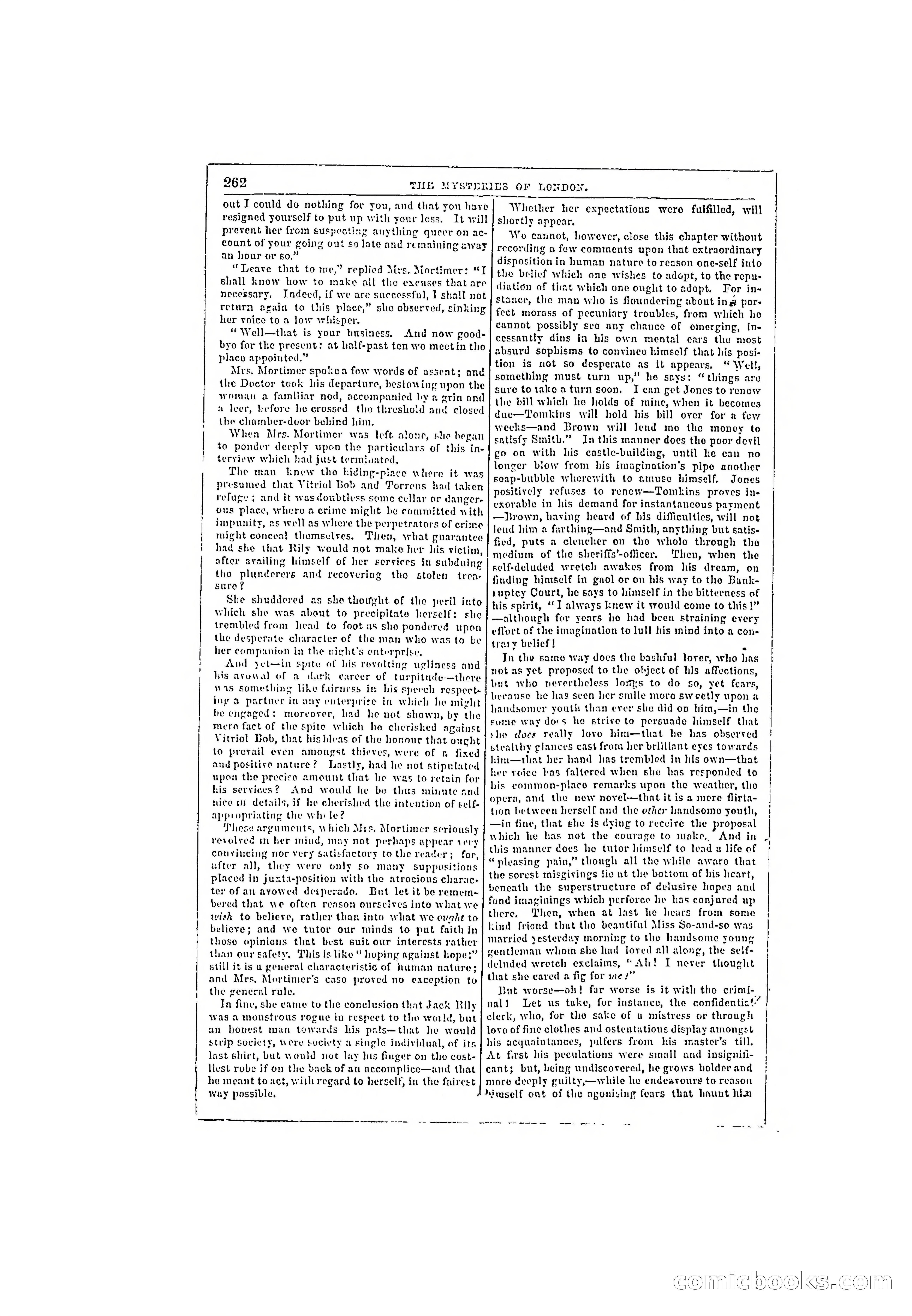
A restored page from Penny Dreadfuls, 1846. Page through the whole issue in the reader above.
📄 Transcribed text from this page (OCR, searchable)
Machine-transcribed from the original scan — historical spelling and the odd misread are preserved.
262 TILE out I could do nothing for you, and that you have resigned yourself to put up with your loss. It will prevent her from suspectisg anything queer on ac- count of your going ont so late and remaining away an hour or s0.” “Leave that to me,” replied Mrs. Mortimer: “JT shall know how to make all tho excuses that are necessary. Indeed, if we are successful, ] shall not return again to this place,” sie observed, sinking her voice to a low whisper. Well—that is your business. And now good- bye for the present: at half-past ten wo meetin tho place appointed.” Mrs, Mortimer spokea few words of assent: and the Doctor teok his departure, bestowing upon the woman a familiar nod, accompanied by a grin and a leer, before he crossed the threshold and closed the chamber-door beltind him. When Mrs. Mortimer was left alone, se began to ponder deeply upon the particulars of this in- terview which had just termiuated, The man knew tho hiding-place where it was presumed that Vitriol Bob and Torrens had taken refuge; and it was doubtless some ccllar or dangere ous place, where a crime might be committed with impunity, as well as where the perpetrators of crime might conceal themselves. Then, what guarantee had sho that Rily would not make her his victim, after availing himsclf of her services in subduing tho plunderers and recovering tho stolen trea- sure ? She shuddered as sho thought of the peril into which she was about to precipitate herself: she trembled from lead to foot as sho pondered upon the desperate character of the man who was to be her companion in the night's enterprise. And yet—in spite of his revolting ugliness and his avowal of a dark earcer of turpitude—there was something like fairness in his speech respect- ing a partner in any enterprise in whieh he might be engaged: moreover, had he not shown, by the mero fact of the spite which he cherished against Vitriol Bob, that hisideas of the honour that oucht to prevail even amongst thieves, were of an fixed and positive nature?) Lastly, had he not stipulated upou the preciso amount that he was to retain for his services? And would he be thus minute and nice m details, if hie cherished the intention of eelf- appropriating the whe le? These arguments, which Mrs. Mortimer seriously revolved in her mind, may not perhaps appear very convincing nor very satisfactors to the reader; for, after all, they were only so many suppusitions placed in juxta-position with the atrocions charac- ter of an avowed desperado. But let it be remem- bered that we often reason ourselves into what we wish to believe, rather than into what we oughe to believe; and we tutor our minds to put faith in thoso opinions that best suit our intorests rather than our safety, This is like “ hoping agaiust hope:” still it is a general characteristic of human nature; and Mrs, Mertimer’s caso proved no exception to the gencral rule. In fine, she camo to the conclusion that Jack Rily was a monstrous rogue in respect to the world, but an honest man towards his pals—that he would strip Socicty, were society a single individual, of its last shirt, but would not Jay his finger on the cost- liest robe if on the back of an accomplice—and that ho meant to act, with regard to herself, in the fairest way possible, eee MYSTERICS OF LONDON. Whether her expectations wero fulfilled, will shortly appear, Wo cannot, however, close this chapter without recording a few comments upon that extraordinary disposition in human nature to reason one-self into the belief which one wishes to adopt, to the repu- diation of that which one ought to adopt. For in- stance, the man who is floundering about ing por- fect morass of pecuniary troubles, from which he cannot possibly seo any chance of emerging, in- cessantly dins in his own mental ears tho most absurd sophisms to convince himsclf that his posi- tion is not so desperate as it appears. “Well, something must turn up,” ho says: “things are sure totakoaturn soon. I can get Jones to renew the bil which he holds of mine, when it becomes duc—Tomkins will hold his bill over for a few weeks—and Brown will lend mo tho monoy to satisfy Smith.’ In this manner docs tho poor devil go on With his castic-building, until he can no longer blow from his imagination’s pipo another soap-bubble wherewith to amuso himself. Jones positively refuses to renew—Tombliins proves ine exorablo in his demand for instantaneous payment —Brown, having heard of his difficultics, will not lend him a farthing—and Smith, anything but satis- fied, puts a clencher on the wholo through the medium of tho sheriffs’-officer. Then, when the sclf-duluded wretch awakes from his dream, on finding himsclf in gaol or on his way to tho Bank- ruptcy Court, lio says to himself in tho bitterness of his spirit, ‘I always knew it would come to this!” —although for years he had been straining every effort of the imagination to lull his mind into a con- trary belicf! . In the same way docs the bashful lover, who has not as yet proposed to the object of his affections, but who nevertheless lots to do so, yet fears, becanse he has seen her smile more sweetly upon a handsomer youth than ever she did on him,—in the come way dors ho strive to persuade himself that the does really lovo him—that ho has observed | stealthy glances cast from her brilliant eyes towards | him—that her hand has trembled in his own—that | her voice bas faltered when she has responded to his common-placo remarks upon the weather, tho | | | opera, and tho now novel-—that it is a mero flirta- tron between herself and the etker handsomo youth, —in fine, that she is dying to reecive the proposal which he has not the courage to make. And in this manner does ho tutor himself to lead a life of “pleasing pain,” though all the whilo aware that the sorest misgivings fio ut the bottom of his heart, beneath the superstructure of deulusive hopes and fond imaginings which perforce he has conjured up there. Then, when at last he hears from some hind friend that the beautiful Aliss So-and-so was married yesterday morning to the handsomo young gontieman whom shoe had loved all along, the self- deluded wretch exclaims, “Ah! I never thought that she cared a fig for aes” But worse—oh! far worse is it with tho crimi- nal! et us take, for instanee, the confidentiat” clerk, who, for the sako of a mistress or through love of fine clothes and ostentatious display amongst his acquaintances, yulfers from his master’s till. At first his peculations were sinall and insigniti- cant; but, being undiscovered, he grows bolder and moro deeply guilty,—while he endeavours to reason Aimsclf ont of the agonising fears that haunt hia wm ee ee we ek ~= GIOOKS (SO) (SO)