
Penny Dreadfuls, 1846 · page 269 of 399
The Mysteries of London, Vol. IV — page 269: what you’re looking at
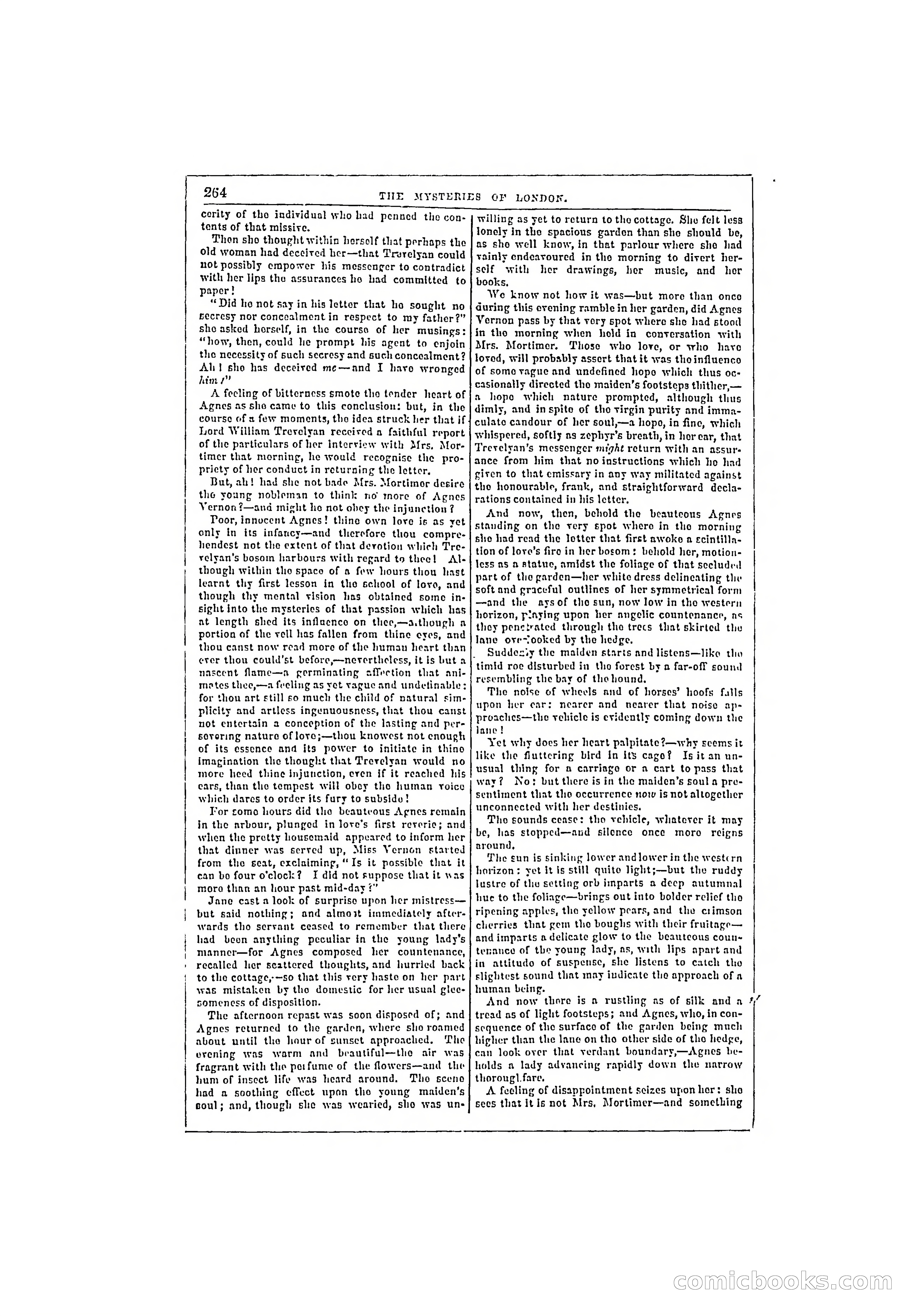
A restored page from Penny Dreadfuls, 1846. Page through the whole issue in the reader above.
📄 Transcribed text from this page (OCR, searchable)
Machine-transcribed from the original scan — historical spelling and the odd misread are preserved.
ee ee a A EY ew FS EP tS GPU es UA SS hse" pee i nei eet ar __— oor ea ete, pee en rr a of a 264 THE MYSTERIES GF LONDON. cerity of tho individual who had penned tho con- tents of that missive. Then sho thought within hersolf that perhaps the old woman had deceived ber—that Trevelyan could not possibly empower his messenger to contradict with her lips the assurances ho had committed to paper! “Did ho not say in his letter that ho sought no Becresy nor concealment in respect to my father?” she asked horself, in the course of her musings: “how, then, could he prompt his agent to enjoin the necessity of such secresy and such concealment? Ali! sho has deceived me—-and I have wronged him 7” A fecling of bitterness smote the tender heart of Agnes as she came to this conclusion: but, in the course of a few moments, the idea struck her that if Lord William Trevelyan received o faithful report of the particulars of her interview with Mfrs, Mor- timer that morning, he would recognise the pro- priety of her conduct in returning the letter, But, ah! had she not bade Mrs. Mortimor desire the young nobleman to think no more of Agnes Vernon ?—and might he not obcy the injunction ? Poor, innocent Agnes! thine own love is as yet only in its infancy—and therefore thou compre- hendest not the extent of that devotion which Tre- relyan’s bosom harbours with regard to thee! Al- though within tho spaco of a few hours thou Inst learnt thy first lesson in the school of love, and though thy mental vision has obtained somo in- sight into the mysterles of that passion which has at length shed its inflacnco on thee,—a.though a portion of the vell has fallen from thine eyes, and thou canst now read more of the human heart than ever thou could’st before,—nevertheless, it is but a} nascent flame—a germinating affection that ani- mates thee,—a fecling as vet vague and undetinable: for thou art still so much the child of natural sim- plicity and artless ingenuousness, that thou canst not entertain 2 conception of the lasting and per- sovoring nature of lore;—thou knowest not cnough of its essence and its power to initiate in thino imagination the thought that Trevelyan would no more heed thine injunction, even if it reached his ears, than tho tempest will obey the human roice which dares to order its fury to subside! Tor como hours did tha beauteous Agnes remain in the nrbour, plunged in love’s first reverio; and when the pretty housemaid appeared to inform her that dinner was served up, Miss Vernon started from the seat, exclaiming, “Is it possible that it can bo four o'clock? I did not suppose that it was more than an hour past mid-day ©” Jane cast a look of surprise upon her mistress— but said nothing; and almost immediately after- wards tho servant ceased to remember that there had been anything peculiar in the young lady's manner—for Agnes composed her countenance, recalled her scattered thoughts, and hurried back to the cottage, so that this very haste on lier part was mistaken by tho domestic for her usual glee- somencss of disposition. The afternoon repast was soon disposed of; and Agnes returned to the garden, where she roamed about until the Jiaur of sunset approached. The eyening was warm and beautiful—the air was fragrant with the porfume of the flowers—and the hum of insect life was heard around. Tho scene had a soothing cffect upon the young maiden’s soul; and, though slic was wearied, sho was uns a willing as yet to return tothecottage. She felt less lonely in the spacious garden than she should be, as she well know, in thet parlour where sho had vainly endeavoured in the morning to divert her- self swith her drawings, her music, and her books, We know not how it was—but moro than onco during this evening ramble in her garden, did Agnes Vernon pass by that very spot where she had stood in tho morning when hold in conrersation with Mrs. Mortimer. Those who love, or who havo loved, will probably assert that it was thoinfluenco of some vague and undefined hopo which thus oc- casionally directed tho maiden’s footsteps thitler,— a hopo which nature prompted, although thus dimly, and inspite of tho virgin purity and imma- culate candour of her soul,—a hops, in fine, which whispered, softly ns zephyr’s breath, in herear, that Trevelyan’s messenger might return with an assur. ance from him that noinstructions which ho had given to that cmissary in any way militated against the honourable, frank, and straightforward decla- rations contained in his lctter. And now, then, behold the beauteous Agnes standing on the very spot whero in tho morning sho had read the letter that first nwoke a ecintilla- tion of love’s firo in her bosom: behold her, motion- less as a statue, amidst the foliage of that secluded part of the garden—her white dress delineating the softand graceful outlines of her symmetrical form —and the aysof tho sun, now low in the western horizon, finying upon ber angelic countenance, as thoy penetrated through the trecs that skirted the Jane ovelooked by the hedge. Suddesiy the maiden starts and listens—like uw timid roe disturbed in tho forest by a far-off sound resembling the bay of the hound, The noise of wheels and of horses’ hoofs falls upon her car; nearer and nearer that noise ap- proaches—the vehicle is evidently coming down the inte ! Yet why does her heart palpitate?—why scems it like the fluttering bird in its cago? Is itan un- usual thing for no carringo or a cart to pass that war? No: but there is in the maiden’s soul a pre- sentiment that tho occurrence nov is not altogether unconnected with her destinies. Tho sounds cease: tho vehicle, whatever it may be, has stopped—and silonce once moro reigns nround, The cun is sinking lower andlower in the westcrn horizon: yet it is still quito light;—but the ruddy lustre of thy setting orb imparts a deep autumnal hue to the foliage—bdrings out into bolder relief the ripening apples, the yellow pears, and the crimson cherries that gem tho boughs with their fruitage— and imparts a delicate glow to the beautcous coun- tenance of the young Indy, a5, with lips apart and in attitudo of suspense, she Hstens to catch tho slightest sound that may indicate the approach of a human being. And now thore is a rustling as of silk and a: tread as of light footsteps; and Agnes, who, in con- sequence of the surface of the garden being much higher than the lane on tho other side of tho hedge, can look over that verdant boundary,—aAgnes be- holds a lady advancing rapidly down the narrow thorougl.fare. A feeling of disappointment seizes upon her: sho sees that itis not Mrs, Mortimer—and something EConnicloooks (CO)