
Penny Dreadfuls, 1846 · page 289 of 399
The Mysteries of London, Vol. IV — page 289: what you’re looking at
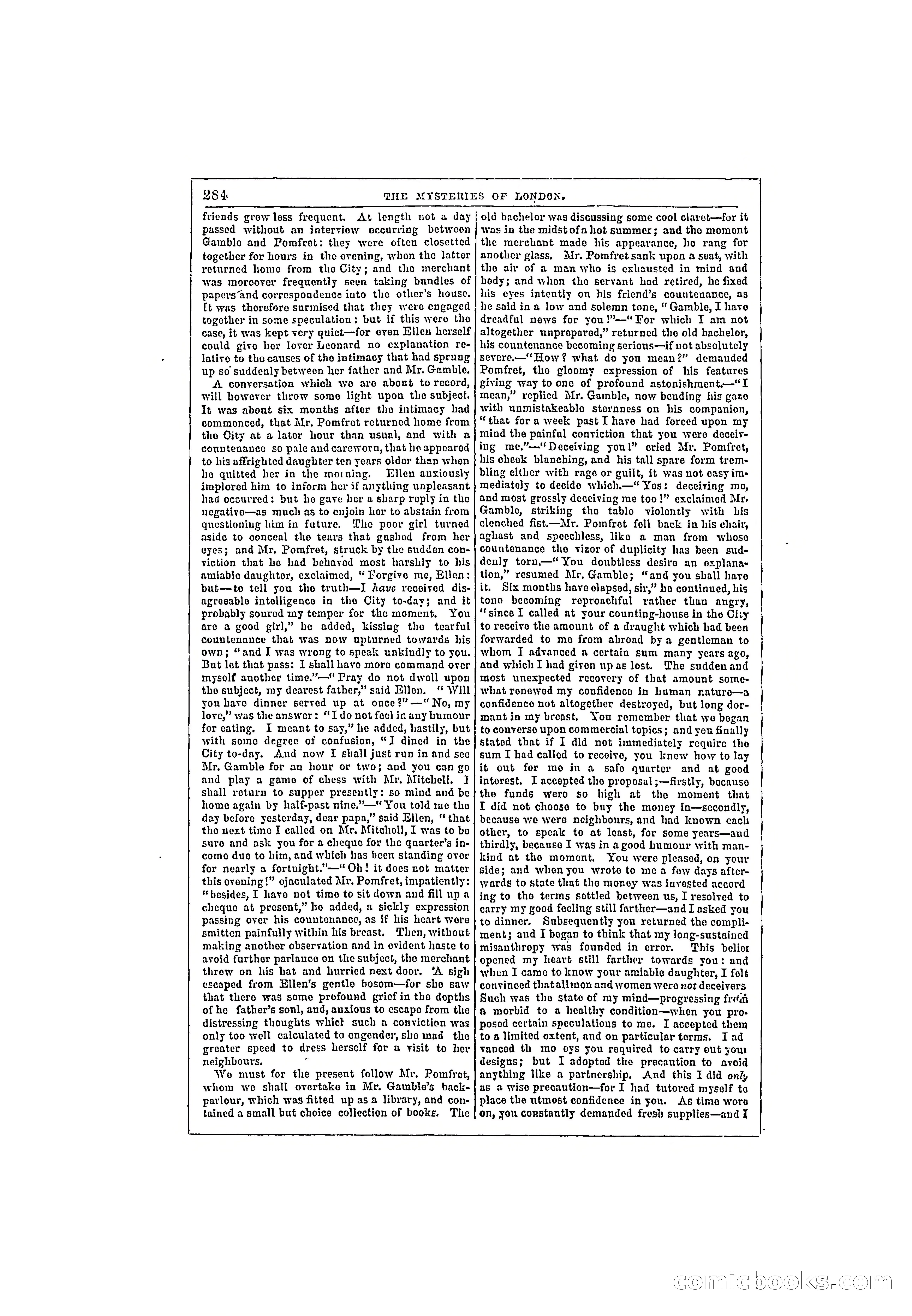
A restored page from Penny Dreadfuls, 1846. Page through the whole issue in the reader above.
📄 Transcribed text from this page (OCR, searchable)
Machine-transcribed from the original scan — historical spelling and the odd misread are preserved.
254 TIE MYSTERIES OF LONDON, friends grew less frequent. At length not a day passed without an interview occurring between Gamble and Pomfrot: they were often closetted together for hours in the evening, when tho latter returned homo from the City; and tho merchant was moroorer frequently seen taking bundles of papors‘and correspondence into the other’s house. (t was thorefore surmised that they wero engaged together in some speculation: but if this wero the case, it was kept very quiet—for even Ellen herself could give her lover Leonard no explanation re- lativo to the causes of the intimacy that had spruog up so suddenly between her father and Mr. Gamble. A conversation which wo are about to record, will however throw some light upon tlie subject. It was about six months after tho intimacy had commonced, that Mr. Pomfret returned home from tho City at a later hour than usual, and with a countenance so pale and careworn, that he appeared to his affrighted daughter ten years older than whon he quitted her in the morning. Ellen anxiously implored him to inform her if anything unpleasant had occurred: but he gave her a sharp reply in tho nepatiyo—as much as to enjoin hor to abstain from questioniug him in future. The poor girl turned aside to conceal the tears that gushod from her eyes; and Mr, Pomfret, struck by the sudden con- viction that he had behayed most harshly to his amiable daughter, exclaimed, “Forgive me, Elicn: but—to tell sou tho truth—I Aave recoived dis- agreeable intelligence in the City to-day; and it probably soured my temper for the moment, You are a good girl,” he added, kissing tho tearful countenance that was now upturned towards his own; “and I was wrong to speak unkindly to you. But let that pass: I shall have more command over myself another time.”—" Pray do not dwell upon tho subject, my dearest father,” said Ellen. “ Will you have dinner served up at once?”—“ No, my love,” was the answer: “I do not fecl in any humour for eating. I meant to say,” he added, hastily, but with some degree of confusion, “I dined in the City to-day. And now [I shall just run in and seo Mr. Gamble for an hour or two; and you can go and play a game of chess with Mr. Mitchell. J shall return to supper presently: 50 mind and be home again by half-past nine.’— You told me the day before yesterday, dear papa,” said Ellen, “ that the nezt timo I called on Mr. Mitchell, I was to bo sure and ask you for a cheque for the quarter’s in- come due to him, and which has been standing over for nearly a fortnight.”—“ Oh! it does not matter this ovening!” ojaculated Mr. Pomfret, impatiently: “besides, I have not time to sit down and fill up a chequo at present,” he added, a sickly expression passing over his countenance, as if his heart wore smitten painfully within his breast. Then, without making another observation and in evident haste to avoid further parlance on the subject, the merchant throw on his hat and hurried next door. *A sigh escaped from Ellen’s gentle bosom—for she saw that there was some profound gricfin the dopths of ho father’s sonl, and, anxious to escape from the distressing thoughts whict such a conviction was only too well calculated to engender, sho mad _ the greater speed to dress herself for a visit to hor neighbours. - Wo must for the present follow Mr. Pomfret, whom we shall overtake in Mr. Gamble’s back- parlour, which was fitted up asa library, and con- tained a small but choice collection of books. The old bachelor was discussing some cool claret—for it was in the midst ofa hot summer; and the momont the merchant made his appearance, ho rang for another glass, Mr. Pomfretsank upon a seat, with the air of a man who is exhausted in mind and body; and whon the serrant bad retired, he fixed his eyes intently on his friend’s countenance, as he said in a low and solemn tone, “ Gamble, I havo dreadful news for you!”—“For which I am not altogether unprepared,” returned tho old bachelor, his countenance becoming serious—if not absolutely scvere,—" How ? what do you moan?” demanded Pomfret, the gloomy cxpression of his features giving way to one of profound astonishment—“ I mean,” replied Mr. Gamble, now bonding his gaze with unmistakeable sternness on his companion, “that fora week past I have had forced upon my mind the painful conviction that you were deceiv- ing me.”— ‘Deceiving you!” cried Mr. Pomfret, his cheek blanching, and his tall spare form trem- bling either with rage or guilt, it was not easy ime mediately to decide which.—* Yes: deceiving mo, and most grossly deceiving me too!” exclaimed Mr. Gamble, striking the tablo yiolontly with his clenched fist—Mr. Pomfret fell back in his chair, aghast and speechless, liko a man from whose countenance tho vizor of duplicity has been sud- denly torn.—* You doubtless desire an oxplana- tion,” resumed Mr. Gamble; “and you shall have it. Six months have clapsed, sir,” he continued, his tono becoming reproachful rather than angry, ‘since I called at your counting-house in the City to receive the amount of a draught which had been forwarded to me from abroad bya gentleman to whom I advanced a certain sum many years ago, and which I had givon up as Jost. The sudden and most unexpected recovery of that amount somo- what renewed my confidence in human nature—a confidence not altogether destroyed, but long dor- mantin my breast. You remember that we began to converse upon commercial topics; and yeu finally stated that if I did not immediately require the sum [ had called to recoive, you knew how to lay it out for mo in a safo quarter and at good interest. I accepted tho proposal ;—firstly, bocause the funds wero so high at the moment that I did not choose to buy the money in—seccondly, because we were neighbours, and had known each other, to speak to af least, for some years—and thirdly, because I was in a good humour with man- kind at the moment. You were pleased, on your Side; and when you wrote to mea few days after- wards to state that the money was invested accord ing to tho terms settled between us, I resolved to carry my good feeling still farther—andI asked you to dinner. Subsequently you returned the compli- ment; and I bogan to think that my long-sustained misanthropy was founded in error. This belier opened my heart still farther towards you: and when I came to know your amiable daughter, I felt convinced thatallmen and women were not deceivers Such was the state of my mind—progressing fre @ morbid to a healthy condition—when you pro: posed certain speculations to me. I accepted them to a limited oxtent, and on particular terms. I ad vanced th mo oys you required to carry out your designs; but I adopted the precaution to avoid anything like a partnership. And this I did only as a Wise precaution—for I had tutored myself ta place the utmost confidence in you. As time wore on, you constantly demanded fresh supplies—and 7 GIOOKS 5} (CO) (CO) >