
Penny Dreadfuls, 1846 · page 333 of 399
The Mysteries of London, Vol. IV — page 333: what you’re looking at
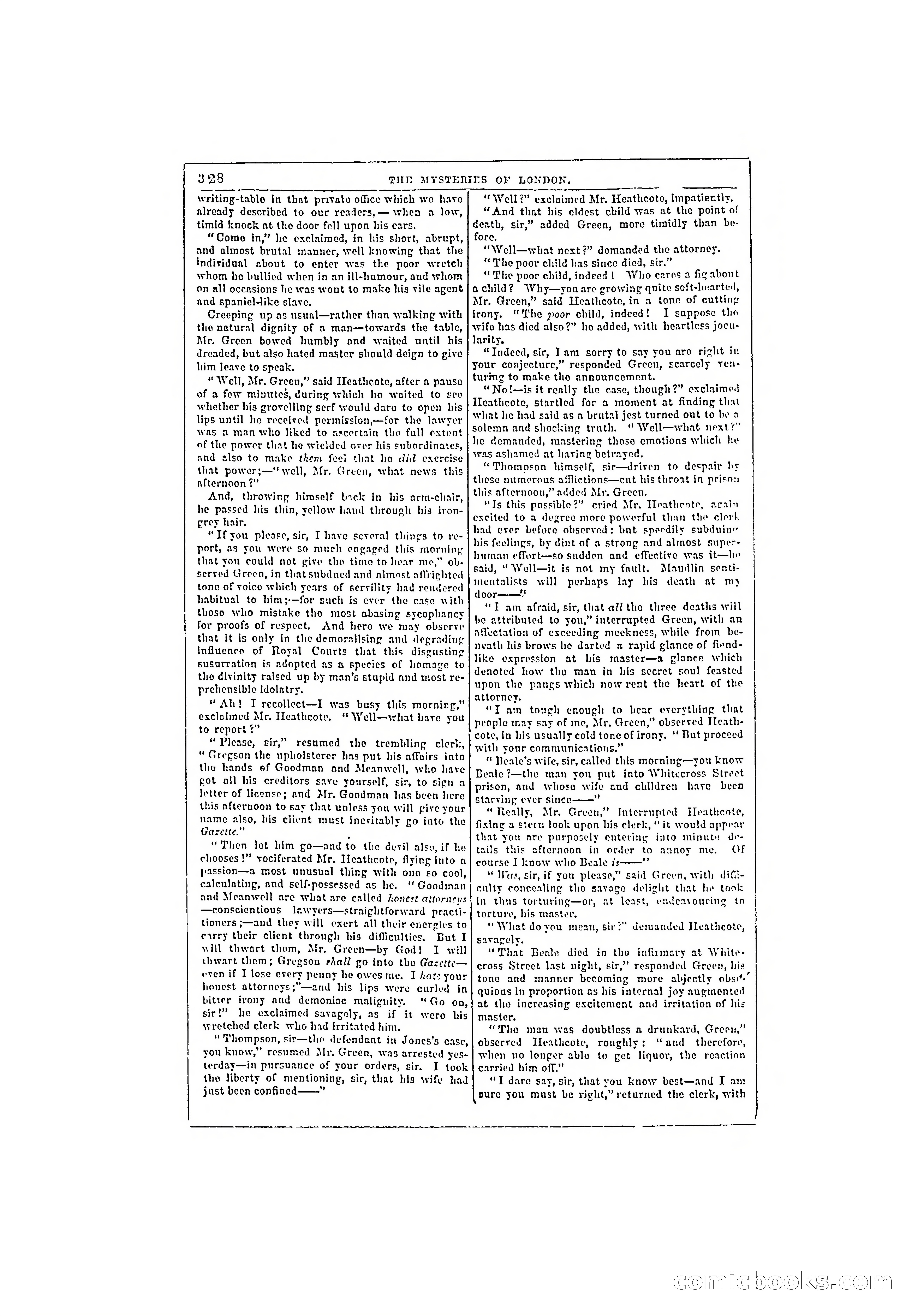
A restored page from Penny Dreadfuls, 1846. Page through the whole issue in the reader above.
📄 Transcribed text from this page (OCR, searchable)
Machine-transcribed from the original scan — historical spelling and the odd misread are preserved.
328 —ee eee oo Writing-tablo in that private office which we have niready described to our readers,— whicn a low, timid knock at tho door fell upon his cars. “Come in,” he exclaimed, in his short, abrupt, and almost brutal manner, well knowing that the individual about to enter was the poor wretch whom he bullied when in an ill-humour, and whom on all occasions he was wont to make his vile agent and spaniel-like slave. Creeping up as usual—rather than walking with tho natural dignity of 2 man—towards the table, Mr. Green bowed humbly and waited until his dreaded, but also hated master should deign to give him lTeave to speak, “Well, Mr. Green,” said Heathcote, after a pause of a fow minutes, during which ho waited to sec whether his grovelling serf would daro to open his lips until he received permission,—for the lawyer was a man who liked to sscertain the full extent of the power that he wiclded over his subordinates, and also to make them feel that he did exercise that power;—“ well, Mr. Green, what news this afternoon ¢” And, throwing himself bick in his arm-chair, he passed his thin, yellow hand through his iron- grey hair. “Tf you please, sir, I have several things to re- port, as you were so much engaged this morning that you could not give tho timo to hear me,” ob- served Green, in thatsubdned and almost affriphted tone of voice which years of servility had rendered habitual to him;-—for such is ever the case with thoso who mistake tho most abasing sycophancy for proofs of respect. and here wo may observe that it is only in the demoralising and degrading influence of Rosal Courts that this discusting susurration is adopted as a species of homage to tho divinity raised up by man’s stupid and most re- prehensible idolatry. “Ah! T recollect—I was busy this morning,” exclaimed Mr. Heathcote. “ Woll—what hare you to report ¢” “Please, sir,” resumed the trembling clerk, “Gregson the upholsterer has put his affairs into the hands ef Goodman and Meanwell, who have fot all his creditors save yourself, sir, to sign a letter of license; and Mr. Goodman has been here this afternoon to say that unless you will pive your name also, his client must inesitably go into the Gazette.” : “Then Iet him go—and to the devil also, if he chooses!” vociferated Mr. Ieathcote, flying into a passion—a most unusual thing with ono so cool, calculating, and self-possessed as he. ‘ Goodman and Meanwell are what are called honest attorneys —conscicntious Jnwyers—straightforward practi- tioners ;—and they will exert all their energies to cirry their client through his difficulties. But I will thwart thom, Mr. Green—by God! I will thwart them; Gregson shall go into the Gazette— even if I lose every penny he owes me. I hat: your honest attorneys;"—and his lips were curled in bitter irony and demoniac malignity. ‘Go on, sir!” he exclaimed savagely, as if it wero his wretched clerk who had irritated him. “Thompson, sir—the defendant in Jones's case, you know,” resumed Mr. Green, was arrested yes- terday—in pursuance of your orders, sir. I took the liberty of mentioning, sir, that his wife had just been confincd——” a NDT sc THE AYSTENIVS OF LONDON. a Well?” exclaimed Mr. Heathcote, impatiertly. “And that his eldest child was at the point of death, sir,” added Green, more timidly than be- fore. “Well—what next?” demanded the attorney. “The poor child has since died, sir.” The poor child, indeed! Who cares a fig about achild? Why—you aro growing quite soft-hearted, Mr. Greon,” said Ieathcote, in a tone of cutting irony. “The poor child, indeed! I suppose thie wifo has died also?” ho added, with heartless jocu- larity. “Indeed, sir, Jam sorry to say you aro right in your conjecture,” responded Green, scarcely ven- turmg to make tho announcement. “ No!—is it really the case, though?” exclaimed IIeathcote, startled for a moment at finding that what he had said as a brutal jest turned ont to be a solemn and shocking truth. ‘ Well—what next he demanded, mastering those cmotions which he was ashamed at having betrayed. “Thompson himself, sir—driven to despair bs these numerous afflictions—cut his throat in prison this afternoon,” added Mr. Green. “Ts this possible?” cried Mr. IIeatheote, again excited to a degree more powerful than the clerk had ever before observed: but speedily subduiny his feclings, by dint of a strong and almost super- human effort—so sudden and effective was it—he said, “ Well—it is not my fault. Maudlin senti- mentalists will perbaps Iay his death at my door L “JT am afraid, sir, that all the three deaths will be attributed to you,” interrupted Green, with an affectation of exceeding meekness, whilo from be- neath his brows he darted a rapid glance of fiend- like expression at his master—a glance which denoted how the man in his secret soul feasted upon the pangs which now rent the heart of the attorney. “Tam touch enough to bear everrthing that people may say of ine, Mr. Green,” observed Heath- cote, in his usually cold tone of irons. ‘‘ But proceed with your communications.” * Boale’s wife, sir, called this morning—you know Beale ?—the man you put into Whitecross Street prison, and whose wife and children have been starving ever since y “Teally, Mr. Green,” interrupted Heathcote, fixing a stern look upon his clerk, “it would appear that you are purposely entering into minuty de- tails this afternoon in order to annoy me. Of course I know who Beale is a “Was, sir, if you please,” said Green, with dim- culty concealing tho savago delight that he took in thus torturing—or, at least, endeavouring to torture, his master. “What do vou mean, sir 7’ demanded Heathcote, savaccely. That Beale died in tho infirmary at White- cross Street last night, sir,” responded Green, his tone and manner becoming more abjectly obs’ quious in proportion as his internal joy augmented at the increasing excitement and irritation of his master. “Tho man was doubtless a drunkard, Green,” observed Jleathcote, roughly: “and therefore, when no longer able to get liquor, the reaction carried him off.” “T dare say, sir, that you know best—and I am sure you must be right,” returned the clerk, with EConnicloooks | (SO)