
Penny Dreadfuls, 1846 · page 361 of 399
The Mysteries of London, Vol. IV — page 361: what you’re looking at
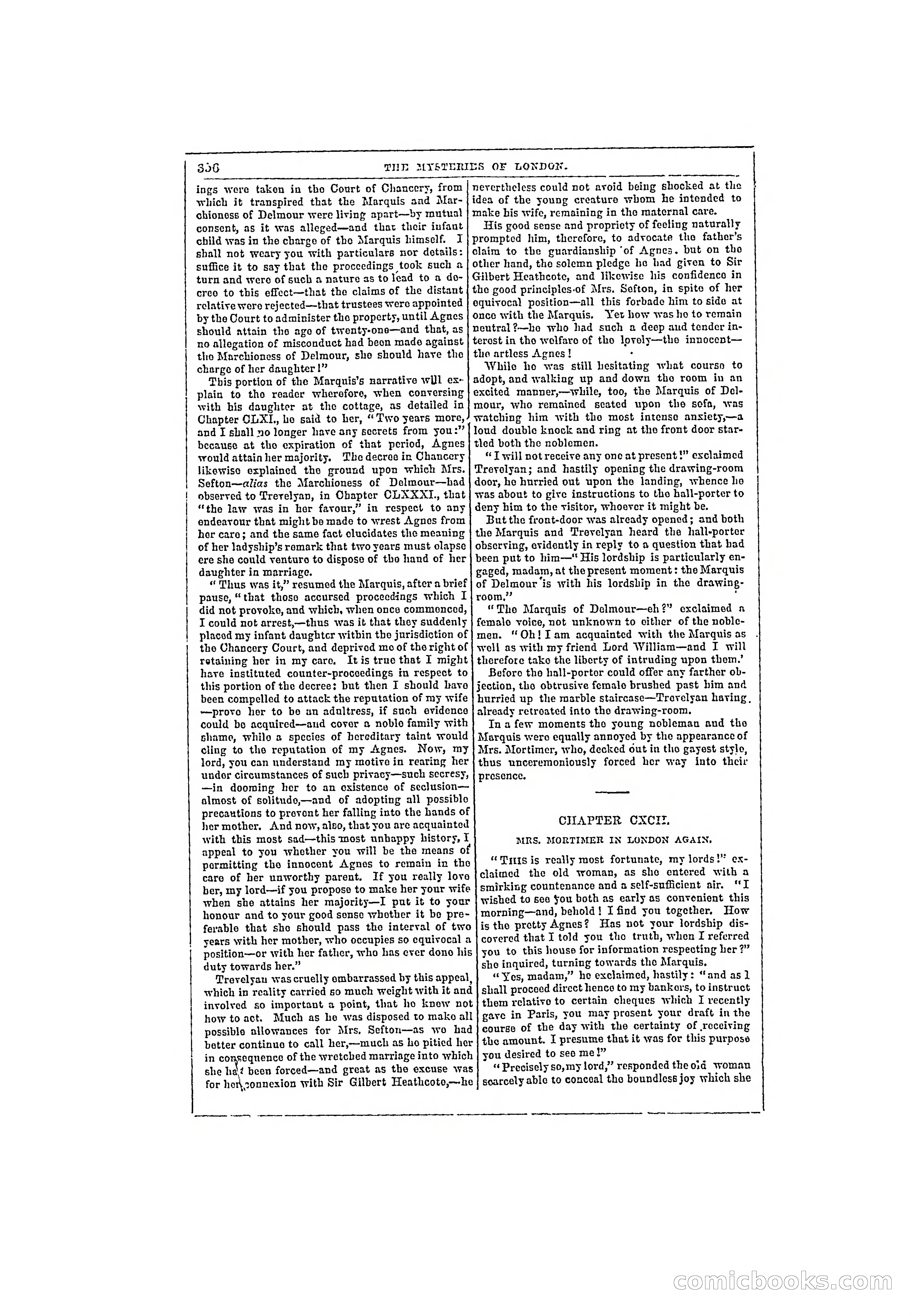
A restored page from Penny Dreadfuls, 1846. Page through the whole issue in the reader above.
📄 Transcribed text from this page (OCR, searchable)
Machine-transcribed from the original scan — historical spelling and the odd misread are preserved.
| | i. eam aaeuenine Oe ings were taken in the Court of Chancery, from TIE which it transpired that the Marquis and Mar- chioness of Delmour were living apart—by mutual consent, as it was alleged—and that their infant child was in the charge of the Marquis himself. J shall not weary you with particulars nor details: suffice it to say that the proccedings took such a turn and were of such a nature as to lead to a do- creo to this effect—that the claims of the distant relative wore rejected—that trustees were appointed by the Court to administer the property, until Agnes should attain the ago of twenty-one—and that, as no allegation of misconduct had beon made against tho Marchioness of Delmour, she should have the charge of her daughter!” This portion of the Marquis’s narrative will ex~ plain to tho reader wherefore, when conversing with his daughter at the cottage, as detailed in Chapter CLXI., he said to her, “Two years more; and I shall no longer have any secrets from you:’ because at the expiration of that period, Agnes wrould attain her majority. The decree in Chancery likewise explained the ground upon which Mrs. Sefton—alias the Marchioness of Delmour—had observed to Trerelyan, in Chapter CLAXAL,, that “the law was in her favour,” in respect to any endearour that might be made to wrest Agnes from hor care; and the same fact clucidates the meaning of her ladyship’s remark that two years must olapse ere she could venture to dispose of the hand of her daughter in marriage. “Thus was it,” resumed the Marquis, after a brief pause, “that those accursed proceedings which I did not provoke, and which, when once commenced, I could not arrest,—thus was it that they suddenly placed my infant daughtcr within the jurisdiction of the Chancery Court, and deprived me of the right of retaining hor in my care, Itis true that 1 might have instituted counter-proceedings im respect to this portion of the decree: but then I should lave been compelled to attack the reputation of my wife ——provo her to be un adaltress, if such evidence could be acquired—aud cover a noble family with shame, whilo a species of hereditary taint would cling to the reputation of my Agnes. Now, my lord, you can understand my motive in rearing her undor circumstances of such privacy—such secresy, —in dooming her to an osistence of seclusion— almost of solitude,—and of adopting all possiblo precautions to prevont her falling into the hands of her mother. And now, algo, that you are acquainted with this most sad—this most unhappy histors, I appeal to you whether you will be the means of permitting the innocent Agnes to remain in tho care of her unworthy parent. If you really love ber, my lord—if you propose to make her your wife when she attains her majority—I put it to your honour and to your good sense whother it be pre- ferable that she should pass the interval of two sears with her mother, who occupies so equivocal a position—or with her father, who has ever dono his duty towards her.” Trevelyan was cruelly embarrassed by this appeal, which in reality carried so much weight with it and involved so important a point, that ho knew not how to act. Much as he was disposed to make all possible allowances for Mrs, Sefton—as wo had better continue to call her,—much as ho pitied her in consequence of the wretched marriage into which she ha? been forced—and great as the excuse was for holsonnesion with Sir Gilbert Heathcoto,—he nevertheless could not avoid being shocked at the ne nl MYSTERIES OF LONDOR. = idea of the young creature whom he intended to make his wife, remaining in the maternal care. His good sense and propriety of feeling naturally prompted him, therefore, to advocate the father’s claim to the guardianship ‘of Agnes. but on tho other hand, the solemn pledge he had given to Sir Gilbert Heathcote, and likewise his confidence in the good principles-of Mrs. Sefton, in spite of her equivocal position—all this forbade him to side at once with the Marquis, Yet how was ho to remain neutral ?—ho who had such a deep aud tender in- terost in the welfare of the lorely—the innocent— the artless Agnes! , While he was still hesitating what courso to adopt, and walking up and down the room in an excited manner,—while, too, the Marquis of Del- mour, who remained seated upon the sefa, be watching him with the most intense ansiety,— loud double knock and ring at the front door Ls tled both the noblemen. “Twill not receive any one at present!” exclaimed Treyolyan; and hastily opening the drawing-room door, he hurried out upon the landing, whence he was about to give instructions to the bhall-porter to deny him to the visitor, whoever it might be. But the front-door was already opened; and both the Marquis and Trevelyan heard the hall-porter observing, evidently in reply to a question that had been put to him—* His lordship is particularly en- gaged, madam, at the present moment: the Marquis of Delmour ’ is with his lordship in the drawing- room,” “The Marquis of Delmour—eh?” exclaimed 1 femalo voice, not unknown to either of the noble- men. “Oh! Iam acquainted with the Marquis as well as with my friend Lord William—and I will therefore tako the liberty of intruding upon them.’ Beforo tho hall-portor could offer any farther ob- jection, tho obtrusive female brushed past him and hurried up the marble staircase—Trevelyan having, already retroated into tho drawing-room. In a few moments the young nebleman and the Marquis wero equally annoyed by the appearance of Mrs. Mortimer, who, decked out in tho gayest style, thus unceremoniously forced her way into their presence. CHAPTER CXCIz, MRS. MORTIMER IN LONDON AGAIN, “Mrs is really most fortunate, my lords!” ex- claimed the old woman, as she entered with a smirking countenance and a self-sufficient air. ‘I wished to see Fou both as early as convenient this morning—and, behold! I find you together, How is the pretty Agnes? Has not your lordship dis- corered that I told you tho truth, when I referred you to this house for information respecting her ?” she inquired, turning towards the Marquis. “Yes, madam,” he exclaimed, hastily: “and as 1 shall proceed direct hence to my bankers, to instruct them relative to certain cheques which I recently gave in Paris, you may prosent your draft in the course of the day with the certainty of receiving the amount. I presume that it was for this purpose you desired to seo me!” ‘¢ Precisely s0,my lord,” responded theo.ad woman scarcely able to conceal ‘the boundless joy which she econmlelooolks 5} (CO) >