
Penny Dreadfuls, 1846 · page 392 of 399
The Mysteries of London, Vol. IV — page 392: what you’re looking at
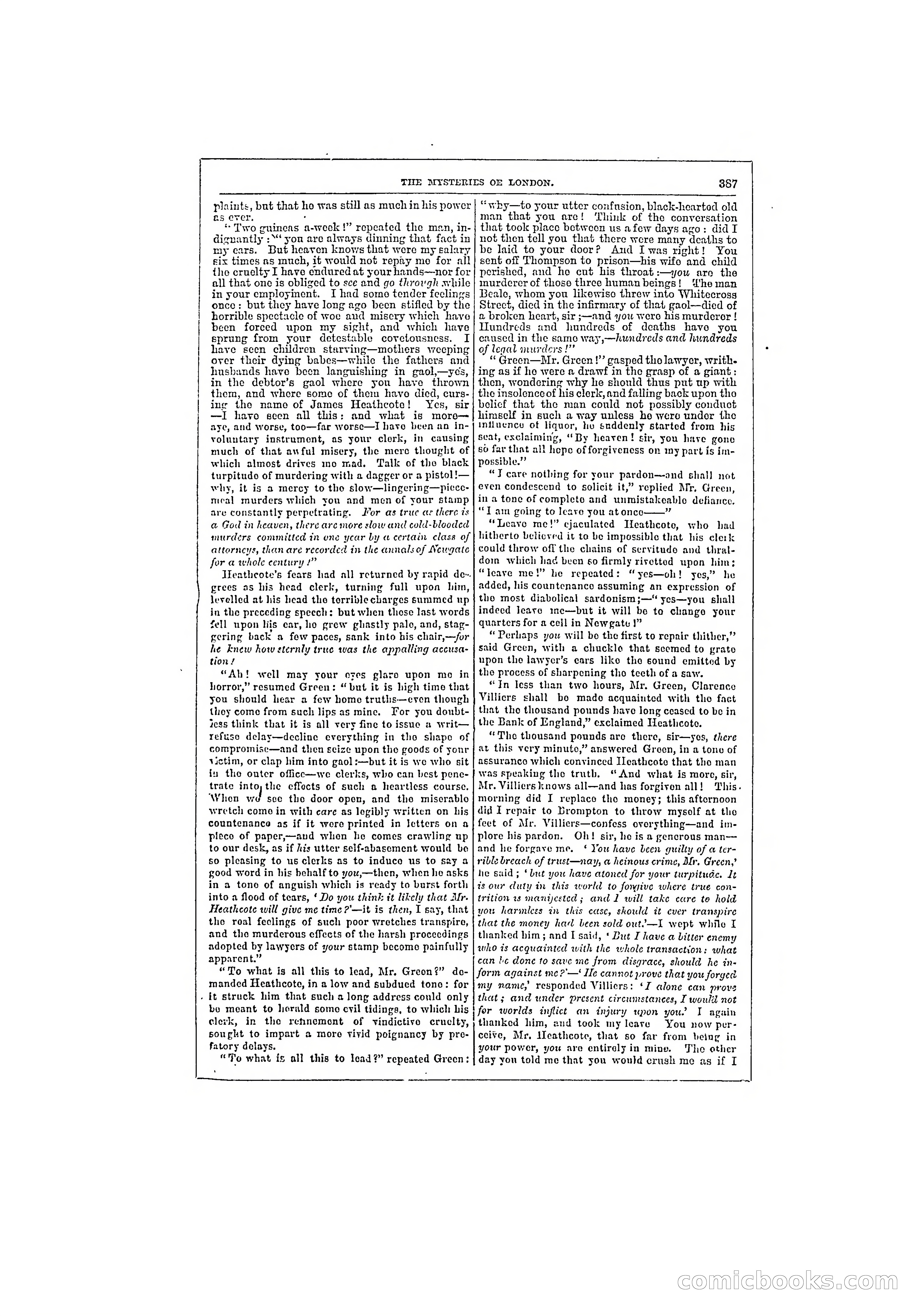
A restored page from Penny Dreadfuls, 1846. Page through the whole issue in the reader above.
📄 Transcribed text from this page (OCR, searchable)
Machine-transcribed from the original scan — historical spelling and the odd misread are preserved.
LS TN TC i a PD nr THE MYSTERIES OF LONDON. 387 plaints, but that ho was still as much in his power a5 ever, Two guinens a-week dicnantly :““‘ yon are always dinning that fact in my cars. But heaven knows that were my salary six times as much, it would not repay me for all the cruelty I have endured at your hands—nor for all that one is obliged to sce and go through while in your employinent. I had some tender feelings once: but they have Jong ago been stifled by the horrible spectacle of woe and misery which have been forced upon my sight, and which have sprung from your detestable covetousness. I have seen children starving—mothers weeping over their dying babes—while the fathers and husbands have been languishing in gaol,—yes, in the debtor’s gaol where you have thrown them, and where some of them have died, curs- ing the name of James Heathcote! Yes, sir —I have seen all this: and what is more— aye, and worse, too—far worse—I have been an in- voluntary instrument, as your clerk, in causing much of that awful misery, the mere thought of which almost drives mo mad. Talk of the black turpitudo of murdering with a dagger or a pistol!— why, it is a mercy to tho slow—lingcring—piccc- meal murders which you and men of your stamp are constantly perpetrating. Jor as true as there ts a God in heaven, there are more slow and cold-blooded q?? “wey—to your utter confasion, black-hearted old man that you are! Think of the conversation repeated the mean, in-{ that took place between us afew days ago: did I not then tell you that there were many deaths to be laid to your door? And Iwas right! You sent off Thompson to prison—his wife and child perished, and he cut his throat :—yow are the murderer of those three human beings! ‘he man Beale, whom you likewise threw into Whitecross Strect, died in the infirmary of that gaol—died of a broken heart, sir ;—and you were his murderer ! Wundreds and hundreds of deaths have you caused in the samo way,—hundreds and hundreds of legal murders!” “ Green—Mr. Green!” gasped tho lawyer, writh. ing as if he were a drawf in the grasp of a giant: then, wondering why he should thus put up with the insolenceof his clerk, and falling back upon tho belief that the man could not possibly conduct himself in such a way unless he were undor the influence of liquor, he suddenly started from his seat, exclaiming, ‘By heaven! sir, you have gone so far that all hope of forgiveness on my part is im- possible.” “J care nothing for your pardon—and shall not even condescend to solicit it,” replied Mr, Green, in a tone of complete and unmistakeablo defiance. “Tam going to Icavo you at onco a “Zicave me!” cjaculated Tleathcote, who had murders committed in une year by a certain class of | hitherto belicved it to be impossible that his clerk attorneys, han are recorded in the annals of Newgate for a whole century 2” Ieathcote’s fears had all returned by rapid de-. grees as his head clerk, turning full upon him, levelled at his head the terrible charges summed up in the preceding speech: but when those last words fell upon Nis car, ho grew ghastly palo, and, stag- gcering back a few paces, sank into his chair,—for he knew how sternly true was the appalling accusa- tion / “Ab! well may your eves pglaro upon mo in horror,” resumed Green: “but it is high time that you should hear a few home truths—even though thoy come from such lips as mine. Tor you doubt- ess think that it is all very fine to issue a writ— refuso delay—deccline everything in the shapo of compromise—and then seize upon the goods of your victim, or clap him into gaol:—but it is we who sit iu the outer officce—we clerks, who can best pene- trate into, the effects of such ao heartless course. ‘Whon we sce the door open, and tho miscrablo wretch come in with care as legibly written on his countenance as if it were printed in Ictters on a pleco of paper,—and when hoe comes crawling up to our desk, as if his utter self-abasement would be so pleasing to us clerks as to induce us to say a good word in his behalf to you,—then, when he asks in a tone of anguish which is ready to burst forth into a flood of tears, ‘Do you think tt likely that Afr. Heathcote will give me time ?'—it is then, I say, that the roal feclings of such poor wretches transpire, and the murderous effects of the harsh procecdings adopted by lawyers of your stamp become painfully apparent.” “™o what is all this to lead, Mr. Green?” do- manded Heathcote, in a low and subdued tone: for . ft struck him that such a long address conld only bo meant to herald some cvil tidings, to which his clerk, in the rehnemeont of vindictive cruelty, sought to impart a moro vivid poignancy by pre- fatory delays. & eT ee could throw off the chains of servitude and thral- doin which had been 60 firmly rivettod upon him: “Jeave me!’ he repeated: “yes—oh! yes,” he added, his countenance assuming an expression of tho most diabolical sardonism;— yes—you shall indecd Jeave inc—but it will be to chango your quarters for a cell in Newpate }” “Perhaps you will be the first to repair thither,” said Green, with a chuckle that scemed to grate upon the lawycer’s cars like the sound emittod by the process of sharpening tho tecth of a saw. “In less than two hours, Mr. Green, Clarence Villiers shalt be mado acquainted with tho fact that tho thousand pounds have long ceased to be in the Bank of England,” exclaimed Heathcote. “The thousand pounds are there, sir—yos, there at this very minuto,” answered Groen, in a tone of assurance which convinced Ilcathcote that tho man was Speaking the truth. “And what is more, sir, Mr. Villiers knows all—and has forgiven all! morning did I replace the money; this afternoon did I repair to Brompton to throw mysolf at the fect of Mr. Villiers—confess ovorything—and im- plore his pardon. Oh! siy, he is a pencrous man— and he forgave me. ‘ You have been guilty of a ter- rible breach of trust—nay, a heinous crime, JLy. Green,’ he said; ‘but you have atoned for your turpitude. It 7s our duty in this world to fonyive where true con- trition 7 mantested; andl will take care to hold vou harmlces an this case, should it ever transpire that the money had been sold out’—I wept while I thanked him; and I said, ‘ But I have a bitter enemy who is acquainted with the whole transaction: what can be done to save me from disgrace, should he in- form against me ?'—‘ He cannot prove that you forged my namic, responded Villiers: ‘I alone can prove that; and under present circunrstances, I woulil not for worlds inflict an injury upon you. I again thanked him, and took my leave You now per- ceive, Mr, Weathcote, that so far from being in your power, you are entirely in mine. The other “fo what is all this to lead?” repeated Green: { day you told me that you would crush me as if I _ This. Pm, (C(O) (C DOO <S LL (SO)