
Penny Dreadfuls, 1846 · page 47 of 399
The Mysteries of London, Vol. IV — page 47: what you’re looking at
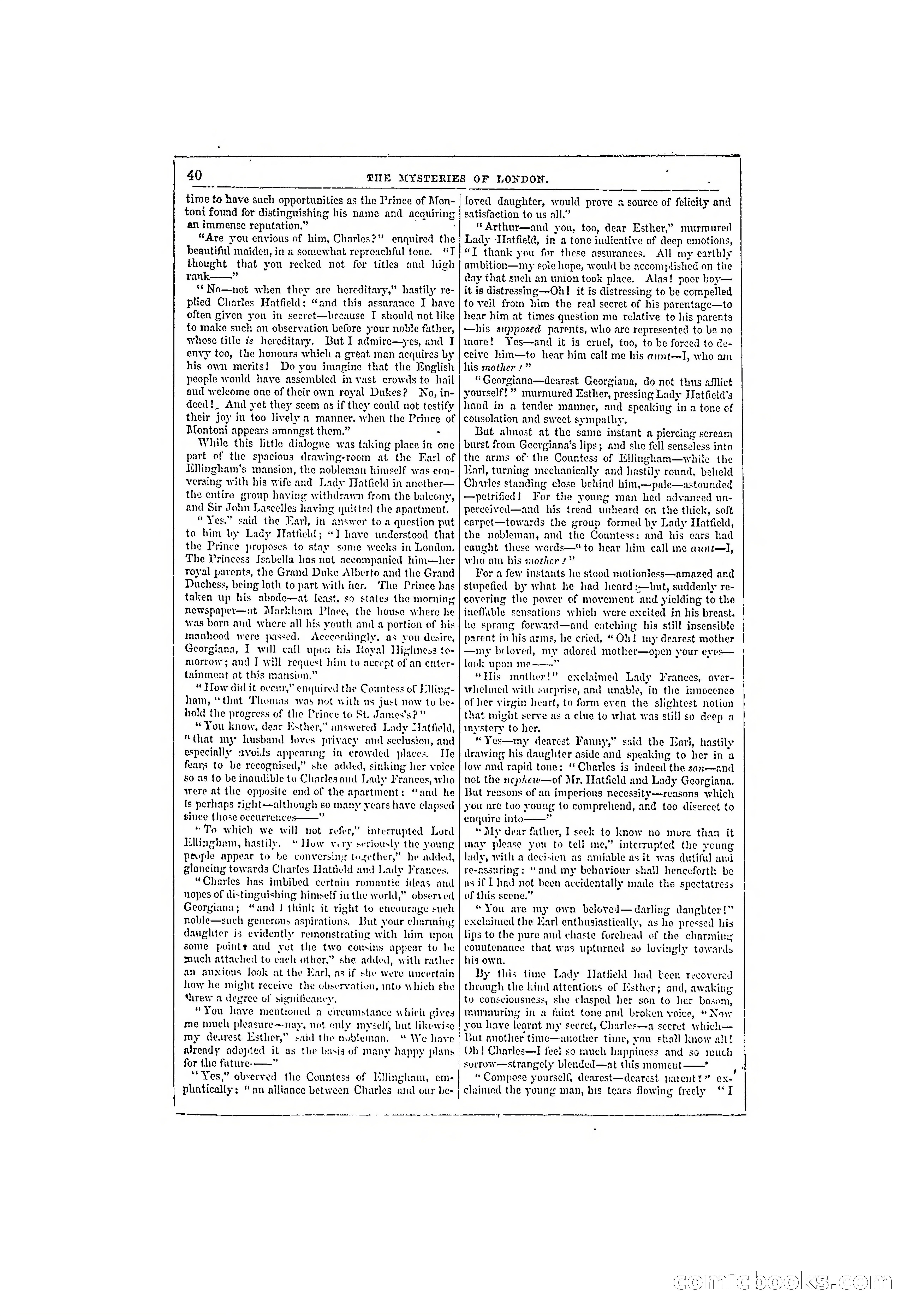
A restored page from Penny Dreadfuls, 1846. Page through the whole issue in the reader above.
📄 Transcribed text from this page (OCR, searchable)
Machine-transcribed from the original scan — historical spelling and the odd misread are preserved.
40 time to have such opportunities as the Prince of Mon- toni found for distinguishing his name and acquiring an immense reputation.” | “Are you envious of him, Charles?” enquired the beautiful maiden, in a somewhat reproachful tone. “I thought that you recked not for titles and high rank o ** No—not when they are hereditary,” hastily re- plied Charles Hatfield: “and this assurance I have often given you in secret-——because I should not like to make such an observation before your noble father, whose title zs hereditary. But I admire—yes, and I envy too, the honours which a great man acquires by his own merits! Do you imagine that the English people would have assembled in vast crowds to hail and welcome one of their own royal Dukes? No, in- deed!_ And yet they seem as if they could not testify their joy in too lively a manner. when the Prince of Montoni appears amongst them.” . While this little dialogue was taking place in one part of the spacious drawing-room at the Earl of Jillingham’s mansion, the nobleman himself was con- versing with his wife and Lady Hatfield in another— the entire group having withdrawn from the balcony, and Sir John Lascelles having quitted the apartment. “Yes,” said the Earl, in answer to a question put to him by Lady Hatfield; “I have understood that the Prince proposes to stay some weeks in London. The Princess Isabella has not accompanied him—her royal parents, the Grand Duke Alberto and the Grand Duchess, being loth to part with her. The Prince has taken up his abode—at least, so states the morning newspaper—at Markham Place, the house where he was born and where all his youth and a portion of his manhood were passed. Acccordingly, as you desire, Georgiana, I will call upon his Roval Highness to- morrow; and I will request him to accept of an enter- tainment at this mansion.” “ How did it occur,” enquired the Countess of Riling- ham, “that Thomas was not with us just now to be- hold the progress of the Prince to St. James's?” “You know, dear Esther,” answered Lady Zlatfield, “that my husband loves privacy and seclusion, and especially avoids appearing in crowded places. He fears to be recognised,” she added, sinking her voice so as to be inaudible to Charles and Lady Frances, who were at the opposite end of the apartment: “and he is perhaps right—although so many years have elapsed since those occurrences——” “To which we will not refer,” interrupted Lord Eltingham, hastily. “ How very seriously the young pevple appear to be conversing torether,” he added, glancing towards Charles Hatfield and Lady Frances. “Charles has imbibed certain romantic ideas and nopes of distinguishing himself inthe world,” obsers ed Georgiana; “and } think it right to encourage such noble—such generous aspirations. But your charming daughter is evidently remonstrating with him upon some points and yet the two cousins appear to be much attached to each other,” she added, with rather an anxious look at the Earl, as if she were uncertain how he might receive the observation, into whieh she threw a degree of significancy, “You have mentioned a circumstance whieh gives me much pleasure—nay, not only myselt, but likewise my dearest Esther,” said the nobleman. “ We have aready adopted it as the basis of many happy plans for the future-—” “Yes,” observed the Countess of ENingham, em- ~ THE MYSTERIES OF BHONDON. ——— loved daughter, would prove a source of felicity and satisfaction to us all.” “ Arthur—and you, too, dear Esther,” murmured Lady ‘Hatfield, in a tone indicative of deep emotions, “JT thank you for these assurances. All my earthly ambition—my sole hope, would b2 accomplished on the day that such an union took place. Alas! poor boy— it is distressing—Oh! it is distressing to be compelled to veil from him the real secret of his parentage—to hear him at times question me relative to his parents —his supposed parents, who are represented to be no more! Yes—and it is cruel, too, to be forced to de- ecive him—to hear him call me his aznt—I, who am his mothers” “Georgiana—dearest Georgiana, do not thus afflict yourself! ” murmured Esther, pressing Lady Hatfield's hand in a tender manner, and speaking in a tone of consolation and sweet sympathy. But almost at the same instant a piercing scream burst from Georgiana’s lips; and she fell senseless into the arms of: the Countess of EVingham—while the Earl, turning mechanically and hastily round, beheld Charles standing close behind him,—pale—astounded —petrified! For the young man had advanced un- perecived—and his tread unheard on the thick, soft carpet—towards the group formed by Lady Ifatfield, the nobleman, and the Countess: and his ears had caught these words—“to hear him call me aunt—I, who am his mothers” For a few instants he stood motionless—amazed and stupefied by what he had heard :—but, suddenly re- covering the power of movement and yielding to the ineflable sensations which were excited in his breast. he sprang forward—and catching his still insensible parent im his arms, he cried, “Oh! my dearest mother —iny bcloved, my adored mother—open your cyes— look upon me a “Vlis mother!” exclaimed Lady Frances, over- whelimed with surprise, and unable, in the innocence of her virgin heart, to form even the slightest notion that might serve as a clue to what was still so deep a mystery to her. “Yes—my dearest Fanny,” said the Earl, hastily drawing his daughter aside and speaking to her in a Jow and rapid tone: “ Charles is indeed the son—and not the nephew—of Mr. IIatficld and Lady Georgiana. But reasons of an imperious necessity—reasons which you are too young to comprehend, and too discreet to enquire into——” “My dear father, 1 seck to know no more than it may please you to tell me,” interrupted the young lady, with a decision as amiable as it was dutiful and reeassuring: “and my behaviour shall henceforth be as if I had not been accidentally made the spectatress of this scene.” “You are my own belovedl—darling daughter!” exclaimed the Earl enthusiastically, as he pressed his lips to the pure and chaste forehead of the charming countenance that was upturned so lovingly towards his own, By this time Lady Watfield liad teen recovered through the kind attentions of Esther; and, awaking ty consciousness, she clasped her son to her bosom, murmuring in a faint tone and broken voice, “ Now you have learnt my seeret, Charles—a secret which— But another time—another time, you shail know alt! Oh! Charles—I feel so much happiness and so much surrow—strangely blended—at this moment ? ft “Compose yourself, dearest—dearest pareut!” ex- phatically: “an alliance between Charles and our be- j claimed the young man, his tears flowing freely ‘I (SO) GIOOKS (SO)