
Penny Dreadfuls, 1846 · page 53 of 399
The Mysteries of London, Vol. IV — page 53: what you’re looking at
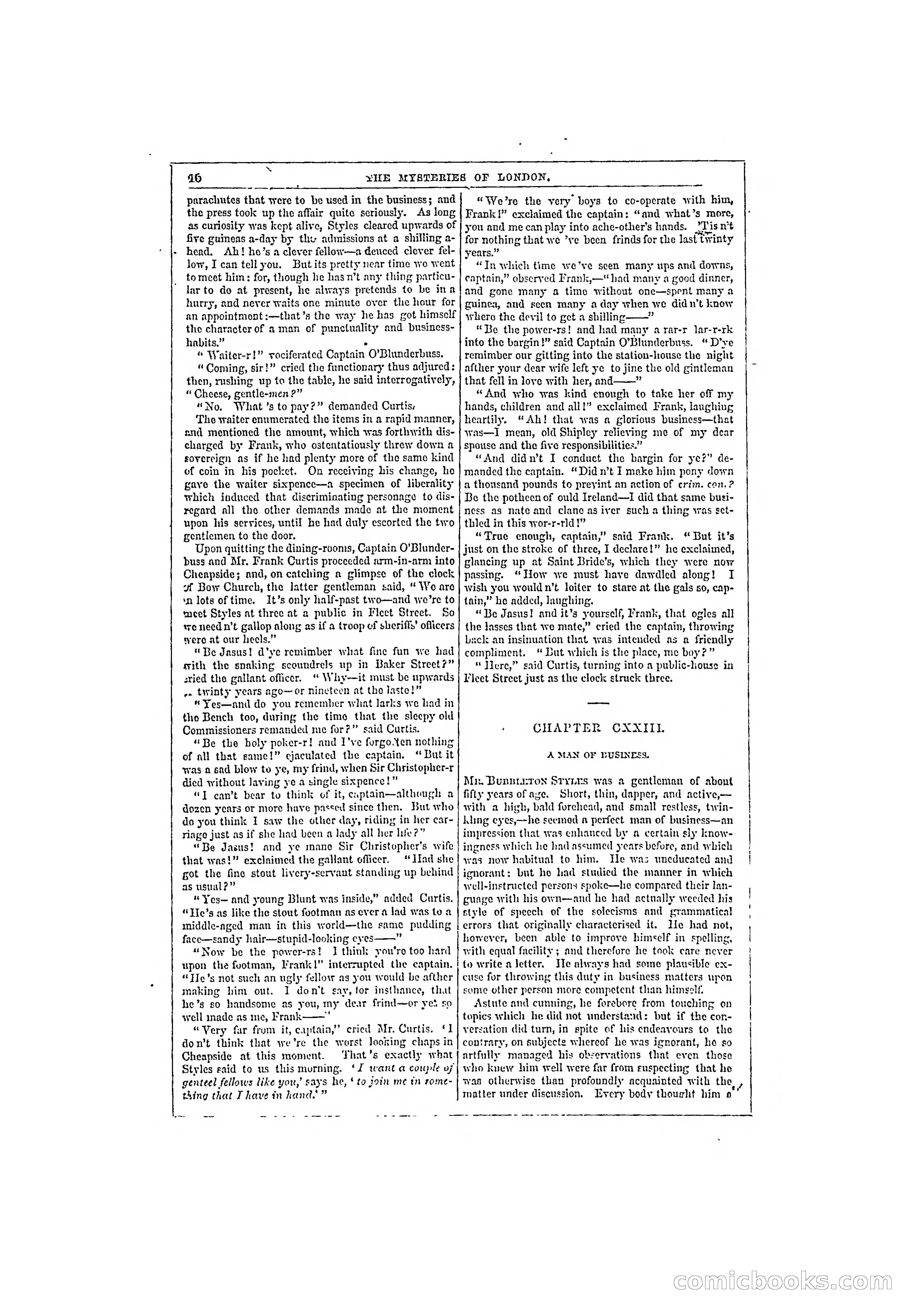
A restored page from Penny Dreadfuls, 1846. Page through the whole issue in the reader above.
📄 Transcribed text from this page (OCR, searchable)
Machine-transcribed from the original scan — historical spelling and the odd misread are preserved.
oo“ —w ~~ 16 parachutes that were to be used in the business; and the press took up the affair quite seriously. As long as curiosity was kept alive, Styles cleared upwards of five guineas a-day by the admissions at a shilling a- head. Ah! he’s a clever fellow—a deuced clever fel- low, I can tell you. Butits pretty near time wo went to meet him: for, though he has n’t any thing particu- lar to do at present, he always pretends to be ina hurry, and never waits one minute over the hour for an appointmont :—that’s the way he has got himself the character of a man of punctuality and business- al “ Waiter-r!” vociferated Captain O’Bhlunderbuss. “ Coming, sir!” cried the functionary thus adjured: then, rushing up to the table, he said interrogatively, “ Cheese, gentle-men ?” “No. What ’s to pay?” demanded Curtis: Tho waiter enumerated the items in a rapid manner, rnd mentioned the amount, which was forthwith dis- charged by Frank, who ostentatiously threw down a sovercign as if he had plenty more of the same kind of coin in his pocket. On receiving his change, ho gave the waiter sixpence—a specimen of liberality which induced that discriminating personage to dis- regard all the other demands made at the moment upon his services, until he had duly escorted the two gentlemen to the door. Upon quitting the dining-rooms, Captain O’Blunder- buss and Mr. Frank Curtis proceeded arm-in-arm into Chenpside; and, on catching a glimpse of the clock of Bow Church, the latter gentleman said, “ We are in lots of time. It’s only half-past two—and we’re to meet Styles at three at a public in Ficet Street. So wwe needn’t gallop along as if a troop ef sheriffs’ officers vero at our heels.” Be Jasus! d’ye remimber what fine fun we had srith the snaking scoundrels up in Baker Street?” sried the gallant officer. “ Why-—it must be upwards yo twinty years ago— or nineteen at the laste!” *Yes—and do you remember what larks we had in tho Bench too, during the time that the slecpy old Commissioners remanded me for?” said Curtis. “Be the holy poker-r! and I've forgo.Xen nothing of all that same!” cjaculated the captain. “ But it was a sad blow to ye, my frind, when Sir Christopher-r died without laving ye a single sixpence!” “] can’t bear to think of it, captain—although a dozen years or more have passed since then, But who do you think I saw the other day, riding in her car- riage just as if she had been a lady all her hfe?” “Be Jasus! and ye mane Sir Christopher's wife that was!” exclaimed the gallant officer. “fad she got the fine stout livery-servant standing up behind as usual?” * Yes— and young Blunt was inside,” added Curtis. “JTo’s as like the stout footman as ever a lad was to a middle-aged man in this world—the same pudding facco—sandy hair—stupid-looking cyes———” “Now be the power-rs! J think you're too hard upon the fvotman, Frank!” interrupted the captain. “Te’s not such an ugly fellow as you would be afther making him out. I don’t say, for insthance, that he’s so handsome as you, my dear frind—or yer so well made as me, Frank “Very far from it, captain,” cried Mr. Curtis. ‘1 don’t think that we're the worst loosing chaps in Cheapside at this moment. That's exactly what Styles said to us this murning. ‘J want a couple of genteel fellows like you,’ says he, ‘to gotn me in rome- thing that Ihave in hand!” oe ee - = eo oe — =- a re YHE MYSTERIES OF LONDON, mm “Were the very boys to co-operate with him, Frank!” exclaimed the captain: “and what’s more, you and me can play into ache-other’s hands. *J'is n’t for nothing that we ’ve been frinds for the last twinty years.” “Tn which time we’ve seen many ups and downs, captain,” observed Frank,—" had many a good dinner, and gone many a time without one—spent many a guinea, and seen many a day when we didn’t know where the devil to get a shilling-—— * Be the power-rs! and had many a rarer lar-r-rk info the bargin!” said Captain O’Blunderbuss. “ D’ye remimber our gitting into the station-house the night afther your dear wife left ye to jine the old gintleman that fell in love with her, and——” “And who was kind enough to take her off my hands, children and all!” exclaimed Frank, langhiug heartily. “Ah! that was a glorious business—that was—I mean, old Shipley relieving me of my dear Spouse and the five responsibilities.” “And didn’t I conduct the bargin for ye?” de- manded the captain. “Did n’t I make him pony down a thousand pounds to preyint an action of crim. con. ? Be the potheen of ould Ireland—I did that same buti- ness as nate and clane as iver such a thing was set- thled in this wor-r-rld!” “True enough, captain,’ said Frank. “ But it’s just on the stroke of three, I declare!” he exclaimed, glancing up at Saint Bride’s, which they were now passing. “iow we must have dawdled along! I wish you would n’t loiter to stare at the gals so, cap- tain,” he added, laughing. “Be Jasus! and it’s yourself, rank, that ogles all the lasses that we mate,” cried the captain, throwing back an insinuation that was intended as a friendly compliment. “ But which is the place, me boy?” “Vere,” said Curtis, turning into a public-liouse in Vleet Street just as the clock struck three. err ‘ CHAPTER CAXIIL A MAN OF LUSINESS. Mn. Bupais:ron STyYLrs was a gentleman of about fifty years of ase. Short, thin, dapper, and active,— with a high, bald forehead, and small restless, twin- hing cyes,—he seemed « perfect man of business—an impression that was cnhanced by a certain sly know- ingness which he had assumed years before, and which was now habitual to him. He was uneducated and ignorant: but he had studied the manner in which well-instructed persons spoke—he compared their Ian- guage with his own—and he had actually weeded his style of speech of the solecisms and grammatical errors that originally characterised it. Ile had not, however, been able to improve himself in spelling, with equal facility ; and therefore he took care never to write a Setter. We always had some plausible ex- cuse for throwing this duty in business matters upon some other person more competent than himegelf Astute and cunning, he forebore from touching on topics which he did not understand: but if the con- versation did turn, in spite of his endeavours to the contrary, on subjects whereof he was ignorant, ho so artfully managed his observations that even those who knew him well were far from suspecting that he wvan otherwise than profoundly acquainted with the matter under discussion, LEvery body thought him p° ee ee ee a, (SO) GIOOKS (SO)