
Penny Dreadfuls, 1846 · page 63 of 399
The Mysteries of London, Vol. IV — page 63: what you’re looking at
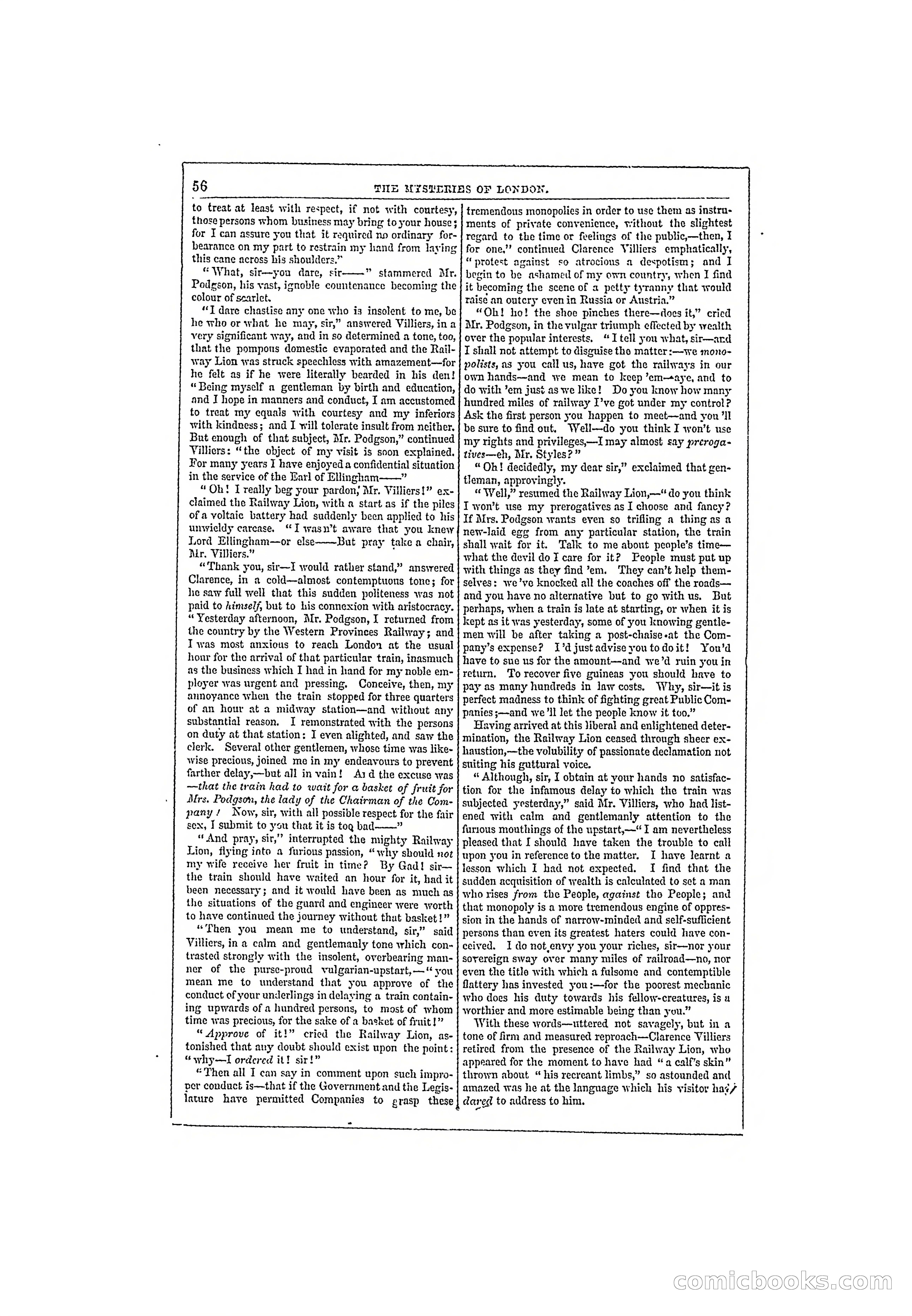
A restored page from Penny Dreadfuls, 1846. Page through the whole issue in the reader above.
📄 Transcribed text from this page (OCR, searchable)
Machine-transcribed from the original scan — historical spelling and the odd misread are preserved.
er ant i 56 THE WYSTORIES OF LONDON, to treat at least with respect, if not with courtesy, those persons whom business may bring to your house: for I can assure you that it required no ordinary for- bearance on my part to restrain my hand from laving this cane across his shoulders.” “What, sir—you dare, sir-——” stammered Mr. Podgson, his vast, ignoble countenance becoming the colour of scarlet. “‘T dare chastise any one who is insolent to me, be he who or what he may, sir,” answered Villiers, in a very significant way, and in so determined a tone, too, that the pompous domestic evaporated and the Rail- way Lion was struck speechless with amazement—for he felt as if he were literally bearded in his den! “Being myself a gentleman by birth and education, and I hope in manners and conduct, I am accustomed to treat my equals with courtesy and my inferiors with kindness; and I will tolerate insult from neither. But enough of that subject, Mr. Podgson,” continued Villiers: “the object of my visit is soon explained. For many years I have enjoyed a confidential situation in the service of the Earl of ENingham——” “Oh?! LT really beg your pardon; Mr. Villiers!” ex- claimed the Railway Lion, with a start as if the piles of a voltaic battery had suddenly been applied to his unwieldy carcase. “I wasn’t aware that you knew Lord Etingham—or else——~But pray tale a chair, Mr. Villiers.” “Thank you, sir~I would rather stand,” answered Clarence, in a cold—almost contemptuons tone; for he saw full well that this sudden politeness was not paid to himsel/, but to his connexion with aristocracy. “Yesterday afternoon, Mr. Podgson, I returned from the country by the Western Provinces Railway; and Twas most anxious to reach London at the usual hour for the arrival of that particular train, inasmuch as the business which I had in hand for my noble em- ployer was urgent and pressing, Conceive, then, my annoyance when the train stopped for three quarters of an hour at a midway station—and without any substantial reason. I remonstrated with the persons on duty at that station: I even alighted, and saw the clerk. Several other gentlemen, whose time was like- wise precious, Joined me in my endeavours to prevent farther delay,—but all in vain! Aird the excuse was —that the train had to wait for a basket of fruit for Ars. Podgsom, the lady of the Chatrman of the Com- pany / Now, sir, with all possible respect for the fair sex, I submit to you that it is tog bad~—~” “And pray, sit,” interrupted the mighty Railway Lion, flying iato a furious passion, “why should not my wife receive her fruit in time? By Gad! sir~ the train should have waited an hour for it, had it been necessary; and it would have been as much as the situations of the guard and engineer were worth to have continued the journey without that basket!” “Then you mean me to understand, sir,” said Villiers, ina calm and gentlemanly tone which con- trasted strongly with the insolent, overbearing man- ner of the purse-proud vulgarian-upstart,—“ you mean me to understand that you approve of the conduct of your underlings in delaying a train contain- ing upwards of a hundred persons, to most of whom time was precious, for the sake of a basket of fruit!” “ Approve of it!” cried the Railway Lion, as- tonished that any doubt should exist upon the point: “why—I ordered it! sir!” “Then all I can say in comment upon such impro- per conduct is—that if the Government and the Legis- lature have permitted Companies to prasp these tremendous monopolies in order to use them as instru- ments of private convenience, without the slightest regard to the time or feelings of the public,—then, I for one’? continued Clarence Villiers emphatically, “protest against so atrocious a despotism; and I begin to be ashamed of my own country, when I find it becoming the scene of a petty tyranny that would raise an outcry even in Russia or Austria.” “Oh! ho! the shoe pinches there—docs it,” cried Mr, Podgson, in the vulgar triumph effected by wealth over the popular interests. “ I tell you what, sir—ard I shall not attempt to disguise the matter :—we mono- polists,as you callus, have got the railways in our own hands—and we mean to keep ’em—aye, and to do with ’em just aswe like! Do you know how many hundred miles of railway I’ve got under my control? Ask the first person you happen to mect—and you ’Il be sure to find out, VWWell—do you think I won’t use my rights and privileges,—I may almost say preroga- tives—eh, Mr. Styles?” “Qh! decidedly, my dear sir,” exclaimed that gen- tleman, approvingly. Well,” resumed the Railway Lion,—“ do you think IT won’t use my prerogatives as I choose and fancy? If Mrs. Podgson wants even so trifling a thing as a new-laid ege from any particular station, the train shall wait for it. Talk to me about people’s time— what the devil do I care for it? People must put up with things as they find em. They can’t help them- selves: we’ve knocked all the coaches off the roads— and you have no alternative buf to go withus. But perhaps, when a train is late at starting, or when it is kept as it was yesterday, some of you knowing gentle- men will be after taking a post-chaise-at the Com- pany’s expense? I’djustadvise youtodoit! You'd have to sne us for the amount—and we’d ruin you in return, To recover five guineas you should have to pay as many hundreds in law costs. Why, sir—it is perfect madness to think of fighting great Public Com- panies ;—and we ‘jl let the people know it too.” Having arrived at this liberal and enlightened deter- mination, the Railway Lion ceased through sheer ex- haustion,—the volubility of passionate declamation not suiting his guttural voice. “ Although, sir, I obtain at your hands no satisfac- tion for the infamous delay to which the train was subjected yesterday,” said Mr. Villiers, who had list- ened with calm and gentlemanly attention to the furious mouthings of the upstart,“ I am nevertheless pleased that I should have taken the trouble to call upon you in reference to the matter. I have learnt a lesson which I had not expected. I find that the sudden acquisition of wealth is calculated to set a man who rises from the People, against the People; and that monopoly is a more tremendous engine of oppres- sion in the hands of narrow-minded and self-sufficient persons than even its greatest haters could have con- ceived. Ido not.envy you your riches, sir—nor your sovereign sway over many miles of railroad—no, nor even the title with which a fulsome and contemptible flattery has invested you:—for the poorest mechanic who does his duty towards his fellow-creatures, is a worthier and more estimable being than you.” With these words—uttered not savagely, but in a tone of firm and measured reproach—Clarence Villiers retired from the presence of the Railway Lion, who appeared for the moment to have had “a calf’s skin” thrown about “ his recreant limbs,” so astounded and amazed was he at the language which his visitor haz/ dared to address to him. ct nen rt et erat (SO) GIOOKS (SO)