
Penny Dreadfuls, 1846 · page 68 of 399
The Mysteries of London, Vol. IV — page 68: what you’re looking at
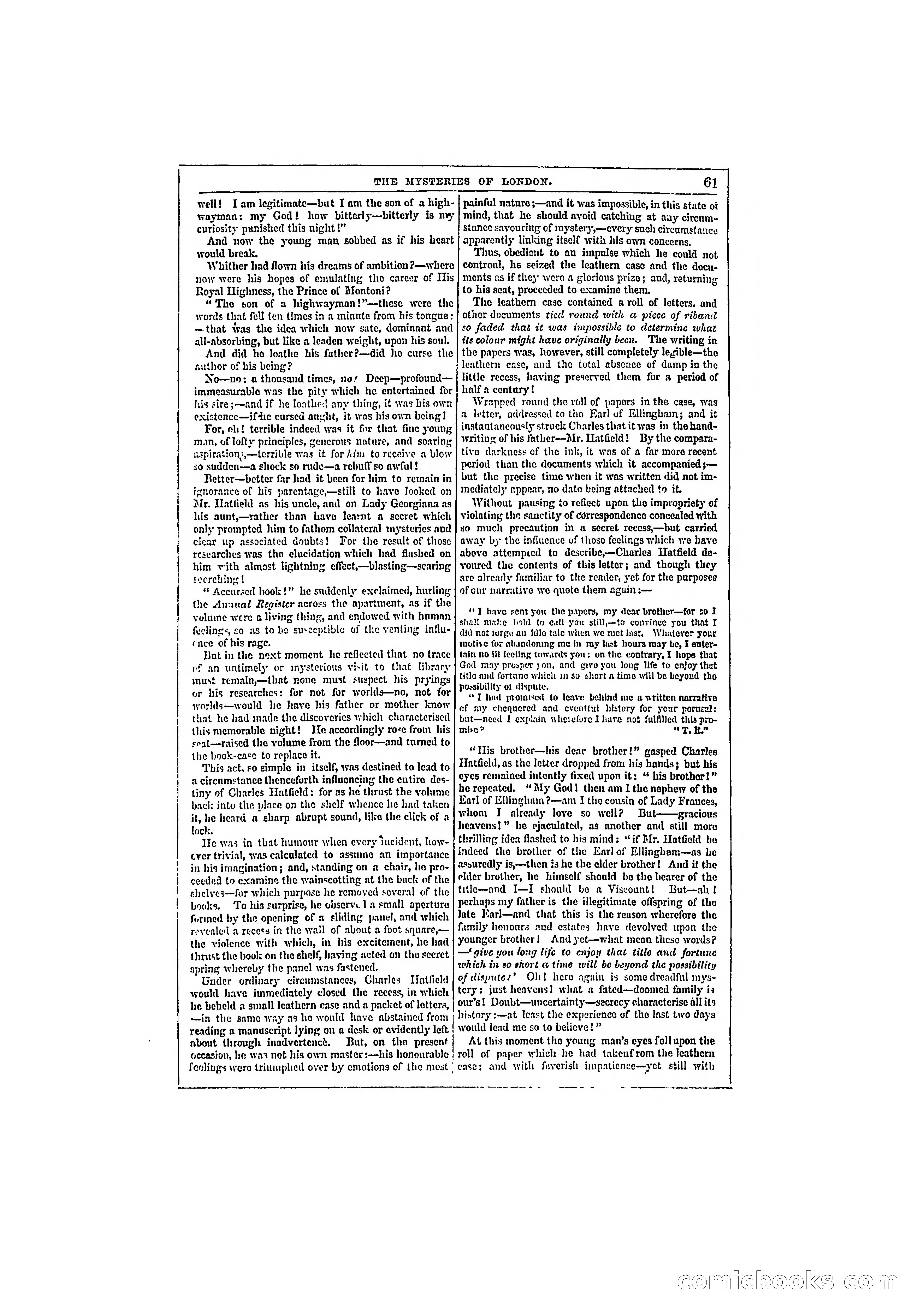
A restored page from Penny Dreadfuls, 1846. Page through the whole issue in the reader above.
📄 Transcribed text from this page (OCR, searchable)
Machine-transcribed from the original scan — historical spelling and the odd misread are preserved.
THE XEYSTERIES OF LONDON. well! Iam legitimate—but I am the son of a high- wayman: my God! how bitterly—bitterly is my curjosity punished this night!” And now the young man sobbed as if his heart would break. Whither had flown his dreams of ambition ?—where iow were his hopes of emulating tho carcer of His Royal Highness, the Prince of Montoni? “The son of a highwayman!”—these were the words that fell ten {imes in a minute from his tongue: —that was the idca which now sate, dominant and all-absorbing, but like a leaden weight, upon his soul. And did he loathe his father?—did ho curse the author of his being? No—no; a thousand times, no’ Deep—profound— immeasurable was the pity which he entertained for his sire ;—and if he loathed any thing, if was his own existence—ifdie cursed aught, it was his own being! For, oh! terrible indeed was it for that fine young man, of lofty principles, generous nature, and soaring aspiration:,—terrible was it for him to receive a blow so sudden—a shock so rude—a rebuff so awful ! Better—better far had it been for him to remain in iznorance of his parentage,—still to have Iooked on Mr. Uatfield as his uncle, and on Lady Georgiana as his aunt,—rather than have learnt a secret which only; prompted him to fathom collateral mystcrics and clear up associated doubts! For the result of those researches was tho elucidation which had flashed on him with almost lightning effect,—blasting—scaring scorching ! * Accursed book!” le suddenly exclaimed, hurling the sinnual Register across the apartment, as if the yulume were a living thing, and endowed with human feclings, so as to be susceptible of the venting influ- ence of his rage. But in the next moment hie reflected that no trace ef an untimely or mysterious visit to that library must remainx—that none must suspect his pryings or his researches: for not for worlds—no, not for worlds—would he have his father or mother know that he had inade the discoveries which characterised this memorable night! We accordingly ro<e froin his reat—raised the volume from the floor—and turned to the book-case to replace it. This act, so simple in itself, was destined to Icad to a circumstance thenceforth influencing the entire des- tiny of Charles Hatfield: for as he thrust the volume bach: into the place on the shelf whence he had taken it, he heard a sharp abrupt sound, like the click of a lock. Me was in that humour when every incident, how- cver trivial, was calculated to assume an importance in his imagination; and, standing on a chair, he pro- ceeded to examine the wainscotting at the back of the shelyes-—for which purpose he removed several of the bouks. To his surprise, he observe 1a small aperture formed by the opening of a sliding panel, and which revealed a recess in the wall of about a foot square,— the violence with which, in his excitement, he had thrust the bool: on the shelf, having acted on the secret spring whereby the panel was fastened. Under ordinary circumstances, Charles Tatfield would have immediately closed the recess, in which ; 61 painful nature ;—and it was impossible, in this state ot mind, that he should avoid catching at aay circum- stance sayouring of mystery,—every such circumstance apparently linking itself with his own concerns. Thus, obedient to an impulse which he could not controul, he seized the Ieathern case and the docu- ments as if they were a glorious prize; and, returning to his scat, proceeded to examine them. The leathern case contained a roll of letters, and other documents tied round with @ picee of riband so faded that it was impossible to determine what tts colour might have originally becn. The writing in the papers was, however, still completely lezible—the leathern case, and the total absence of damp in the little recess, having preserved them for a period of half a century ! Wrapped round the roll of papers in the case, was a letter, addressed ta tha Earl vf Ellingham; and it instantaneously struck Charles that it was in the hand- writing of his father—Mr. Hatfield! By the compara- tive darkness of the ink, it was of a far more recent period than the documents which it accompanied ;— but the precise time when it was written did not im- mediately appear, no date being attached to it. Without pausing to reflecé upon tle impropriety of violating the sanctity of correspondence concealed with so much precaution in a secret recess,—but carried away by the influence of those feclings which we have above attempted to describe,—Charles Hfatfield de- voured the contents of this letter; and though they are already familiar to the reader, yct for the purposes of our narrative we quote them again s— ‘«] have sent you the papers, my dear brother—for so I Shall make bot to call you still,—to convince you that I did not torge an idle tale when we met last, Whatever your motive tov abundoning me in my lust hours may be, I enter- tain no i} feeling towards you; on the contrary, I hope that God may prusper yon, and give you long Hfe to enjoy that title and fortune which in so short a time will be beyoud tho possibility ot dispute. *T had promiscad to leave behind me a written narrativo of my chequered and eventtul history for your perusal: but—need I explain wheiefore Ihave not fulfilled this pro- mise ? OT. Ba “Ylis brother—his dear brother!” gasped Charles Hatfield, as tho letter dropped from his hands; but his eyes remained intently fixed upon it: “ his brother!” he repeated. “My God! then am I the nephew of the Earl of Eiingham ?—am I the cousin of Lady Frances, whom I already love so well? But-——gracious heavens!” he ejaculated, as another and still more thrilling idea flashed to his mind: “if Mr. Hatfield be indeed the brother of the Earl of Ellingham—as he assuredly is,—then is he the elder brother! And it the elder brother, he himself should be the bearer of the title—and I—I should be a Viscount! But—ah! perhaps my father is the illegitimate offspring of the Jate Earl—and that this is the reason wherefore the family honours and estates have devolved upon the younger brother! And yet—what mean these words? —‘give vou long life to enjoy that title and fortune which in so short a time will be beyond the possibility of disputez’ Oh! here again is some dreadful mys- tery: just heavens! what a fated—doomed family ts he beheld a small Ieathern case and a packet of letters, | our’s! Doubt—uncertainty—secrecy characterise all its —in the samo way as he would have abstained from reading 2 manuscript lying on a desk or evidently left nbout through inadvertencé. But, on the present history :—at least the experience of the last tivo days would lead me so to belicve!” At this moment the young man’s eyes fell upon the occasion, he wa3 net his own master:—his honourable : roll of paper which he had takenfrom the leathern 1 a wearer: — e . ° I ® e e < ry e foulings wero triumphed over by emotions of the most case: and with feverish impatience--yct still with om ee wwe ee <——— —- = ee ee ee erro (C(O) (C DOO SS (SO)