
Penny Dreadfuls, 1846 · page 76 of 399
The Mysteries of London, Vol. IV — page 76: what you’re looking at
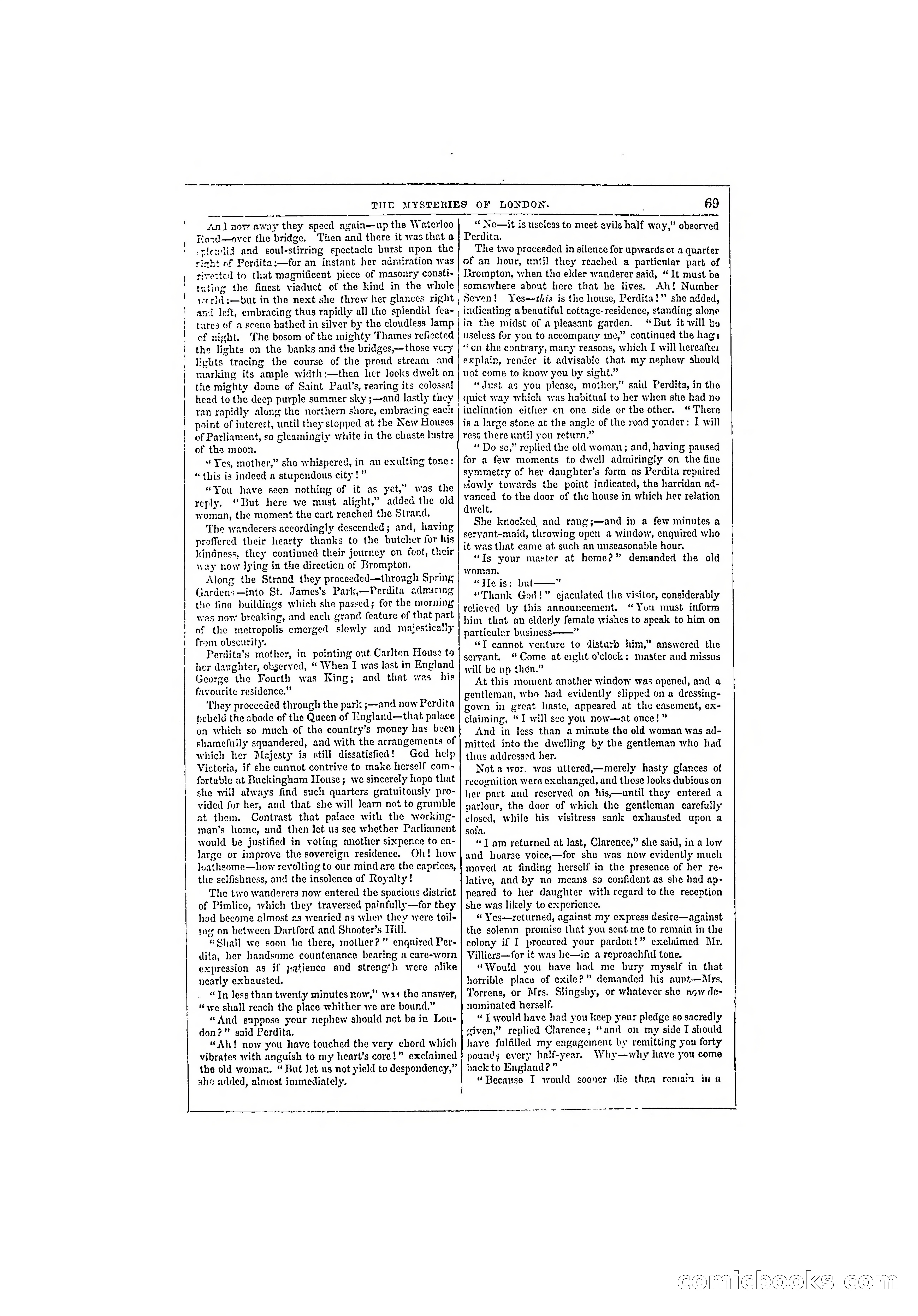
A restored page from Penny Dreadfuls, 1846. Page through the whole issue in the reader above.
📄 Transcribed text from this page (OCR, searchable)
Machine-transcribed from the original scan — historical spelling and the odd misread are preserved.
' TIIEK MYSTERIES OF LONDON. ee ee Anlaow away they speed again—up the Waterloo Eowd—over the bridge. Then and there it was that a :-clendid and soul-stirring spectacle burst upon the sight of Perdita:—for an instant her admiration was rivetted to that magnificent piece of masonry consti- tuting the finest viaduct of the kind in the whole vwerld:—but in the next she threw her glances right and left, embracing thus rapidly all the splendid fea- tures of a scene bathed in silver by the cloudless lamp of night. The bosom of the mighty Thames refiected the lights on the banks and the bridges,—those very lights tracing the course of the proud stream and marking its ample width:—-then her looks dwelt on the mighty dome of Saint Paul’s, rearing its colossal head to the deep purple summer sky ;—and lastly they ran rapidly along the northern shore, embracing each point of interest, until they stopped at the New Houses of Parliament, so gleamingly white in the chaste lustre of tha moon. “Yes, mother,” she whispered, in an exulting tone: “this is indeed a stupendous city!” “You have seen nothing of it as yet,” was the reply. ‘But here we must alight,” added the old woman, the moment the cart reached the Strand. The wanderers accordingly descended; and, having proffered their hearty thanks to the butcher for his kindness, they continued their journey on foot, their way now lying in the direction of Brompton. Along the Strand they proceeded—through Spring Gardens—into St. James’s Park,—Perdita admsaring the fine buildings which she passed; for the morning was now breaking, and each grand feature of that part of the metropolis emerged slowly and majestically from obscurity. Perdita’s mother, in pointing out Carlton House to her daughter, obgerved, “ When I was last in England George the Fourth was King; and that was_ his favourite residence.” They proceeded through the park ;~-and now Perdita beheld the abode of the Queen of England—that palace on which so much of the country’s money has been shamefully squandered, and with the arrangements of which her Majesty is still dissatisfied! God help Victoria, if she cannot contrive to make herself com- fortable at Buckingham House; we sincerely hope that she will always find such quarters gratuitously pro- vided for her, and that she will learn not to grumble at them. Contrast that palace with the working- man’s home, and then Iet us see whether Parliament would be justified in voting another sixpence to en- Jarge or improve the sovereign residence. Oh! how luathsome—how revolting to our mind are the caprices, the selfishness, and the insolence of Royalty ! The two wandercrs now entered the spacious district of Pimlico, which they traversed painfully—for they hod become almost 2s wearied a3 wher thev were toil- ine on between Dartford and Shooter’s Hill. “Shall we soon be there, mother? ” enquired Per- dita, her handsome countenance bearing a care-worn expression as if patience and streng*h were alike nearly exhausted. “Tn less than twenty minutes now,” was the answer, ‘we shall reach the place whither we are bound.” “ And suppose your nephew should not be in Lon- don?” said Perdita. “Ah! now you have touched the very chord which vibrates with anguish to my heart’s core!” exclaimed the old womar. “But Iet us not yield to despondency,” she added, almost immediately. on i wa ie pS) 69 “ No—it is useless to meet evils half way,” obgorved Perdita. The two proceeded in silence for upwards ot a quarter of an hour, until they reached a particular part of Lirompton, when the elder wanderer said, “It must be somewhere about here that he lives. Ah! Number Seven! Yes—this is the house, Perdita!” she added, indicating a beautiful cottage- residence, standing alone in the midst of a pleasant garden. “But it will be useless for you to accompany me,” continued the hag: ‘Con the contrary, many reasons, which. I will hereafte: explain, render it advisable that my nephew should not come to know you by sight.” “Just as you please, mother,” said Perdita, in the quict way which was habitual to her when she had no inclination cither on one side or the other. “ There is a large stone at the angle of the road yonder: | will rest there until you return.” ‘“‘Do go,” replied the old woman; and, having paused for a few moments to dwell admiringly on the fine symmetry of her daughter’s form as Perdita repaired slowly towards the point indicated, the harndan ad- vanced to the door of the house in which her relation dwelt. She knocked, and rang;—and in a few minutes a servant-maid, throwing open a window, enquired who it was that came at such an unseasonable hour. “Ts your master at home?” demanded the old woman, “Peis: but ” “Thank God!” ejaculated the visitor, considerably relieved by this announcement. “Yuu must inform him that an elderly female wishes to speak to him on particular business . “JT cannot venture to disturb him,” answered the servant. ‘Come at eight o’clock: master and missus will be up then.” At this moment another window was opened, and a gentleman, who had evidently slipped on a dressing- gown In great haste, appeared at the casement, ex- claiming, “I will see you now—at once!” And in less than a minute the old woman was ad- mitted into the dwelling by the gentleman who had thus addressed her. Not a wor. was uttered,—merely hasty glances of recognition were exchanged, and those looks dubious on her part and reserved on his,—until they entered a parlour, the door of which the gentleman carefully closed, while his visitress sank exhausted upon a sofa. “Tam returned at last, Clarence,” she said, in a low and hoarse voice,—for she was now evidently much moved at finding herself in the presence of her re lative, and by no means so confident as she had ap- peared to her daughter with regard to the reception she was likely to experience. “ Yes—returned, against my express cdesire—against the solenin promise that you sent me to remain in the colony if I procured your pardon!” exclaimed Mr. Villiers—for it was he—in a reproachful tone. “Would you have had me bury myself in that horrible place of exile?” demanded his aunt-—Mrs, Torrens, or Mrs. Slingsby, or whatever she now de- nominated herself. “JT would have had you keep yeur pledge so sacredly civen,” replicd Clarence; “and on my side I should have fulfilled my engagement by remitting you forty pounds every half-year. Why—why have you come hack to England?” “Because I would sooner die then remam in a (C(O) (C DOO <S LL (SO)