
Penny Dreadfuls, 1846 · page 85 of 399
The Mysteries of London, Vol. IV — page 85: what you’re looking at
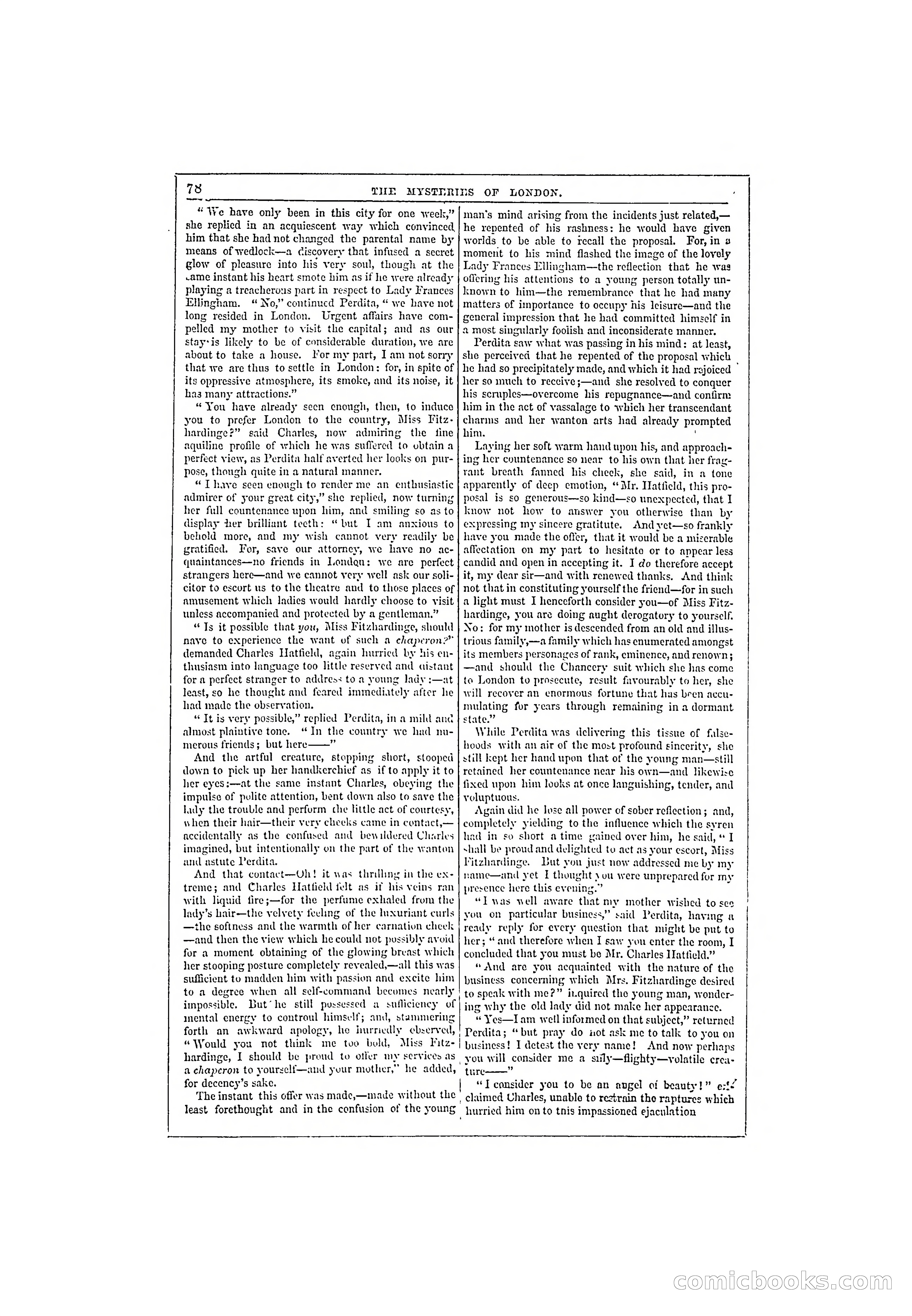
A restored page from Penny Dreadfuls, 1846. Page through the whole issue in the reader above.
📄 Transcribed text from this page (OCR, searchable)
Machine-transcribed from the original scan — historical spelling and the odd misread are preserved.
78 “We have only been in this city for one week,” she replied in an acquiescent way which convinced him that she had not changed the parental name by means of wedlock—a Ciscovery that infused a secret glow of pleasure into his very soul, though at the -ame instant his heart smote him as if he were already playing a treacherous part in respect to Lady Frances Eiingham. “ No,’ continucd Perdita, “ we have not long resided in London. Urgent affairs have com- pelled my mother to visit the capital; and as our staysis likely to be of considerable duration, we are about to take a house. lor my part, IJ am not sorry that we are thus to settle in London: for, in spite of its oppressive atmosphere, its smoke, and its noise, it ha3 many attractions.” “You have already secn enough, then, to induce you to prefer London to the country, Miss Titz- hardinge?” said Charles, now admiring the fine aquiline profile of which he was suffered to obtain a perfect view, as Perdita half averted her looks on pur- pose, though quite in a natural manner. “ Thave seen enough to render me an enthusiastic admirer of your great city,” she replied, now turning her full countenance upon him, and smiling so as to display her brilliant teeth: “but I am anxious to behold more, and my wish cannot very readily be gratified. For, save our attorney, we have no ac- quaintances—no friends in Londen: we are perfect strangers here—and we cannot very well ask our soli- citor to escort us to the theatre and to those places of amusement which ladies would hardly choose to visit unless accompanied and protected by a gentleman.” “Ts it possible that you, Aliss Fitzhardinge, should naye to experience the want of such a chaperon?” demanded Charles Hatfield, again hurried by his en- thusiasm into language too little reserved and aistant for a perfect stranger to address toa young lady :—at least, so he thought and feared immediately after he had made the observation. “It is very possible,” replied Perdita, in a mild and almost plaintive tone. “In the country we had no- merous friends; but here pa And the artful creature, stepping short, stooped down to pick up her handkerchief as if to apply it to her eyes:—at the same mstant Charles, obeying the impulse of polite attention, bent down also to save the lady the trouble and perfurm che little act of courtesy, when their hair—their very cheeks came in contact,— accidentally as the confused and bewildered Charles imagined, but intentionally on the part of the wanton and astute Perdita. And that contact—Oh! it was thrilling in the ex- treme; and Charles Hatfield felt as if his veins ran with liquid fire;—for the perfume exhaled from the lady’s hair—the velvety feeling of the luxuriant curls —the softness and the warmth of her carnation cheek —and then the view which he could not possibly avoid for a moment obtaining of the glowing breast which her stooping posture completely revealed,—all this was sufficient to madden him with passion and excite him to a degree when all self-command becomes nearly impossible. But*he still pussessed a sufficiency of mental energy to controul himself; and, stammering forth an awkward apology, he hurriedly cbserved, “Would you not think me too bold, Miss Fitz- hardinge, I should be proud to offer my services as a chaperon to yourself{—and your mother,” he added, for decency’s sake. The instant this offer was made,—made without the least forethought and in the confusion of the young ——. THE MYSTHERINS OF LONDON, ON en a yar) rr man’s mind arising from the incidents just related,— he repented of his rashness: he would have given worlds to be able to recall the proposal. For, in a moment to his mind flashed the image of the lovely Lady Frances Ellingham—the reflection that he was offcring his attentions to a young person totally un- known to him—the remembrance that he had many matters of importance to occupy his leisure—and the gencral impression that he had committed himself in a most singularly foolish and inconsiderate manner. Perdita saw what was passing in his mind: at least, she perceived that he repented of the proposal which he had so precipitately made, and which it had rejoiced | her so much to receive ;—and she resolved to conquer his seruples—overcome his repugnance~—and contirm him in the act of vassalage to which her transcendant charms and her wanton arts had already prompted him. Laying her soft warm hand upon his, and approach- ing her countenance so near to his own that her frag- rant breath fanned his check, she said, in a tone apparently of deep emotion, “Mr. Iatficld, this pro- posal is so generous—so kind—so unexpected, that I know not how to answer you otherwise than by expressing my sincere gratitute. And yet—so frankly have you made the offer, that it would be a miserable affectation on my part to hesitate or to appear less candid and open in accepting it. I do therefore accept it, my dear sir—and with renewed thanks. And think not that in constituting yourself the friend—for in such a light must I henceforth consider you—of Miss Fitz- hardinge, you are doing aught derogatory to yourself. No: for my mother is descended from an old and illus- trious family,—a family which has enumerated amongst its members personages of rank, eminence, and renown; —and should the Chancery suit which she has come to London to prosecute, result favourably to her, she will recover an enormous fortune that has been accu- mulating for years through remaining in a dormant state.” While Perdita was delivering this tissue of false- hoods with an air of the most profound sincerity, she still kept her hand upon that of the young man—still retained her countenance near his own—and likewise fixed upon him looks at once languishing, tender, and voluptuous. Again did he lose all power of sober reflection; and, completely yielding to the influence which the syren had in so short atime gained over him, he said, “I shall be proud and delighted to act as your escort, Miss Vitzhardinge. But you just now addressed me by my name—and yet PE thought you were unprepared for my presence here this evening.” “Twas well aware that my mother wished to sea you on particular business,” said Perdita, having a ready reply for every question that might be put to her; “and therefore when I saw you enter the room, I concluded that you must be Mr. Charles IIatfield.” “And are you acquainted with the nature of the business concerning which Mrs. F itzhardinge desired to speak with me?” inquired the young man, wonder- ing why the old lady did not make her appearance. “ Yes—Iam well informed on that subject,” returned | Perdita; “ but pray do not ask me to talk to you on | business! I detest the very name! And now perhaps you will consider me a suly—flighty—volatile crea- ture——” Py a A “Tconsider you to be an angel of beauty!” et _ claimed Uharles, unable to restrain the raptures which hurried him on to tnis impassioned ejaculation (SO) GIOOKS (SO)