
Penny Dreadfuls, 1846 · page 92 of 399
The Mysteries of London, Vol. IV — page 92: what you’re looking at
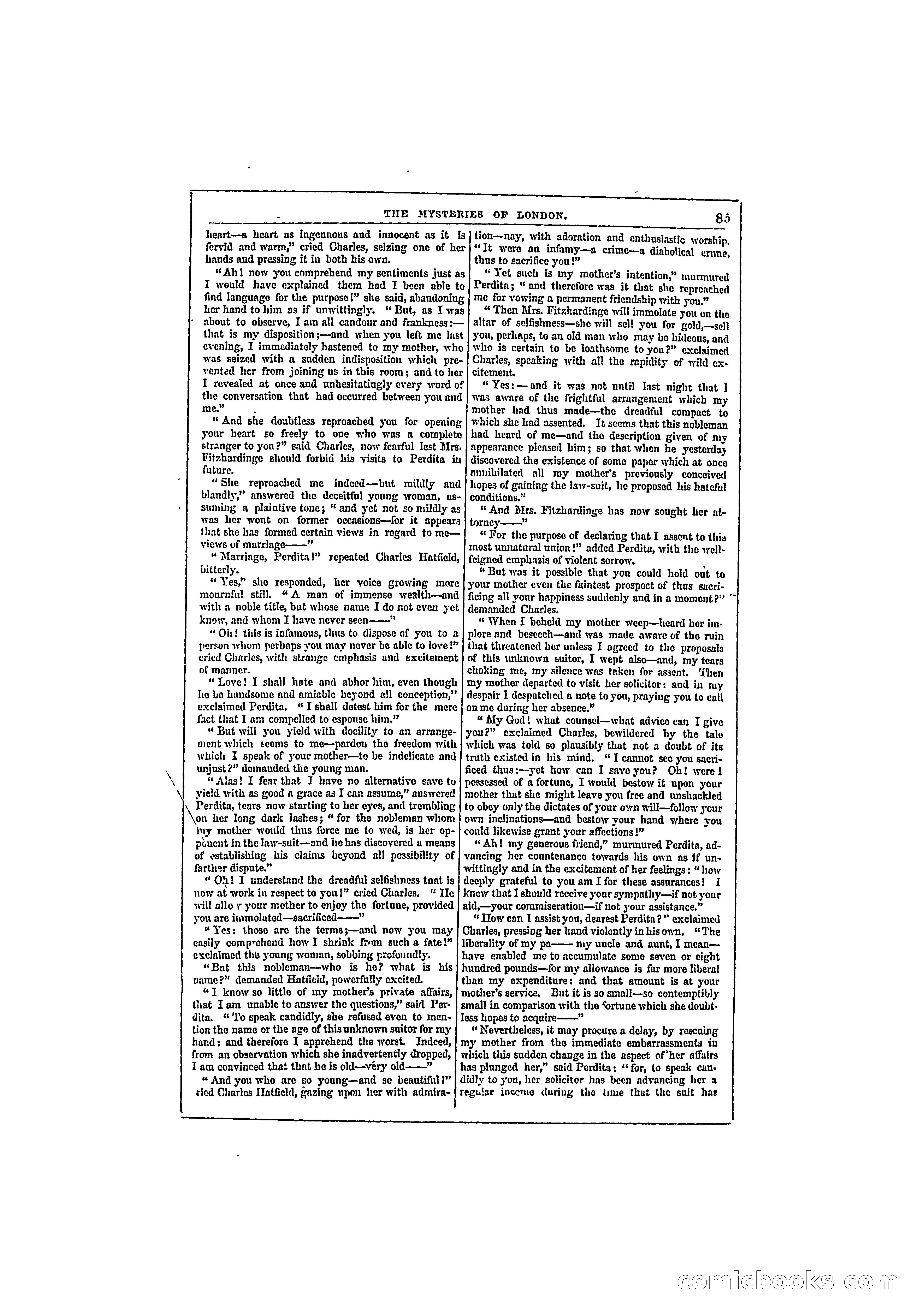
A restored page from Penny Dreadfuls, 1846. Page through the whole issue in the reader above.
📄 Transcribed text from this page (OCR, searchable)
Machine-transcribed from the original scan — historical spelling and the odd misread are preserved.
THE - 2 oe ewer. heart—a heart as ingennous and innocent as if is fervid and warm,” cried Charles, seizing one of her hands and pressing it in both his own. “Ah! now you comprehend my sentiments just as I would have explained them had I been able te find language for the purpose!” she said, abandoning her hand to him as if unwittingly. “ But, as I was about to observe, J am all candour and frankness :— that is my disposition ;—-and when you left me last evening, I immediately hastened to my mother, who was seized with a sudden indisposition which pre- vented her from joining us in this room; and to her I revealed at once and unhesitatingly every word of the conversation that had occurred between you and me.” ; “And she doubtless reproached you for opening your heart so freely to one who was a complete stranger to you?” said Charles, now fearful lest Mrs. litzhardinge should forbid his visits to Perdita in future. “She reproached me indeed—but mildly and blandly,” answered the deceitful young woman, as- suming a plaintive tone; “and yet not so mildly as was lier wont on former occasions—for it appears that she has formed certain views in regard to me— views of marriage——”’ “ Marriage, Perdita!” repeated Charles Hatfield, bitterly. “Yes,” she responded, her voice growing more mournful still, “A man of immense wealth—and with a noble title, but whose name I do not even yet know, and whom I have never seen——~” “Oh! this is infamous, thus to dispose of you to a person whom perbaps vou may never be able to love!” cried Charles, with strange emphasis and excitement of manner. “Love! I shall hate and abhor him, even though lic bo handsome and amiable beyond all conception,” exclaimed Perdita, “I shail detest him for the mere fact that I am compelled to espouse him.” “ But will you yield with docility to an arrange- ment which seems to me—pardon the freedom with Which I speak of your mother—to be indelicate and unjust?” demanded the young man. “Alas! I fear that J have no alternative save to vield with as good a grace as I can assume,” answered Perdita, tears now starting to her cyes, and trembling Nan her long dark lashes; “ for the nobleman whom wy mother would thus force me to wed, is her op- sonent in the Jaw-suit—and he has discovered a means of establishisg his claims beyond all possibility of farther dispute.” “Oh! I understand the dreadful selfishness taat is now at work in respect to you!” cried Charles. “ IIc will allo y your mother fo enjoy the fortune, provided you are inmolated—sacrificed-———” “Yes; those are the terms;—and now you may easily comprehend how I shrink from such a fate!” exclaimed the young woman, sobbing profoundly. “Bunt this nobleman—who is he? what is his name?” demanded Hatiield, powerfully excited. “TJ know so little of my mother’s private affairs, that Iam unable to answer the questions,” said Per- dita. “‘I'o speak candidly, she refused even to men- tion the name or the age of this unknown suitor for my hand: and therefore 1 apprehend the worst. Indeed, from an observation which she inadvertently dropped, 1 am convinced that that he is old—very old-——” “ And you who are so young—and sce beautiful!” ried Charles ITatfield, gazing upon her with admira- MYSTENIES OF LONDON. 85 tion—nay, with adoration and enthusiastic worship. “It were an infamy—a crime—a diabolical ere, thus to sacrifice you!” “Yet such is my mother’s intention,” murmured Perdita; “and therefore was it that she repreached me for vowing a permanent friendship with you.” “Then Mrs. Fitzhardinge will immolate you on the altar of selfishness—she will sell you for gold,—sell you, perhaps, to an old man who may be hideous, and who is certain to be loathsome to you?” exclaimed Charles, speaking with all the rapidity of wild ex- citement. “'Yes:—and it was not until Iast night that J was aware of the frightful arrangement which my mother had thus made—the dreadful compact to which she had assented. Jt seems that this nobleman had heard of me—and the description given of my appearance pleased him; so that when he yesterday discovered the existence of some paper which at once annihilated all my mother’s previously conceived hopes of gaining the law-suit, he proposed his hateful conditions.” “And Mrs, Fitzhardinge has now sought her at- torney——” “¥or the purpose of declaring that I assent to this most unnatural union!” added Perdita, with the well- feigned emphasis of violent sorrow. . “ But was it possible that you could hold out to your mother even the faintest prospect of thus sacri- ficing all your happiness suddenly and in a moment?” * demanded Charles. “ When f beheld my mother weep—heard her iin- plore and beseech—and was made aware of the ruin that threatened her unless I agreed to the proposals of this unknown suitor, I wept also—and, my tears choking me, my silence was taken for assent. ‘i‘hen my mother departed to visit her solicitor: and in my despair I despatched a note to you, praying you to call on me during her absence.” “ My God! what counsel—what advice can I give you?” exclaimed Charles, bewildered by the tale which was told so plausibly that not a doubt of its truth existed in his mind. “I cannot sec you sacri- ficed thus:—-yet how can I save you? Oh! were! possessed of a fortune, I would bestow it upon your mother that she might leave you free and unshackled to obey only the dictates of your own will—follow your own inclinations—and bestow your hand where you could likewise grant your affections !” “Ah! my generous friend,” murmured Perdita, ad- vancing her countenance towards his own as if un- wittingly and in the excitement of her feelings: “how deeply grateful to you am I for these assurances! I knew that I should receive your sympathy—if not your aid,—your commiseration—if not your assistance.” “‘ ¥Jow can I assist you, dearest Perdita?* exclaimed Charles, pressing her hand violently inhisown. “The liberality of my pa-—— my uncle and aunt, I mean— have enabled me to accumulate some seven or cight hundred pounds—for my allowance is far more liberal than my expenditure: and that amount is at your mother’s service. But it is so small—so contemptibly small in comparison with the ‘ortune which she doubt- less hopes to acquire———-” ‘s Nevertheless, it may procure a delay, by rescuing my mother from the immediate embarrassments in which this sudden change in the aspect of her affairs has plunged her,” said Perdita; ‘for, to speak can- didly to you, her solicitor has been adyancing her a regular inccme during tlie time that the suit has e a i, (C(O) DOO ZN i (SO)