
Penny Dreadfuls, 1895 · page 130 of 395
The Island School — page 130: what you’re looking at
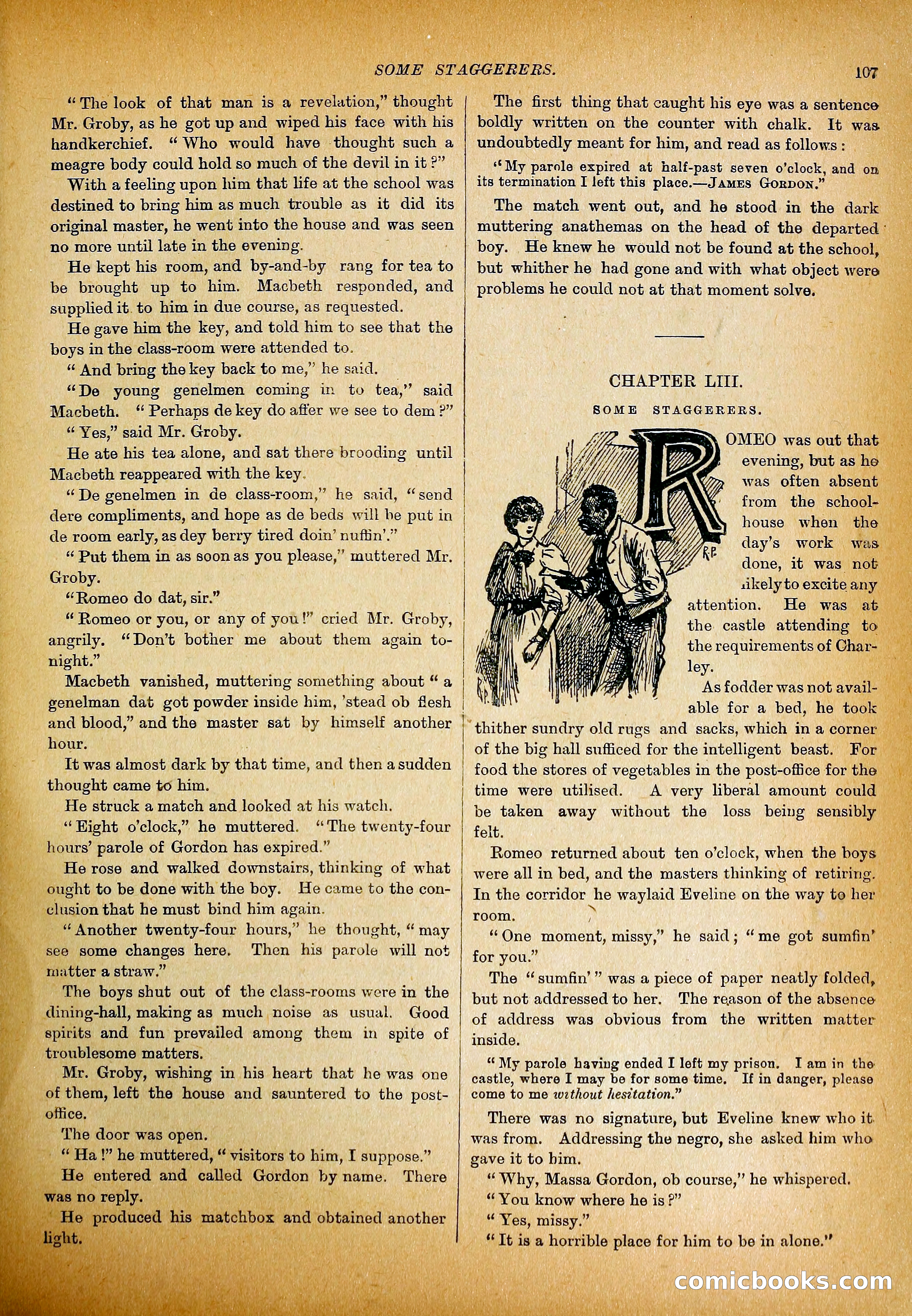
A restored page from Penny Dreadfuls, 1895. Page through the whole issue in the reader above.
📄 Transcribed text from this page (OCR, searchable)
Machine-transcribed from the original scan — historical spelling and the odd misread are preserved.
SOME STAGGERERS. “The look of that man is a revelation,” thought Mr. Groby, as he got up and wiped his face with his handkerchief. ‘ Who would have thought such a meagre body could hold so much of the devil in it ?” With a feeling upon him that life at the school was destined to bring him as much trouble as it did its original master, he went into the house and was seen no more until late in the evening. He kept his room, and by-and-by rang for tea to be brought up to him. Macbeth responded, and supplied it. to him in due course, as requested. He gave him the key, and told him to see that the boys in the class-room were attended to. “ And bring the key back to me,” he said. “De young genelmen coming in to tea,” said Macbeth. “ Perhaps de key do after we see to dem ?” “Yes,” said Mr. Groby. He ate his tea alone, and sat there brooding until Macbeth reappeared with the key. “De genelmen in de class-room,” he said, “send dere compliments, and hope as de beds will he put in de room early, as dey berry tired doin’ nufiin’.” “ Put them in as soon as you please,” muttered Mr. Groby. “Romeo do dat, sir.” “ Romeo or you, or any of you!” cried Mr. Groby, angrily. “Don’t bother me about them again to- night.” Macbeth vanished, muttering something about “a genelman dat got powder inside him, ’stead ob flesh and blood,” and the master sat by himself another hour. | It was almost dark by that time, and then asudden thought came to him. He struck a match and looked at his watch. “Hight o'clock,” he muttered. ‘The twenty-four hours’ parole of Gordon has expired.” He rose and walked downstairs, thinking of what ought to be done with the boy. He came to the con- clusion that he must bind him again. “ Another twenty-four hours,” he thought, “ may see some changes here. Then his parole will not matter a straw.” The boys shut out of the class-rooms were in the dining-hall, making as much noise as usual. Good spirits and fun prevailed among them in spite of | troublesome matters. Mr. Groby, wishing in his heart that he was one of them, left the house and sauntered to the post- office. The door was open. “Ha !” he muttered, “ visitors to him, I suppose.” He entered and called Gordon by name. There was no reply. He produced his matchbox and obtained another 107 The first thing that caught his eye was a sentence boldly written on the counter with chalk. It was undoubtedly meant for him, and read as follows: ‘“My parole expired at half-past seven o’clock, and on its termination I left this place.—James Gorpon.” The match went out, and he stood in the dark muttering anathemas on the head of the departed boy. He knew he would not be found at the school, but whither he had gone and with what object were problems he could not at that moment solve. CHAPTER LIII. SOME STAGGERERS. Wy Ss \ OMEO was out that {| Wy Yy evening, but as he WH / was often absent am. | ima Y from the school- SP house when the day’s work was done, it was not sikely to excite any attention. He was at the. castle attending to HE a the requirements of Char- (li Mgeisia As fodder was not avail- able for a bed, he took thither sundry old rugs and sacks, which in a corner of the big hall sufficed for the intelligent beast. For food the stores of vegetables in the post-office for the time were utilised. A very liberal amount could be taken away without the loss being sensibly felt. Romeo returned about ten o’clock, when the boys were all in bed, and the masters thinking of retiring. In the corridor he waylaid Eveline on the way to her room. “One moment, missy,” he said; “me got sumfin’ for you.” The “sumfin’” was a piece of paper neatly folded, but not addressed to her. The reason of the absence of address was obvious from the written matter inside. . alge. fae ‘a we “ My parole having ended I left my prison. JI amin the castle, where I may be for some time, If in danger, please come to me wzthout hesztation.” There was no signature, but Eveline knew who it was from. Addressing the negro, she asked him who gave it to him. “ Why, Massa Gordon, ob course,” he whispered. “You know where he is ?” “ Yes, missy.” “It is a horrible place for him to be in alone.” cs Eom a 00 ( Gf @ )