
Penny Dreadfuls, 1895 · page 15 of 395
The Island School — page 15: what you’re looking at
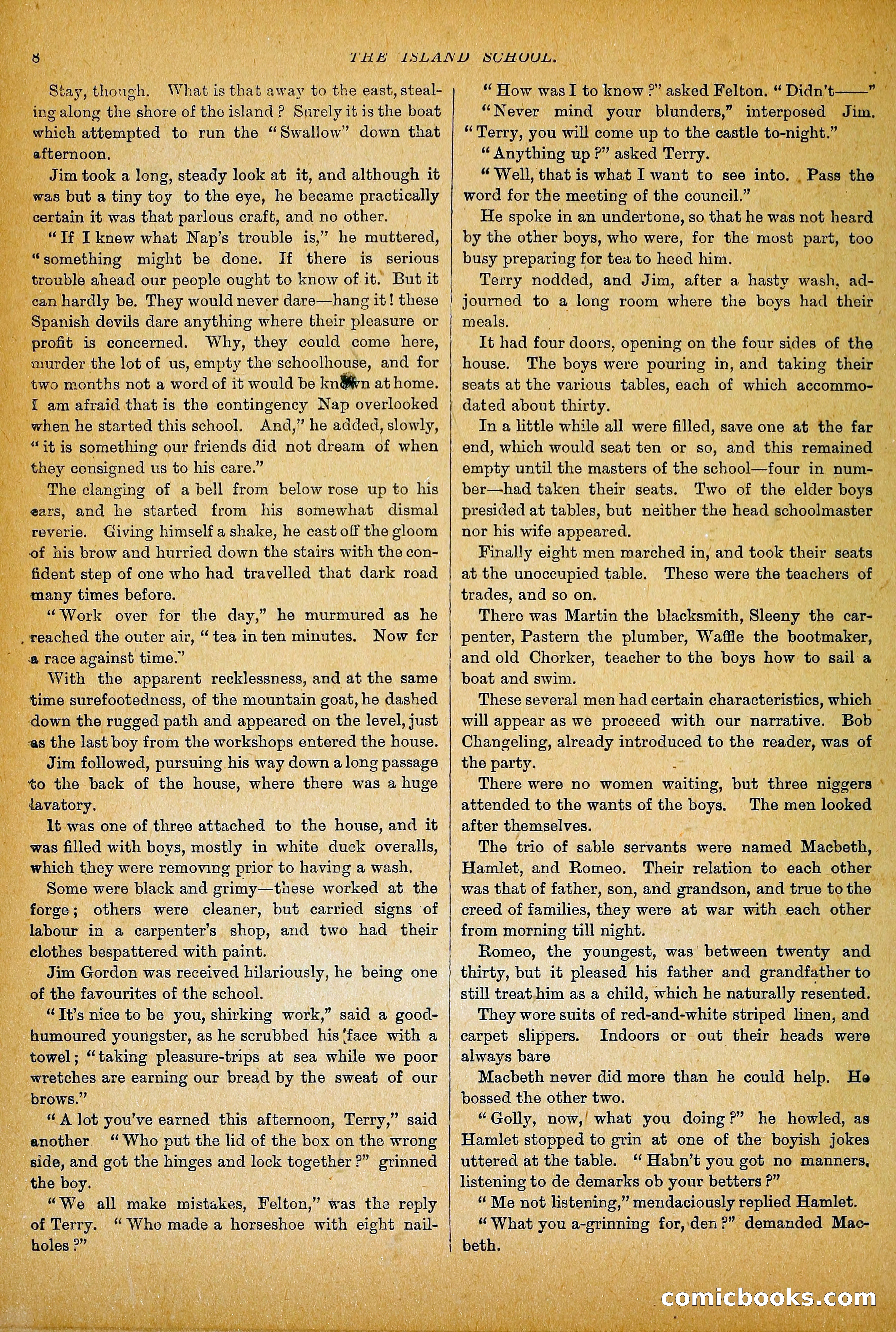
A restored page from Penny Dreadfuls, 1895. Page through the whole issue in the reader above.
📄 Transcribed text from this page (OCR, searchable)
Machine-transcribed from the original scan — historical spelling and the odd misread are preserved.
fo) : THK L1SLAND Stay, though. What is that away to the east, steal- ing along the shore of the island? Surely it 1s the boat which attempted to run the “Swallow” down tnat aiternoon. Jim took a long, steady look at it, and although it was but a tiny toy to the eye, he became practically certain it was that parlous craft, and no other. ~ “Tf I knew what Nap’s trouble is,” he muttered, “something might be done. If there is serious trouble ahead our people ought to know of it. But it ean hardly be. They would never dare—hang it! these Spanish devils dare anything where their pleasure or profit is concerned. Why, they could come here, murder the lot of us, empty the schoolhouse, and for two months not a word of it would be kn&Wn at home. I am afraid that is the contingency Nap overlooked when he started this school. And,” he added, slowly, “it is something our friends did not dream of when they consigned us to his care.” The clanging of a bell from below rose up to his ears, and he started from his somewhat dismal reverie. Giving himselfa shake, he cast off the gloom of his brow and hurried down the stairs with the con- fident step of one who had travelled that dark road many times before. “Work over for the day,” he murmured as he _ reached the outer air, “tea inten minutes. Now for @ race against time.’ With the apparent recklessness, and at the same time surefootedness, of the mountain goat, he dashed down the rugged path and appeared on the level, just ‘as the last boy from the workshops entered the house. Jim followed, pursuing his way down a long passage to the back of the house, where there was a huge lavatory. 1t was one of three attached to the house, and it was filled with boys, mostly in white duck overalls, which they were removing prior to having a wash. Some were black and grimy—tnese worked at the forge; others were cleaner, but carried signs of labour in a carpenter’s shop, and two had their clothes bespattered with paint. Jim Gordon was received hilariously, he being one of the favourites of the school. “Tt’s nice to be you, shirking work,” said a good- humoured youngster, as he scrubbed his {face with a towel; “taking pleasure-trips at sea while we poor wretches are earning our bread by the sweat of our brows.” “ A lot you’ve earned this afternoon, Terry,” said another. ‘“ Who put the lid of the box on the wrong side, and got the hinges and lock together?” grinned the boy. “We all make mistakes, Felton,” was the reply of Terry. ‘ Who made a horseshoe with eight nail- holes ?” SCHOUL. “ How was I to know P” asked Felton. “ Didn’t he “Never mind your blunders,” interposed Jim, “Terry, you will come up to the castle to-night.” “ Anything up ?” asked Terry. “ Well, that is what I want to see into. . Pass the word for the meeting of the council.” ) He spoke in an undertone, so that he was not heard by the other boys, who were, for the most part, too busy preparing for tea to heed him. Terry nodded, and Jim, after a hasty wash, ad- journed to a long room where the boys had their meals, | It had four doors, opening on the four sides of the house. The boys were pouring in, and taking their seats at the various tables, each of which accommo- dated about thirty. In a little while all were filled, save one at the far end, which would seat ten or so, and this remained empty until the masters of the school—four in num- ber—had taken their seats. Two of the elder boys presided at tables, but neither the head schoolmaster nor his wife appeared. Finally eight men marched in, and took their seats at the unoccupied table. These were the teachers of traces, and so on. There was Martin the blacksmith, Sleeny the car- penter, Pastern the plumber, Waffle the bootmaker, and old Chorker, teacher to the boys how to sail a boat and swim. These several men had certain characteristics, which - will appear as we proceed with our narrative. Bob Changeling, already introduced to the reader, was of the party. é There were no women waiting, but three niggers ° attended to the wants of the boys. The men looked after themselves. The trio of sable servants were named Macbeth, . Hamlet, and Romeo. Their relation to each other was that of father, son, and grandson, and true to the creed of families, they were at war with each other from morning till night. Romeo, the youngest, was’ between twenty and thirty, but it pleased his father and grandfather to still treat.him as a child, which he naturally resented. They wore suits of red-and-white striped linen, and carpet slippers. Indoors or out their heads were always bare Macbeth never did more than he could help. bossed the other two. “Golly, now,’ what you doing?” he howled, as Hamlet stopped to grin at one of the boyish jokes uttered at the table. ‘ Habn’t you got no manners, listening to de demarks ob your betters P” “ Me not listening,” mendaciously replied Hamlet. ‘What you a-grinning for, den?” demanded Mac- He | beth. com 900KS O -comi