
Penny Dreadfuls, 1854 · page 101 of 394
Joseph Wilmot, or, The Memoirs of a Man-Servant — page 101: what you’re looking at
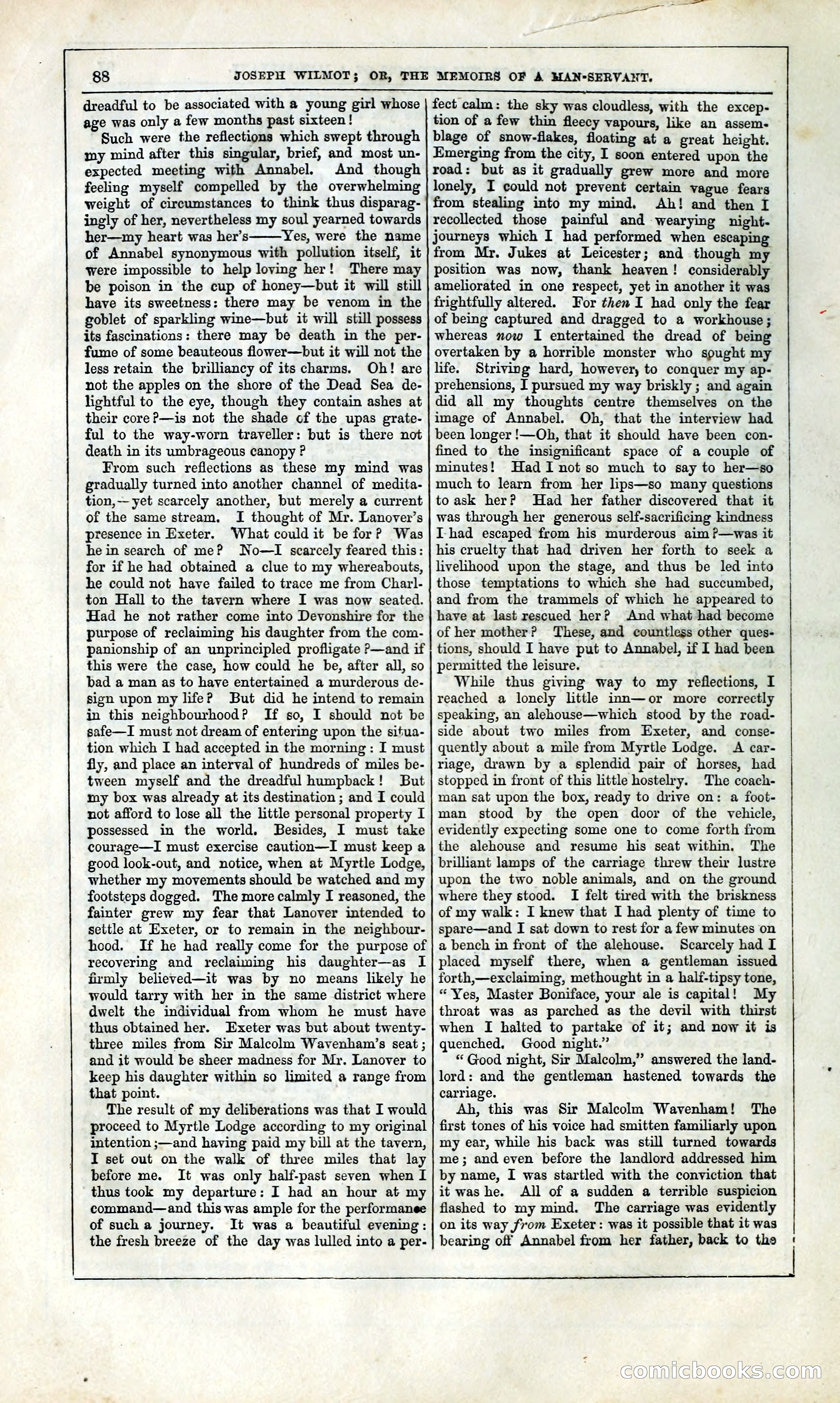
A restored page from Penny Dreadfuls, 1854. Page through the whole issue in the reader above.
📄 Transcribed text from this page (OCR, searchable)
Machine-transcribed from the original scan — historical spelling and the odd misread are preserved.
88 dreadful to be associated with a young girl whose age was only a few months past sixteen! Such were the reflections which swept through my mind after this singular, brief, and most un- expected meeting with Annabel. And though feeling myself compelled by the overwhelming weight of circumstances to think thus disparag- ingly of her, nevertheless my soul yearned towards her—my heart was her’s Yes, were the name of Annabel synonymous with pollution itself, it were impossible to help loving her! There may be poison in the cup of honey—but it will still have its sweetness: there may be venom in the goblet of sparkling wine—but it will still possess its fascinations: there may be death in the per- fume of some beauteous flower—but it will not the less retain the brilliancy of its charms. Oh! are not the apples on the shore of the Dead Sea de- lightful to the eye, though they contain ashes at their core P—is not the shade of the upas grate- ful to the way-worn traveller: but is there not death in its umbrageous canopy P From such reflections as these my mind was gradually turned into another channel of medita- tion,— yet scarcely another, but merely a current of the same stream. I thought of Mr. Lanover’s presence in Exeter. What could it be for? Was he in search of me? No—I scarcely feared this: for if he had obtained a clue to my whereabouts, he could not have failed to trace me from Charl- ton Hall to the tavern where I was now seated. Had he not rather come into Devonshire for the purpose of reclaiming his daughter from the com- panionship of an unprincipled profligate P—and if this were the case, how could he be, after all, so bad a man as to have entertained a murderous de- sign upon my lifeP But did he intend to remain in this neighbourhood? If so, I should not be safe—I must not dream of entering upon the situa- tion which I had accepted in the morning: I must fly, and place an interval of hundreds of miles be- tween myself and the dreadful humpback! But my box was already at its destination ; and I could not afford to lose all the little personal property I possessed in the world. Besides, I must take courage—I must exercise caution—I must keep a good look-out, and notice, when at Myrtle Lodge, whether my movements should be watched and my footsteps dogged. The more calmly I reasoned, the fainter grew my fear that Lanover intended to settle at Exeter, or to remain in the neighbour- hood. If he had really come for the purpose of recovering and reclaiming his daughter—as I firmly believed—it was by no means likely he would tarry with her in the same district where dwelt the individual from whom he must have thus obtained her. Exeter was but about twenty- three miles from Sir Malcolm Wavenham’s seat ; and it would be sheer madness for Mr. Lanover to keep his daughter within so limited a range from that point. The result of my deliberations was that I would proceed to Myrtle Lodge according to my original intention ;—and having paid my bill at the tavern, I set out on the walk of three miles that lay before me. It was only half-past seven when I thus took my departure: I had an hour at my command—and this was ample for the performanee of such a journey. It was a beautiful evening: the fresh breeze of the day was lulled into a per- JOSEPH WILMOT; OR, THE MEMOIRS OF A MAN*SERVANT. fect calm: the sky was cloudless, with the excep- tion of a few thin fleecy vapours, like an assem- blage of snow-flakes, floating at a great height. Emerging from the city, I soon entered upon the road: but as it gradually grew more and more lonely, I could not prevent certain vague fears from stealing into my mind. Ah! and then I recollected those painful and wearying night- journeys which I had performed when escapi from Mr. Jukes at Leicester; and though my position was now, thank heaven! considerably ameliorated in one respect, yet in another it was frightfully altered. For then I had only the fear of being captured and dragged to a workhouse; whereas now I entertained the dread of being overtaken by a horrible monster who sought my life. Striving hard, however, to conquer my ap- prehensions, I pursued my way briskly ; and again did all my thoughts centre themselves on the image of Annabel. Oh, that the interview had been longer !—Oh, that it should have been con- fined to the insignificant space of a couple of minutes! Had I not so much to say to her—so much to learn from her lips—so many questions toask her? Had her father discovered that it was through her generous self-sacrificing kindness I-had escaped from his murderous aim P—was it his cruelty that had driven her forth to seek a livehhood upon the stage, and thus be led into those temptations to which she had succumbed, and from the trammels of which he appeared to have at last rescued her? And what had become of her mother? These, and countless other ques- tions, should I have put to Annabel, if I had been permitted the leisure. While thus giving way to my reflections, I reached a lonely little inn—or more correctly speaking, an alehouse—which stood by the road- side about two miles from Exeter, and conse- quently about a mile from Myrtle Lodge. A car- riage, drawn by a splendid pair of horses, had stopped in front of this little hostelry. The coach- man sat upon the box, ready to drive on: a foot- man stood by the open door of the vehicle, evidently expecting some one to come forth from the alehouse and resume his seat within. The brilliant lamps of the carriage threw their lustre upon the two noble animals, and on the ground where they stood. I felt tired with the briskness of my walk: I knew that I had plenty of time to spare—and I sat down to rest for a few minutes on a bench in front of the alehouse. Scarcely had I placed myself there, when a gentleman issued forth,—exclaiming, methought in a half-tipsy tone, “Yes, Master Boniface, your ale is capital! My throat was as parched as the devil with thirst when I halted to partake of it; and now it is quenched. Good night.” * Good night, Sir Malcolm,” answered the land- lord: and the gentleman hastened towards the carriage. Ah, this was Sir Malcolm Wavenham! The first tones of his voice had smitten familiarly upon my ear, while his back was still turned towards me; and even before the landlord addressed him by name, I was startled with the conviction that it was he. All of a sudden a terrible suspicion flashed to my mind. The carriage was evidently on its way from Exeter: was it possible that it was bearing off Annabel from her father, back to the ELO@QO) <S (COAN)