
Penny Dreadfuls, 1854 · page 133 of 394
Joseph Wilmot, or, The Memoirs of a Man-Servant — page 133: what you’re looking at
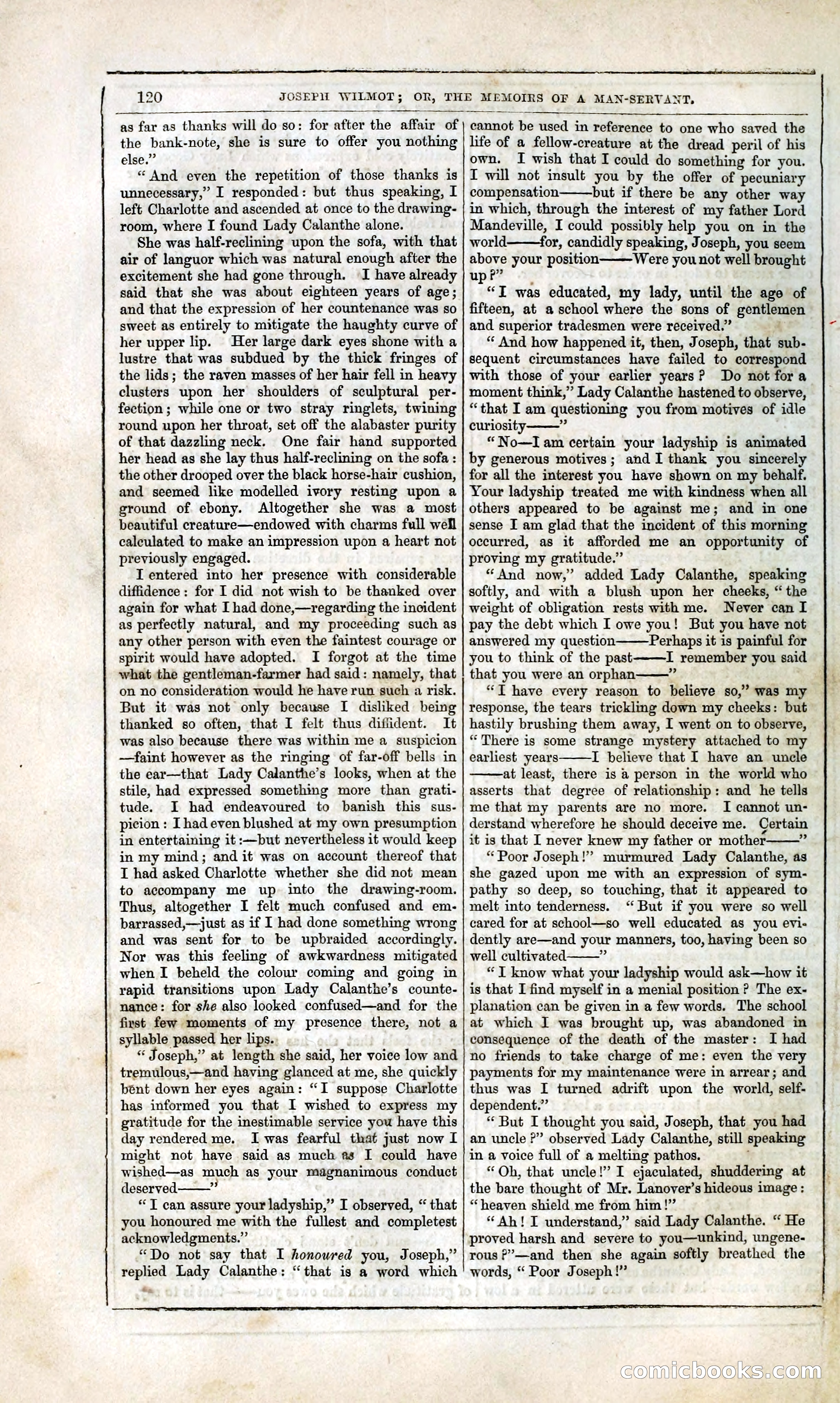
A restored page from Penny Dreadfuls, 1854. Page through the whole issue in the reader above.
📄 Transcribed text from this page (OCR, searchable)
Machine-transcribed from the original scan — historical spelling and the odd misread are preserved.
- . _ > . ia - es Fur - a ia 120 JOSEPM WILMOT; as far as thanks will do so: for after the affair of the bank-note, she is sure to offer you nothing else.” «“ And even the repetition of those thanks is unnecessary,” I responded: but thus speaking, I left Charlotte and ascended at once to the drawing- room, where I found Lady Calanthe alone. She was half-reclining upon the sofa, with that air of languor which was natural enough after the excitement she had gone through. I have already said that she was about eighteen years of age; and that the expression of her countenance was so sweet as entirely to mitigate the haughty curve of her upper lip. Her large dark eyes shone with a lustre that was subdued by the thick fringes of the lids; the raven masses of her hair fell in heavy clusters upon her shoulders of sculptural per- fection; while one or two stray ringlets, twining round upon her throat, set off the alabaster purity of that dazzling neck. One fair hand supported her head as she lay thus half-reclining on the sofa : the other drooped over the black horse-hair cushion, and seemed like modelled ivory resting upon a ground of ebony. Altogether she was a most beautiful creature—endowed with charms full well calculated to make an impression upon a heart not previously engaged. IT entered into her presence with considerable diffdence : for I did not wish to be thanked over again for what I had done,—vregarding the incident as perfectly natural, and my proceeding such as any other person with even the faintest courage or spirit would have adopted. I forgot at the time what the gentleman-farmer had said: namely, that on no consideration would he have run such a risk. But it was not only because I disliked being thanked so often, that I felt thus diffident. It was also because there was within me a suspicion —faint however as the ringing of far-off bells in the ear—that Lady Calanthe’s looks, when at the stile, had expressed something more than grati- tude. I had endeavoured to banish this sus- picion : I had even blushed at my own presumption in entertaining it :—but nevertheless it would keep in my mind; and it was on account thereof that I had asked Charlotte whether she did not mean to accompany me up into the drawing-room. Thus, altogether I felt much confused and em- barrassed,—just as if I had done something wrong and was sent for to be upbraided accordingly. Nor was this feeling of awkwardness mitigated when I beheld the colour coming and going in rapid transitions upon Lady Calanthe’s counte- nance: for she also looked confused—and for the - fivst few moments of my presence there, not a syllable passed her lips. “ Joseph,” at length she said, her voice low and tremmulous,—and having glanced at me, she quickly bent down her eyes again: “I suppose Charlotte has informed you that I wished to express my gratitude for the inestimable service you haye this day rendered me. I was fearful that just now I might not have said as much as I could have wished—as much as your magnanimous conduct deserved “T can assure your ladyship,” I observed, “ that you honoured me with the fullest and completest acknowledgments.” “Do not say that I honowred you, Joseph,” replied Lady Calanthe: “that is a word which a - OR, THE MEMOIRS OF A MAN-SERVANT, cannot be used in reference to one who saved the life of a fellow-creature at the dread peril of his own. I wish that I could do something for you. IT will not insult you by the offer of pecuniary compensation but if there be any other way in which, through the interest of my father Lord Mandeville, I could possibly help you on in the world——for, candidly speaking, Joseph, you seem above your position Were you not well brought up Pr? ; “TIT was educated, my lady, until the age of fifteen, at a school where the sons of gentlemen and superior tradesmen were received.” ; “‘ And how happened it, then, Joseph, that sub- sequent circumstances have failed to correspond with those of your earlier years? Do not fora moment think,” Lady Calanthe hastened to observe, “that I am questioning you from motives of idle curiosity st “No—I am certain your ladyship is animated by generous motives; and I thank you sincerely for all the interest you have shown on my behalf. Your ladyship treated me with kindness when all others appeared to be against me; and in one sense I am glad that the incident of this morning occurred, as it afforded me an opportunity of proving my gratitude.” “And now,’ added Lady Calanthe, speaking softly, and with a blush upon her cheeks, “ the weight of obligation rests with me. Never can I pay the debt which I owe you! But you have not answered my question Perhaps it is painful for you to think of the past I remember you said that you were an orphan MA “T have every reason to believe so,” was my response, the tears trickling down my cheeks: but hastily brushing them away, I went on to observe, “There is some strange mystery attached to my earliest years I believe that I have an uncle at least, there is a person in the world who asserts that degree of relationship: and he tells me that my parents are no more. I cannot un- derstand wherefore he should deceive me. Certain it is that I never knew my father or mother * “Poor Joseph!’ murmured Lady Calanthe, as she gazed upon me with an expression of sym- pathy so deep, so touching, that it appeared to melt into tenderness. ‘“ But if you were so well cared for at school—so well educated as you evi- dently are—and your manners, too, having been so well cultivated “ “IT know what your ladyship would ask—how it is that I find myself in a menial position ? The ex- planation can be given in a few words. The school at which I was brought up, was abandoned in consequence of the death of the master: I had no friends to take charge of me: even the very payments for my maintenance were in arrear; and thus was I turned adrift upon the world, self- dependent.” “ But I thought you said, Joseph, that you had an uncle ?” observed Lady Calanthe, still speaking in a voice full of a melting pathos. “Oh, that uncle!” I ejaculated, shuddering at the bare thought of Mr. Lanover’s hideous image : “heaven shield me from him!’’ “Ah! I understand,” said Lady Calanthe. “ He proved harsh and severe to you—unkind, ungene- rous P’—and then she again softly breathed the words, “ Poor Joseph!” <S Glyoo com a