
Penny Dreadfuls, 1854 · page 138 of 394
Joseph Wilmot, or, The Memoirs of a Man-Servant — page 138: what you’re looking at
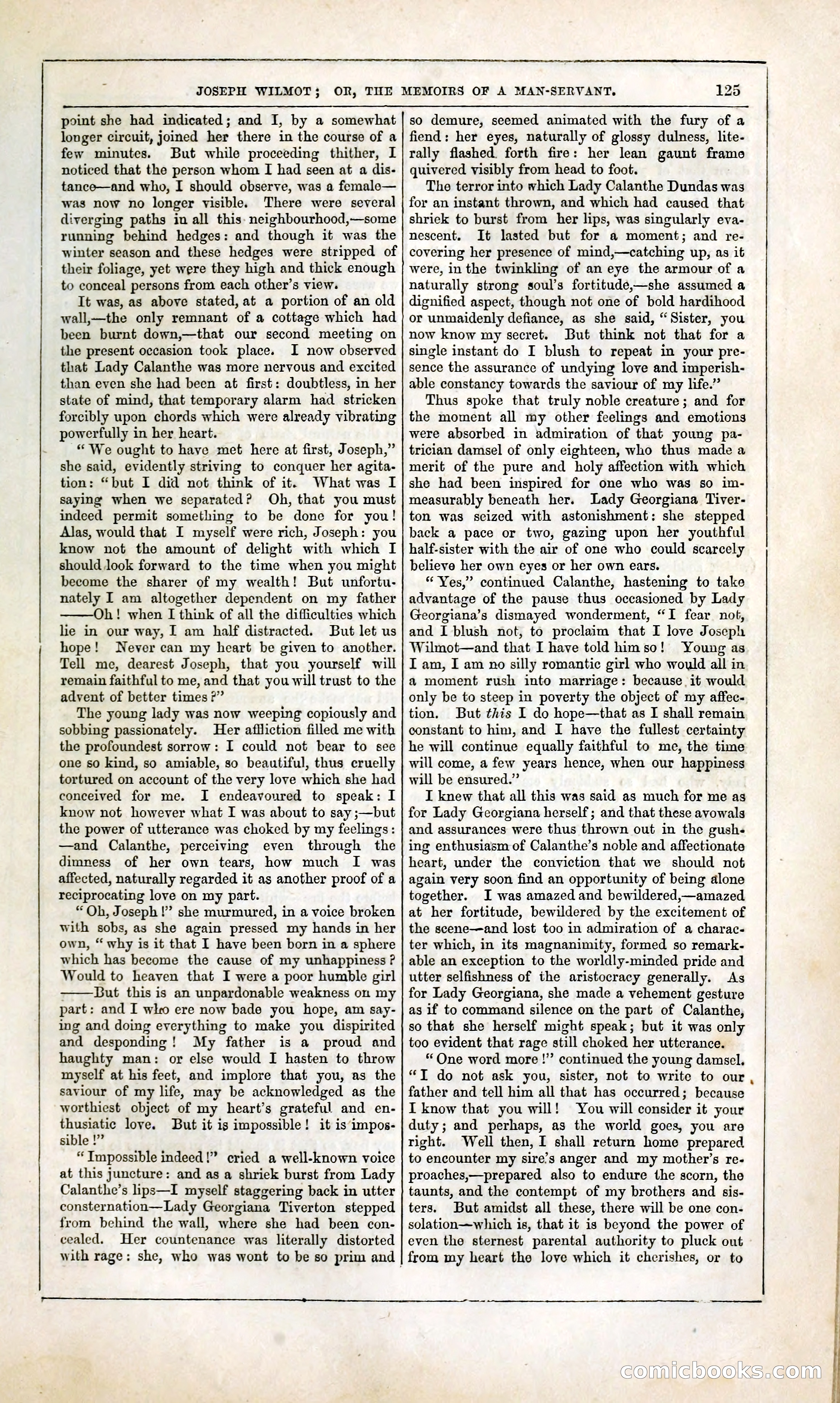
A restored page from Penny Dreadfuls, 1854. Page through the whole issue in the reader above.
📄 Transcribed text from this page (OCR, searchable)
Machine-transcribed from the original scan — historical spelling and the odd misread are preserved.
JOSEPH WILMOT; OR, THE MEMOIRS OF A MAN-SERVANT. 125 point she had indicated; and I, by a somewhat longer circuit, joined her there in the course of a few minutes. But while proceeding thither, I noticed that the person whom I had seen at a dis- tance—and who, I should observe, was a femalo— was now no longer visible. There were several diverging paths in all this: neighbourhood,—some running behind hedges: and though it was the winter season and these hedges were stripped of | their foliage, yet were they high and thick enough to conceal persons from each other’s view. It was, as above stated, at a portion of an old wall,—the only remnant of a cottage which had been burnt down,—that our second meeting on the present occasion took place. I now observed that Lady Calanthe was more nervous and excited than even she had been at first: doubtless, in her state of mind, that temporary alarm had stricken forcibly upon chords which were already vibrating powerfully in her heart. “We ought to have met here at first, Joseph,” she said, evidently striving to conquer her agita- tion: “but I did not think of it. What was I saying when we separated? Oh, that you must indeed permit something to be done for you! Alas, would that I myself were rich, Joseph: you know not the amount of delight with which I should look forward to the time when you might become the sharer of my wealth! But unfortu- nately I am altogether dependent on my father ——Oh! when I think of all the difficulties which lie in our way, I am half distracted. But let us hope! Never can my heart be given to another. Tell me, dearest Joseph, that you yourself will remain faithful to me, and that you will trust to the advent of better times ?” The young lady was now weeping copiously and sobbing passionately. Her affliction filled me with the profoundest sorrow: I could not bear to see one so kind, so amiable, so beautiful, thus cruelly tortured on account of the very love which she had conceived for me. I endeavoured to speak: I know not however what I was about to say ;—but the power of utterance was choked by my feelings: —and Calanthe, perceiving even through the dimness of her own tears, how much I was affected, naturally regarded it as another proof of a reciprocating love on my part. “Oh, Joseph !” she murmured, in a voice broken with sobs, as she again pressed my hands in her own, “why is it that I have been born in a sphere which has become the cause of my unhappiness ? Would to heaven that I were a poor humble girl : But this is an unpardonable weakness on my part: and I who ere now bade you hope, am say- ing and doing everything to make you dispirited and desponding! My father is a proud and haughty man: or else would I hasten to throw myself at his feet, and implore that you, as the saviour of my life, may be acknowledged as the worthiest object of my heart’s grateful and en- thusiatic love. But it is impossible! it is‘impos- sible !” “ Impossible indeed!” cried a well-known voice at this juncture: and as a shriek burst from Lady Calanthe’s lips—I myself staggering back in utter consternation—Lady Georgiana Tiverton stepped from behind the wall, where she had been con- cealed. Her countenance was literally distorted with rage: she, who was wont to be so prim and | so demure, seemed animated with the fury of a fiend: her eyes, naturally of glossy dulness, lite- rally flashed. forth fire: her lean gaunt frame quivered visibly from head to foot. The terror into which Lady Calanthe Dundas was for an instant thrown, and which had caused that shriek to burst from her lips, was singularly eva- nescent. It lasted but for a moment; and re- covering her presence of mind,—catching up, as it were, in the twinkling of an eye the armour of a naturally strong soul’s fortitude,—she assumed a dignified aspect, though not one of bold hardihood or unmaidenly defiance, as she said, “Sister, you now know my secret. But think not that for a single instant do I blush to repeat in your pre- sence the assurance of undying love and imperish- able constancy towards the saviour of my life.” Thus spoke that truly noble creature; and for the moment all my other feelings and emotions were absorbed in admiration of that young pa- trician damsel of only eighteen, who thus made a merit of the pure and holy affection with which she had been inspired for one who was so im- measurably beneath her. Lady Georgiana Tiver- ton was seized with astonishment: she stepped back a pace or two, gazing upon her youthful half-sister with the air of one who could scarcely believe her own eyes or her own ears. “ Yes,” continued Calanthe, hastening to take advantage of the pause thus occasioned by Lady Georgiana’s dismayed wonderment, “I fear not, and I blush not, to proclaim that I love Joseph Wilmot—and that I have told himso! Young as I am, I am no silly romantic girl who would all in a moment rush into marriage: because it would only be to steep in poverty the object of my affec- tion. But this I do hope—that as I shall remain constant to him, and I have the fullest certainty he will continue equally faithful to me, the time will come, a few years hence, when our happiness will be ensured.” I knew that all this was said as much for me as for Lady Georgiana herself; and that these avowals and assurances were thus thrown out in the gush- ing enthusiasm of Calanthe’s noble and affectionate heart, under the conviction that we should not again very soon find an opportunity of being alone together. I was amazed and bewildered,—amazed at her fortitude, bewildered by the excitement of the scene—and lost too in admiration of a charac- ter which, in its magnanimity, formed so remark- able an exception to the worldly-minded pride and utter selfishness of the aristocracy generally. As for Lady Georgiana, she made a vehement gesture as if to command silence on the part of Calanthe, so that she herself might speak; but it was only too evident that rage still choked her utterance. “One word more!” continued the young damsel, “T do not ask you, sister, not to write to our father and tell him all that has occurred; because I know that you will! You will consider it your duty; and perhaps, as the world goes, you are right. Well then, I shall return home prepared to encounter my sire’s anger and my mother’s re- proaches,—prepared also to endure the scorn, the taunts, and the contempt of my brothers and sis- ters. But amidst all these, there will be one con- solation—which is, that it is beyond the power of even the sternest parental authority to pluck out from my heart the love which it cherishes, or to CoOnniclooolks (©)