
Penny Dreadfuls, 1854 · page 141 of 394
Joseph Wilmot, or, The Memoirs of a Man-Servant — page 141: what you’re looking at
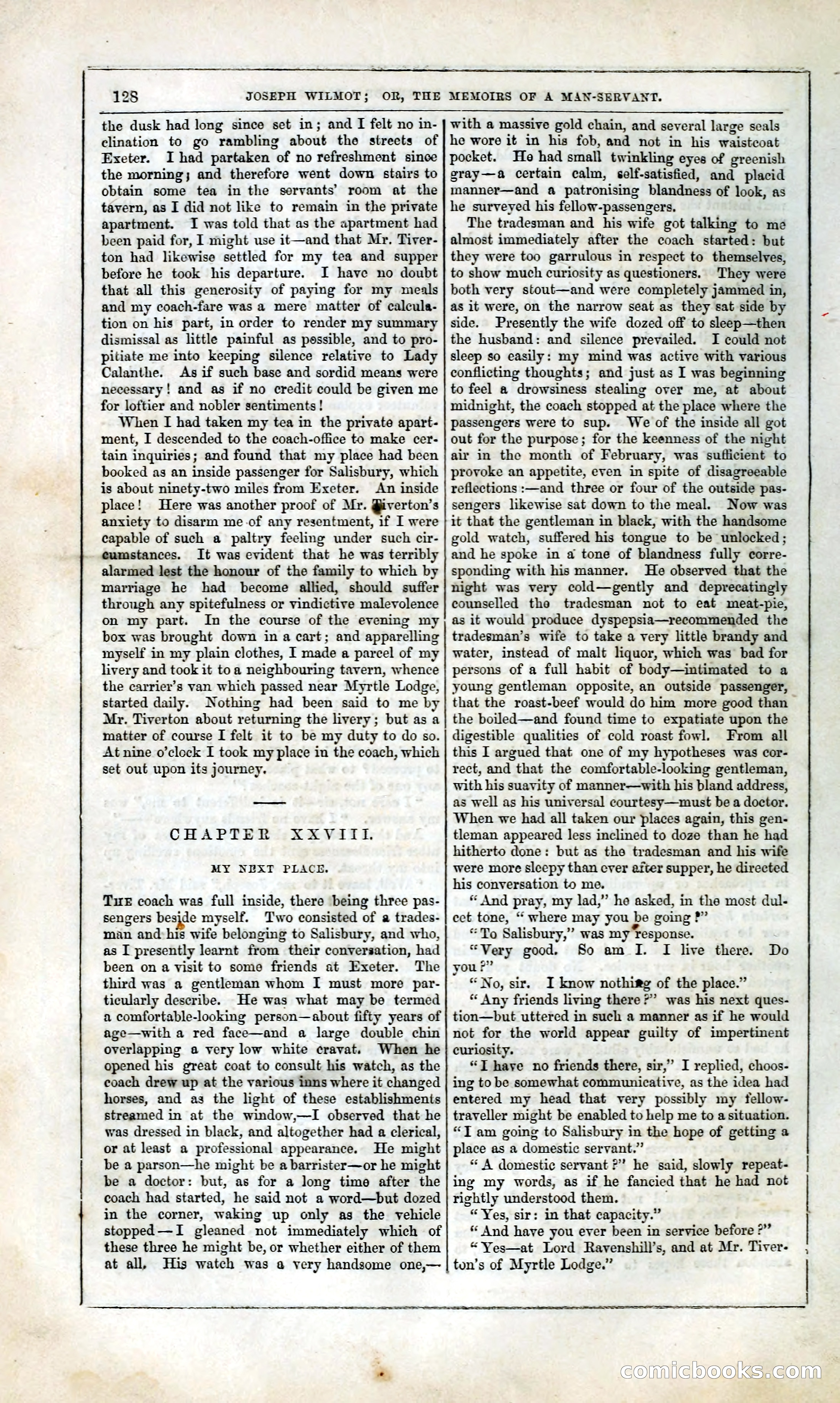
A restored page from Penny Dreadfuls, 1854. Page through the whole issue in the reader above.
📄 Transcribed text from this page (OCR, searchable)
Machine-transcribed from the original scan — historical spelling and the odd misread are preserved.
128 JOSEPH WILMOT; the dusk had long since set in; and I felt no in- clination to go rambling about the streets of Exeter. I had partaken of no refreshment since the morning; and therefore went down stairs to obtain some tea in the servants’ room at the tavern, as I did not like to remain in the private apartment. I was told that as the apartment had been paid for, I might use it—and that Mr. Tiver- ton had likewise settled for my tea and supper before he took his departure. I have no doubt that all this generosity of paying for my meals and my coach-fare was a mere matter of calcula- tion on his part, in order to render my summary dismissal as little painful as pessible, and to pro- pitiate me into keeping silence relative to Lady Calanthe. As if such base and sordid means were necessary! and as if no credit could be given me for loftier and nobler sentiments! When I had taken my tea in the private apart- ment, I descended to the coach-office to make cer- tain inguiries; and found that my place had been booked as an inside passenger for Salisbury, which is about ninety-two miles from Exeter. An inside place! Here was another proof of Mr. @iverton’s anxiety to disarm me-of any resentment, if I were capable of such a paltry feeling under such cir- cumstances. It was evident that he was terribly alarmed lest the honour of the family to which by marriage he had become allied, should suffer through any spitefulness or vindictive malevolence on my part. In the course of the evening my box was brought down in a cart; and apparelling myself in my plain clothes, I made a parcel of my livery and took it toa neighbouring tavern, whence the carrier’s van which passed near Myrtle Lodge, started daily. Nothing had been said to me by Mr. Tiverton about returning the livery; but as a matter of course I felt it to be my duty to do so. At nine o’clock I took my place in the coach, which set out upon its journey. CHAPTER XXVIII MY NEXT PLACE. TuE coach was full inside, there being three pas- sengers besjde myself. Two consisted of a trades- man and:his wife belonging to Salisbury, and who, as I presently learnt from their conversation, had been on a visit to some friends at Exeter. The third was a gentleman whom I must more par- ticularly describe. He was what may be termed a comfortable-looking person—about fifty years of age—with a red face—and a large double chin overlapping a very low white cravat. When he opened his great coat to consult his watch, as the coach drew up at the various inns where it changed horses, and as the light of these establishments streamed in at the window,—lI observed that he was dressed in black, and altogether had a clerical, or at least a professional appearance. He might be a parson—he might be a barrister—or he might be a doctor: but, as for a long time after the coach had started, he said not a word—but dozed in the corner, waking up only as the vehicle stopped—I gleaned not immediately which of these three he might be, or whether either of them at all, His watch was a very handsome one,— OR, THE MEMOIRS OF A MAN-SERVANT. with a massive gold chain, and several large seals he wore it in his fob, and not in his waistcoat pocket. He had small twinkling eyes of greenish gray—a certain calm, self-satisfied, and placid manner—and a patronising blandness of look, as he surveyed his fellow-passengers, The tradesman and his wife got talking to me almost immediately after the coach started: but they were too garrulous in respect to themselves, to show much curiosity as questioners. They were both very stout—and were completely jammed in, as it were, on the narrow seat as they sat side by side. Presently the wife dozed off to sleep—then the husband: and silence prevailed. I could not sleep so easily: my mind was active with various conflicting thoughts; and just as I was beginning to feel a drowsiness stealing over me, at about midnight, the coach stopped at the place where the passengers were to sup. We of the inside all got out for the purpose; for the keenness of the night air in the month of February, was suflicient to provoke an appetite, even in spite of disagreeable reflections :—and three or four of the outside pas- sengers likewise sat down to the meal. Now was it that the gentleman in black, with the handsome gold watch, suffered his tongue to be unlocked; and he spoke in a tone of blandness fully corre- sponding with his manner. He observed that the night was very cold—gently and deprecatingly counselled the tradesman not to eat meat-pie, as it would produce dyspepsia—recommended the tradesman’s wife to take a very little brandy and water, instead of malt liquor, which was bad for persons of a full habit of body—intimated to a young gentleman opposite, an outside passenger, that the roast-beef would do him more good than > the boiled—and found time to expatiate upon the digestible qualities of cold roast fowl. From all this I argued that one of my hypotheses was cor- rect, and that the comfortable-looking gentleman, with his suavity of manner—with his bland address, as well as his universal courtesy—must be a doctor. When we had all taken our places again, this gen- tleman appeared less inclined to doze than he had hitherto done: but as the tradesman and his wife were more sleepy than cver after supper, he directed his conversation to me. «* And pray, my lad,” he asked, in the most dul- ect tone, “ where may you be going ?” “To Salisbury,” was my response. “Very good. So am I. I live there. you ?” “No, sir. I know nothigg of the place.” * Any friends living there?’ was his next ques- tion—but uttered in such a manner as if he would not for the world appear guilty of impertinent curiosity. “JT haye no friends there, sir,” I replied, choos- ing to be somewhat communicative, as the idea had entered my head that very possibly my fellow- traveller might be enabled to help me to a situation. “T am going to Salisbury in the hope of getting a place as a domestic servant.” * A domestic servant ?”’ he said, slowly repeat- ing my words, as if he fancied that he had not rightly understood them. . “Yes, sir: in that capacity.” “ And have you ever been in service before ?” “Yes—at Lord Ravenshill’s, and at Mr. Tiver- ton’s of Myrtle Lodge.” Do Gioo S) (FO) ————— —————S" im