
Penny Dreadfuls, 1854 · page 15 of 394
Joseph Wilmot, or, The Memoirs of a Man-Servant — page 15: what you’re looking at
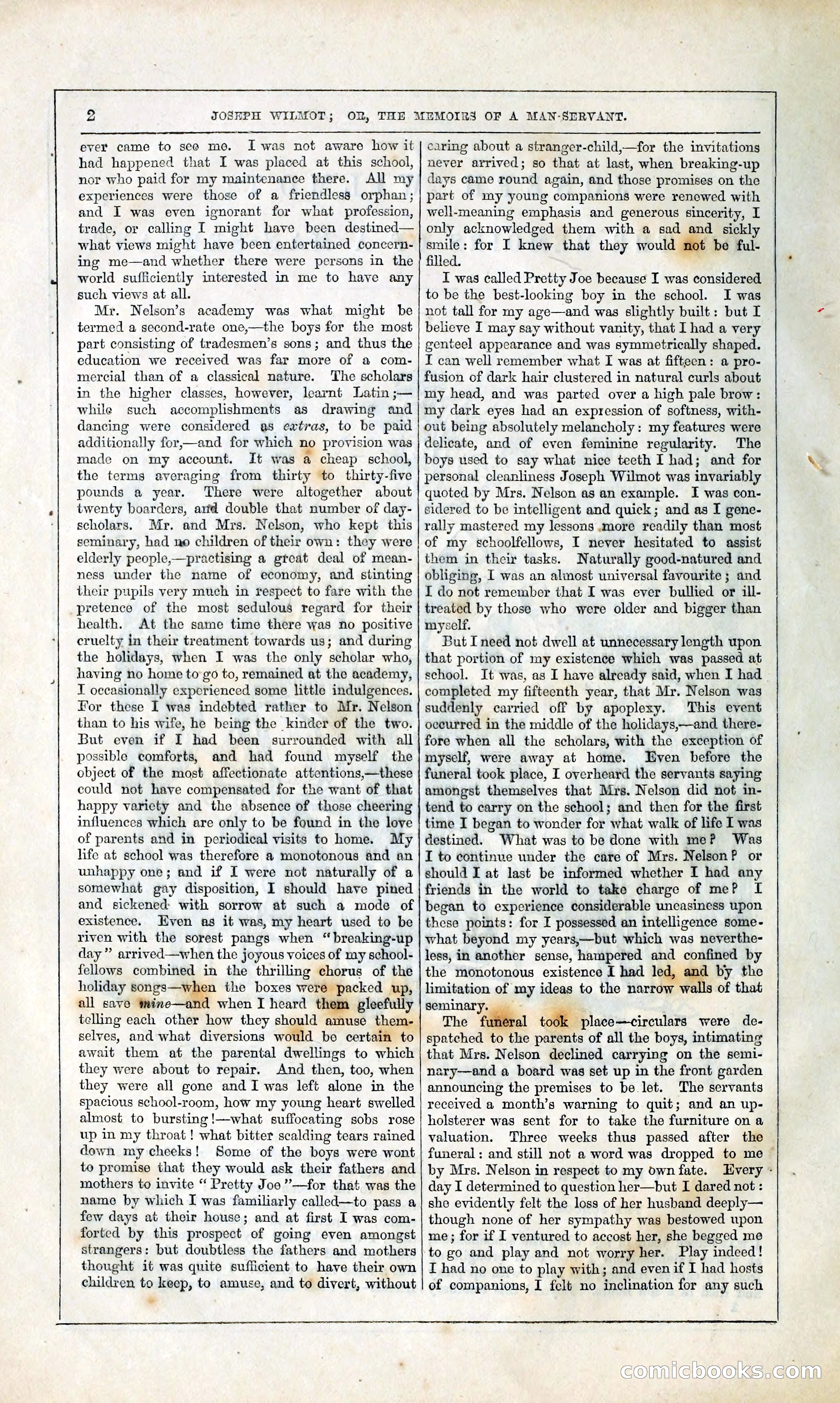
A restored page from Penny Dreadfuls, 1854. Page through the whole issue in the reader above.
📄 Transcribed text from this page (OCR, searchable)
Machine-transcribed from the original scan — historical spelling and the odd misread are preserved.
2 JOSEPH WILMOT; ever came to seo mo. TI was not aware how it had happened that I was placed at this school, nor who paid for my maintenance there. All my experiences were those of a friendless orphan; and I was even ignorant for what profession, trade, or calling I might have been destined— what views might have been entertained concern- ing me—and whether there were persons in the world sufficiently interested in me to have any such views at all. Mr. Nelson’s academy was what might be termed a second-rate one,—the boys for the most part consisting of tradesmen’s sons; and thus the education we received was far more of a com- mercial than of a classical nature. The scholars in the higher classes, however, learnt Latin ;— while such accomplishments as drawing and dancing were considered as extras, to be paid additionally for,—and for which no provision was made on my account. It was a cheap school, the terms averaging from thirty to thirty-five pounds a year. There were altogether about twenty boarders, ard double that number of day- scholars. Mr. and Mrs. Nelson, who kept this seminary, had no children of their own: they were elderly people,—practising a great deal of mean- ness under the name of economy, and stinting their pupils very much in respect to fare with the pretence of the most sedulous regard for their health. At the same time there was no positive cruelty in their treatment towards us; and during the holidays, when I was the only scholar who, having no home to go to, remained at the academy, T occasionally experienced some little indulgences. for these I was indebted rather to Mr. Nelson than to his wife, he being the kinder of the two. But even if I had been surrounded with all possible comforts, and had found myself the object of the most affectionate attontions,—these could not have compensated for the want of that happy variety and the absence of those cheering influences which are only to be found in the love of parents and in periodical visits to home. My life at school was therefore a monotonous and an unhappy one; and if I were not naturally of a somewhat gay disposition, I should have pined and sickened with sorrow at such a mode of existence. Even as it was, my heart used to be riven with the sorest pangs when “breaking-up day” arrived—when the joyous voices of my school- fellows combined in the thrilling chorus of the holiday oe ae the boxes were packed up, all save ‘®ine—and when I heard them gleefully telling each other how they should amuse them- selves, and what diversions would be certain to await them at the parental dwellings to which they were about to repair. And then, too, when they were all gone and I was left alone in the spacious school-room, how my young heart swelled almost to bursting !—what suffocating sobs rose up in my throat! what bitter scalding tears rained down my cheeks! Some of the boys were wont to promise that they would ask their fathers and mothers to invite “‘ Pretty Joo ”—for that was the name by which I was familiarly called—to pass a few days at their house; and at first I was com- forted by this prospect of going even amongst strangers: but doubtless the fathers and mothers thought it was quite sufficient to have their own children to keep, to amuse, and to divert, without * OL, THE MEMOIRS OF A MAN-SERVANT. caring about a stranger-child,—for the invitations never arrived; so that at last, when breaking-up days came round again, and those promises on the part of my young companions were renewed with well-meaning emphasis and generous sincerity, I only acknowledged them with a sad and sickly smile: for I knew that they would not be ful- filled. I was called Pretty Joe because I was considered to be the best-looking boy in the school. I was not tall for my age—and was slightly built: but I believe I may say without vanity, that I had a very genteel appearance and was symmetrically shaped. I can well remember what I was at fifteen: a pro- fusion of dark hair clustered in natural curls about my head, and was parted over a high pale brow: my dark eyes had an expression of softness, with- out being absolutely melancholy: my features were delicate, and of even feminine regularity. The boys used to say what nice teeth I had; and for personal cleanliness Joseph Wilmot was invariably quoted by Mrs. Nelson as an example. I was con- sidered to be intelligent and quick; and as I gene- rally mastered my lessons .more readily than most of my schoolfellows, I never hesitated to assist them in their tasks. Naturally good-natured and obliging, I was an almost universal favourite; and I do not remember that I was ever bullied or ill- treated by those who were older and bigger than myself. But Ineed not dwell at unnecessary length upon that portion of my existence which was passed at school. It was, as I have already said, when I had completed my fifteenth year, that Mr. Nelson was suddenly carried off by apoplexy. This event oceurred in the middle of the holidays,—and there- fore when all the scholars, with the exception of myself, were away at home. Hven before the funeral took place, I overheard the servants saying amongst themselves that Mrs. Nelson did not in- tend to carry on the school; and then for the first time I began to wonder for what walk of life I was destined. What was to be done with me? Was I to continve under the care of Mrs. NelsonP or should I at last be informed whether I had any friends in the world to take charge of meP [I began to experience considerable uncasiness upon these points: for I possessed an intelligence some- what beyond my years,—but which was neverthe- less, in another sense, hampered and confined by the monotonous existence I had le by the limitation of my ideas to the narrow walls of that seminary. | | The funeral took place—circulars were de- spatched to the parents of all the boys, intimating that Mrs. Nelson declined carrying on the semi- nary—and a board was set up in the front garden announcing the premises to be let. The servants received a month’s warning to quit; and an up- holsterer was sent for to take the furniture on a valuation. Three weeks thus passed after the funeral: and still not a word was dropped to me — by Mrs. Nelson in respect to my own fate. day I determined to question her—but I dared not : she evidently felt the loss of her husband deeply— though none of her sympathy was bestowed upon me; for if I ventured to accost her, she begged me to go and play and not worry her. Play indeed! I had no one to play with; and even if I had hosts of companions, I felt no inclination for any such Every EO) Ss (EO) im