
Penny Dreadfuls, 1854 · page 157 of 394
Joseph Wilmot, or, The Memoirs of a Man-Servant — page 157: what you’re looking at
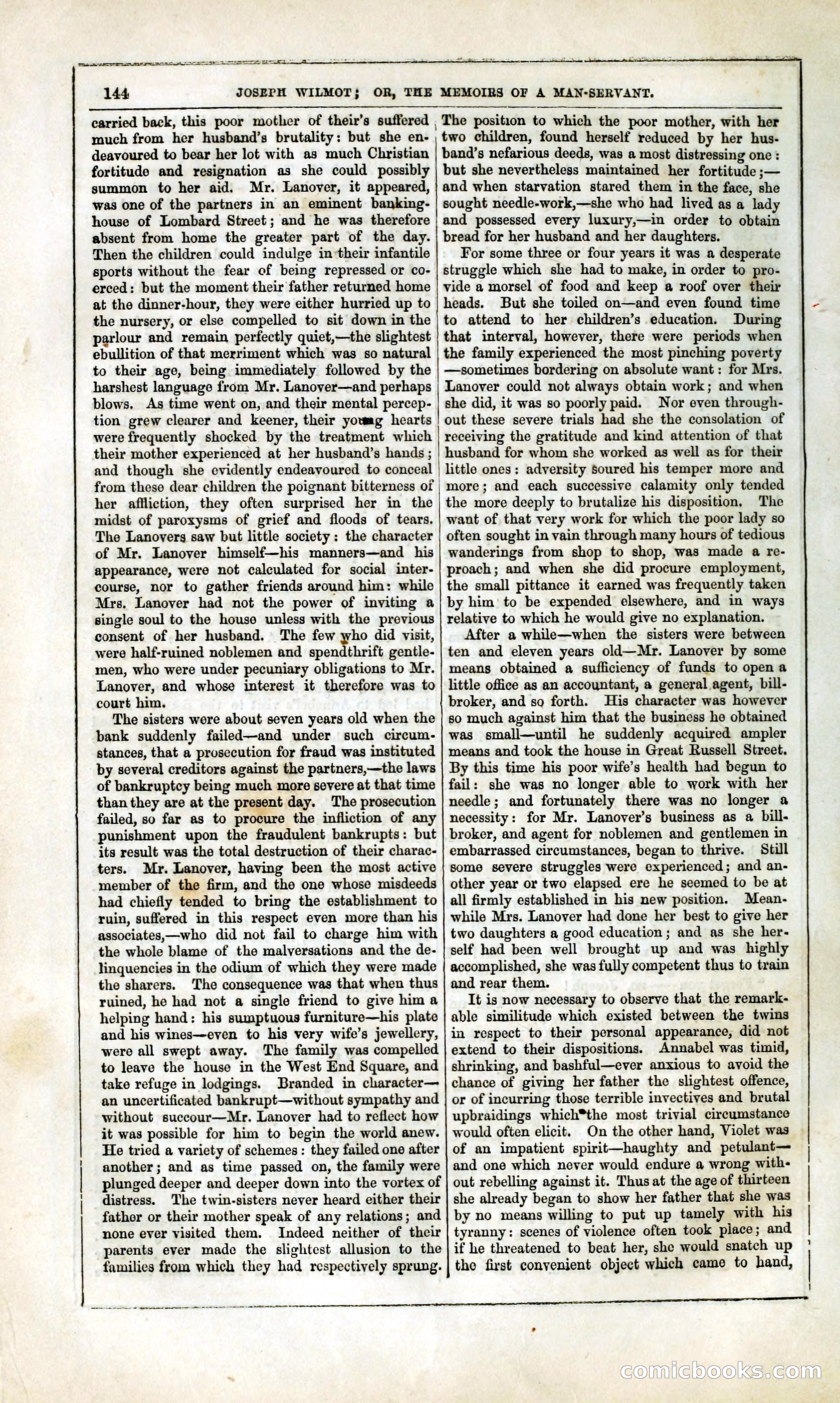
A restored page from Penny Dreadfuls, 1854. Page through the whole issue in the reader above.
📄 Transcribed text from this page (OCR, searchable)
Machine-transcribed from the original scan — historical spelling and the odd misread are preserved.
Se ee ee 3 eee 144 JOSEPH WILMOT; OR, THE MEMOIRS OF A MAN-SERVANT. ne ee ee en ee ee carried back, this poor mother of their’s carried back, this poor mother of their’s suffered The posit position to which the poor mother, with her much from her husband’s brutality: but she en- deavoured to bear her lot with as much Christian fortitude and resignation as she could possibly summon to her aid. Mr. Lanover, it appeared, was one of the partners in an eminent banking- house of Lombard Street; and he was therefore absent from home the greater part of the day. Then the children could indulge in’their infantile sports without the fear ef being repressed or co- erced: but the moment their father returned home at the dinner-hour, they were either hurried up to the nursery, or else compelled to sit down in the parlour and remain perfectly quiet,—the slightest ebullition of that merriment which was so natural to their age, being. immediately followed by the harshest language from Mr. Lanover—and perhaps blows, As time went on, and their mental percep- tion grew clearer and keener, their youmag hearts were frequently shocked by the treatment which their mother experienced at her husband’s hands ; and though she evidently endeavoured to conceal from these dear children the poignant bitterness of | her affliction, they often surprised her in the midst of paroxysms of gricf and floods of tears. The Lanovers saw but little society: the character of Mr. Lanover himself—his manners—and his appearance, were not calculated for social inter- course, nor to gather friends around him: while Mrs. Lanover had not the power of inviting a single soul to the house unless with the previous consent of her husband. The few who did visit, were half-ruined noblemen and spendthrift gentle- men, who were under pecuniary obligations to Mr. Lanover, and whose interest it therefore was to court him. The sisters were about seven years old when the bank suddenly failed—and under such circum- stances, that a prosecution for fraud was instituted by several creditors against the partners,—the laws of bankruptcy being much more severe at that time than they are at the present day. The prosecution failed, so far as to procure the infliction of any punishment upon the fraudulent bankrupts: but its result was the total destruction of their charac- ters. Mr. Lanover, having been the most active member of the firm, and the one whose misdeeds had chiefly tended to bring the establishment to ruin, suffered in this respect even more than his associates,—who did not fail to charge him with the whole blame of the malversations and the de- linquencies in the odium of which they were made the sharers. The consequence was that when thus ruined, he had not a single friend to give hima helping hand: his sumptuous furniture—his plate and his wines—even to his very wife’s jewellery, were all swept away. The family was compelled to leave the house in the West End Square, and take refuge in lodgings. Branded in character— an uncertificated bankrupt—without sympathy and without succour—Mr. Lanover had to reflect how it was possible for him to begin the world anew. He tried a variety of schemes: they failed one after another; and as time passed on, the family were plunged deeper and deeper down into the vortex of distress. The twin-sisters never heard either their fathor or their mother speak of any relations; and none ever visited them. Indeed neither of ‘their parents ever made the slightest allusion to the families from which they had respectively sprung. eee Se te ee two children, found herself reduced by her hus- band’s nefarious deeds, was a most distressing one : but she nevertheless maintained her fortitude ; — and when starvation stared them in the face, she sought needle-work,—she who had lived as a lady and possessed every luxury,—in order to obtain bread for her husband and her daughters. For some three or four years it was a desperate struggle which she had to make, in order to pro- vide a morsel of food and keep a roof over their heads. But she toiled on—and even found time to attend to her children’s education. During that interval, however, there were periods when the family experienced the most pinching poverty —sometimes bordering on absolute want: for Mrs. Lanover could not always obtain work; and when she did, it was so poorly paid. Nor even through- out these severe trials had she the consolation of receiving the gratitude and kind attention of that husband for whom she worked as well as for their little ones: adversity soured his temper more and more; and each successive calamity only tended the more deeply to brutalize his disposition, The want of that very work for which the poor lady so often sought in vain through many hours of tedious wanderings from shop to shop, was made a re- proach; and when she did procure employment, the small pittance it earned was frequently taken by him to be expended elsewhere, and in ways relative to which he would give no explanation. After a while—when the sisters were between ten and eleven years old—Mr. Lanover by some means obtained a sufficiency of funds to opena little office as an accountant, a general agent, bill- broker, and so forth. His character was however so much against him that the business he obtained was small—until he suddenly acquired ampler means and took the house in Great Russell Street. By this time his poor wife’s health had begun to fail: she was no longer able to work with her needle; and fortunately there was no longer a necessity: for Mr. Lanover’s business as a bill- broker, and agent for noblemen and gentlemen in embarrassed circumstances, began to thrive. Still some severe struggles were experienced; and an- other year or two elapsed ere he seemed to be at all firmly established in his new position. Mean- while Mrs. Lanover had done her best to give her two daughters a good education; and as she her- self had been well brought up and was highly accomplished, she was fully competent thus to trai and rear them. It is now necessary to observe that the remark- able similitude which existed between the twins in respect to their personal appearance, did not extend to their dispositions. Annabel was timid, shrinking, and bashful—ever anxious to avoid the chance of giving her father the slightest offence, or of incurring those terrible invectives and brutal upbraidings which*the most trivial circumstance would often elicit. On the other hand, Violet was of an impatient spirit—haughty and petulant— and one which never would endure a wrong with- out rebelling against it. Thus at the age of thirteen she already began to show her father “that she was by no means willing to put up tamely with his tyranny: scenes of violence often took place; and if he threatened to beat her, she would snatch up tho first convenient object which came to hand, ° Doo SHol(SO) | ele ae ee nce a aa Eo Ce im